

322
J. A. Delgado and C. Godard
modification reduced the catalytic activity compared to the unmodified catalyst, it
remarkably increased the alkene selectivity.
Gomez et al. reported the preparation of small zero-valent nickel nanoparticles (1.2 nm) stabilized by cinchona-based alkaloids and TPPTS (tris(3sulfophenyl)phosphine trisodium salt) and their application in the selective
hydrogenation of alkynes [125]. The NiNPs were synthesized from the
organometallic precursor [Ni(cod) 2 ] in neat glycerol under hydrogen pressure. The
colloidal NiNPs dispersed in glycerol demonstrated remarkable activity and selectivity in the hydrogenation of internal alkynes under 3 bar H 2 and 100 °C. The catalytic
phase was recycled at least ten times without loss of activity, affording in each case
metal-free organic products. Other functional groups such as nitro, nitrile and formyl
groups were efficiently hydrogenated to the corresponding anilines, benzylamines
and benzylalcohols, respectively, (77–95% yields).
When interested in the use of water as the media for either the preparation of
the M-NPs or the catalytic reaction, surfactants are frequently the choice of stabilizing agent [30]. Their amphiphilic nature, conditioned with polar and lipophilic
moieties, provides steric stabilization to the M-NPs. One of the most relevant
examples of the use of surfactants as stabilizers of MPs for semi-hydrogenation
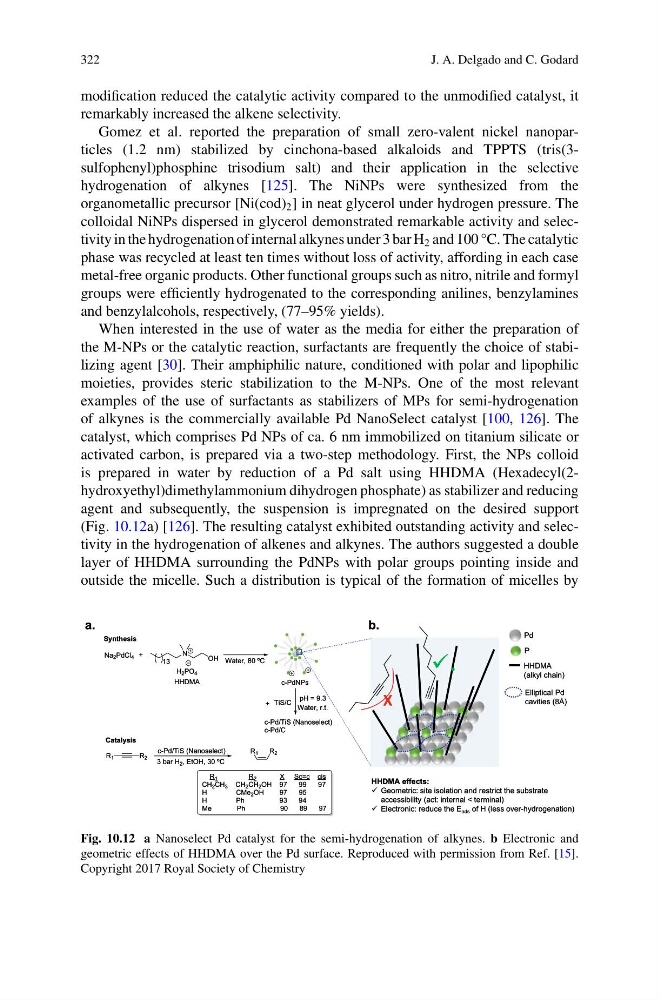
of alkynes is the commercially available Pd NanoSelect catalyst [100, 126]. The
catalyst, which comprises Pd NPs of ca. 6 nm immobilized on titanium silicate or
activated carbon, is prepared via a two-step methodology. First, the NPs colloid
is prepared in water by reduction of a Pd salt using HHDMA (Hexadecyl(2hydroxyethyl)dimethylammonium dihydrogen phosphate) as stabilizer and reducing
agent and subsequently, the suspension is impregnated on the desired support
(Fig. 10.12a) [126]. The resulting catalyst exhibited outstanding activity and selectivity in the hydrogenation of alkenes and alkynes. The authors suggested a double
layer of HHDMA surrounding the PdNPs with polar groups pointing inside and
outside the micelle. Such a distribution is typical of the formation of micelles by
Pd
P
HHDMA
(alkyl chain)
Elliptical Pd
cavities (8Å)
HHDMA effects:
Geometric: site isolation and restrict the substrate
accessibility (act: internal < terminal)
Electronic: reduce the E ads of H (less over-hydrogenation)
X
N
OH
H2PO4
+
Na2PdCl4
13
Water, 80 ºC
c-PdNPs
c-Pd/TiS (Nanoselect)
3 bar H2, EtOH, 30 ºC
HHDMA
R2
R1
R1
R2
R1
R2
X Sc=c cis
CH2CH3 CH2CH2OH 97
99
97
H
CMe2OH
97
95
H
P h
9 3
9 4
Me
Ph
90
89
97
Synthesis
Catalysis
TiS/C
+
Water, r.t.
pH = 9.3
c-Pd/TiS (Nanoselect)
c-Pd/C
a.
b.
Pd
P
HHDMA
(alkyl chain)
Elliptical Pd
cavities (8Å)
HHDMA effects:
Geometric: site isolation and restrict the substrate
accessibility (act: internal < terminal)
Electronic: reduce the E ads of H (less over-hydrogenation)
X
N
OH
H2PO4
+
Na2PdCl4
13
Water, 80 ºC
c-PdNPs
c-Pd/TiS (Nanoselect)
3 bar H2, EtOH, 30 ºC
HHDMA
R2
R1
R1
R2
R1
R2
X Sc=c cis
CH2CH3 CH2CH2OH 97
99
97
H
CMe2OH
97
95
H
P h
9 3
9 4
Me
Ph
90
89
97
Synthesis
Catalysis
TiS/C
+
Water, r.t.
pH = 9.3
c-Pd/TiS (Nanoselect)
c-Pd/C
a.
b.
Fig. 10.12 a Nanoselect Pd catalyst for the semi-hydrogenation of alkynes. b Electronic and
geometric effects of HHDMA over the Pd surface. Reproduced with permission from Ref. [15].
Copyright 2017 Royal Society of Chemistry
J. A. Delgado and C. Godard
modification reduced the catalytic activity compared to the unmodified catalyst, it
remarkably increased the alkene selectivity.
Gomez et al. reported the preparation of small zero-valent nickel nanoparticles (1.2 nm) stabilized by cinchona-based alkaloids and TPPTS (tris(3sulfophenyl)phosphine trisodium salt) and their application in the selective
hydrogenation of alkynes [125]. The NiNPs were synthesized from the
organometallic precursor [Ni(cod) 2 ] in neat glycerol under hydrogen pressure. The
colloidal NiNPs dispersed in glycerol demonstrated remarkable activity and selectivity in the hydrogenation of internal alkynes under 3 bar H 2 and 100 °C. The catalytic
phase was recycled at least ten times without loss of activity, affording in each case
metal-free organic products. Other functional groups such as nitro, nitrile and formyl
groups were efficiently hydrogenated to the corresponding anilines, benzylamines
and benzylalcohols, respectively, (77–95% yields).
When interested in the use of water as the media for either the preparation of
the M-NPs or the catalytic reaction, surfactants are frequently the choice of stabilizing agent [30]. Their amphiphilic nature, conditioned with polar and lipophilic
moieties, provides steric stabilization to the M-NPs. One of the most relevant
examples of the use of surfactants as stabilizers of MPs for semi-hydrogenation
of alkynes is the commercially available Pd NanoSelect catalyst [100, 126]. The
catalyst, which comprises Pd NPs of ca. 6 nm immobilized on titanium silicate or
activated carbon, is prepared via a two-step methodology. First, the NPs colloid
is prepared in water by reduction of a Pd salt using HHDMA (Hexadecyl(2hydroxyethyl)dimethylammonium dihydrogen phosphate) as stabilizer and reducing
agent and subsequently, the suspension is impregnated on the desired support
(Fig. 10.12a) [126]. The resulting catalyst exhibited outstanding activity and selectivity in the hydrogenation of alkenes and alkynes. The authors suggested a double
layer of HHDMA surrounding the PdNPs with polar groups pointing inside and
outside the micelle. Such a distribution is typical of the formation of micelles by
Pd
P
HHDMA
(alkyl chain)
Elliptical Pd
cavities (8Å)
HHDMA effects:
Geometric: site isolation and restrict the substrate
accessibility (act: internal < terminal)
Electronic: reduce the E ads of H (less over-hydrogenation)
X
N
OH
H2PO4
+
Na2PdCl4
13
Water, 80 ºC
c-PdNPs
c-Pd/TiS (Nanoselect)
3 bar H2, EtOH, 30 ºC
HHDMA
R2
R1
R1
R2
R1
R2
X Sc=c cis
CH2CH3 CH2CH2OH 97
99
97
H
CMe2OH
97
95
H
P h
9 3
9 4
Me
Ph
90
89
97
Synthesis
Catalysis
TiS/C
+
Water, r.t.
pH = 9.3
c-Pd/TiS (Nanoselect)
c-Pd/C
a.
b.
Pd
P
HHDMA
(alkyl chain)
Elliptical Pd
cavities (8Å)
HHDMA effects:
Geometric: site isolation and restrict the substrate
accessibility (act: internal < terminal)
Electronic: reduce the E ads of H (less over-hydrogenation)
X
N
OH
H2PO4
+
Na2PdCl4
13
Water, 80 ºC
c-PdNPs
c-Pd/TiS (Nanoselect)
3 bar H2, EtOH, 30 ºC
HHDMA
R2
R1
R1
R2
R1
R2
X Sc=c cis
CH2CH3 CH2CH2OH 97
99
97
H
CMe2OH
97
95
H
P h
9 3
9 4
Me
Ph
90
89
97
Synthesis
Catalysis
TiS/C
+
Water, r.t.
pH = 9.3
c-Pd/TiS (Nanoselect)
c-Pd/C
a.
b.
Fig. 10.12 a Nanoselect Pd catalyst for the semi-hydrogenation of alkynes. b Electronic and
geometric effects of HHDMA over the Pd surface. Reproduced with permission from Ref. [15].
Copyright 2017 Royal Society of Chemistry