

312
J. A. Delgado and C. Godard
AgNO 3 , water
Ascorbic acid
Ag
Pd
H
H
H
H
H
H
H
H H H
H
H
H
H
H
H
H 2
H
H
H
H
H
H
H 2
H
R 1
R 2
R 1
R 2
R 1
R 2
R 1
R 2
+
PdNPs
Pd@Ag NPs
X
Alkyne and alkene are both
adsorbed at the Pd surface and
hydrogenated
Selective adsorption of the
alkyne
at the Ag surface
H is moderatedly suplied by
the Pd core
R 1 = H;
R 2 = CH 3 (CH 2 ) 5
S C=C = >99%,
X= >99%
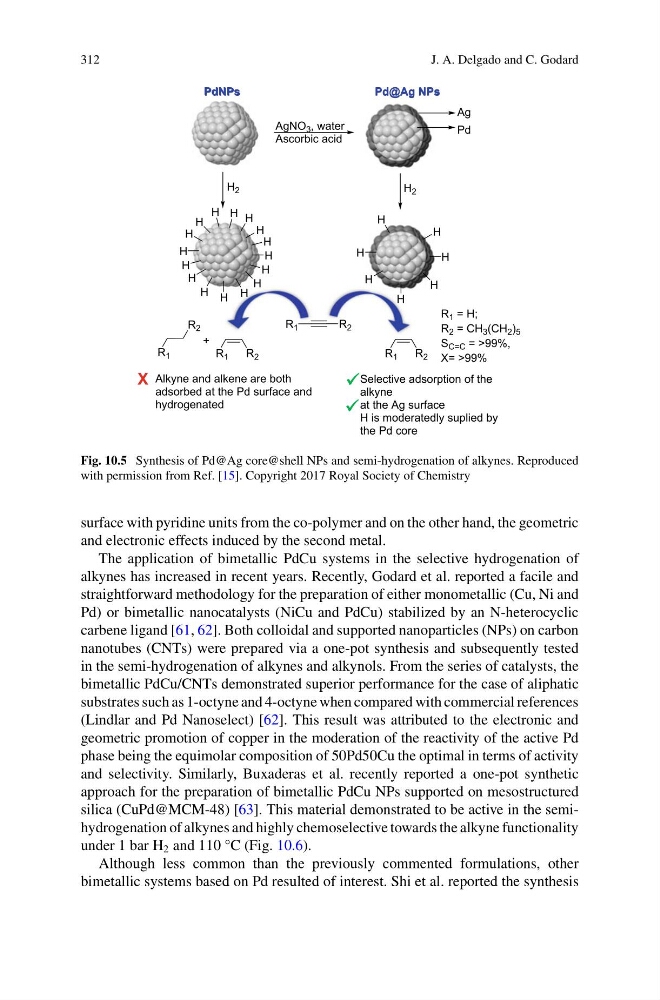
Fig. 10.5 Synthesis of Pd@Ag core@shell NPs and semi-hydrogenation of alkynes. Reproduced
with permission from Ref. [15]. Copyright 2017 Royal Society of Chemistry
surface with pyridine units from the co-polymer and on the other hand, the geometric
and electronic effects induced by the second metal.
The application of bimetallic PdCu systems in the selective hydrogenation of
alkynes has increased in recent years. Recently, Godard et al. reported a facile and
straightforward methodology for the preparation of either monometallic (Cu, Ni and
Pd) or bimetallic nanocatalysts (NiCu and PdCu) stabilized by an N-heterocyclic
carbene ligand [61, 62]. Both colloidal and supported nanoparticles (NPs) on carbon
nanotubes (CNTs) were prepared via a one-pot synthesis and subsequently tested
in the semi-hydrogenation of alkynes and alkynols. From the series of catalysts, the
bimetallic PdCu/CNTs demonstrated superior performance for the case of aliphatic
substrates such as 1-octyne and 4-octyne when compared with commercial references
(Lindlar and Pd Nanoselect) [62]. This result was attributed to the electronic and
geometric promotion of copper in the moderation of the reactivity of the active Pd
phase being the equimolar composition of 50Pd50Cu the optimal in terms of activity
and selectivity. Similarly, Buxaderas et al. recently reported a one-pot synthetic
approach for the preparation of bimetallic PdCu NPs supported on mesostructured
silica (CuPd@MCM-48) [63]. This material demonstrated to be active in the semihydrogenation of alkynes and highly chemoselective towards the alkyne functionality
under 1 bar H 2 and 110 °C (Fig. 10.6).
Although less common than the previously commented formulations, other
bimetallic systems based on Pd resulted of interest. Shi et al. reported the synthesis
J. A. Delgado and C. Godard
AgNO 3 , water
Ascorbic acid
Ag
Pd
H
H
H
H
H
H
H
H H H
H
H
H
H
H
H
H 2
H
H
H
H
H
H
H 2
H
R 1
R 2
R 1
R 2
R 1
R 2
R 1
R 2
+
PdNPs
Pd@Ag NPs
X
Alkyne and alkene are both
adsorbed at the Pd surface and
hydrogenated
Selective adsorption of the
alkyne
at the Ag surface
H is moderatedly suplied by
the Pd core
R 1 = H;
R 2 = CH 3 (CH 2 ) 5
S C=C = >99%,
X= >99%
Fig. 10.5 Synthesis of Pd@Ag core@shell NPs and semi-hydrogenation of alkynes. Reproduced
with permission from Ref. [15]. Copyright 2017 Royal Society of Chemistry
surface with pyridine units from the co-polymer and on the other hand, the geometric
and electronic effects induced by the second metal.
The application of bimetallic PdCu systems in the selective hydrogenation of
alkynes has increased in recent years. Recently, Godard et al. reported a facile and
straightforward methodology for the preparation of either monometallic (Cu, Ni and
Pd) or bimetallic nanocatalysts (NiCu and PdCu) stabilized by an N-heterocyclic
carbene ligand [61, 62]. Both colloidal and supported nanoparticles (NPs) on carbon
nanotubes (CNTs) were prepared via a one-pot synthesis and subsequently tested
in the semi-hydrogenation of alkynes and alkynols. From the series of catalysts, the
bimetallic PdCu/CNTs demonstrated superior performance for the case of aliphatic
substrates such as 1-octyne and 4-octyne when compared with commercial references
(Lindlar and Pd Nanoselect) [62]. This result was attributed to the electronic and
geometric promotion of copper in the moderation of the reactivity of the active Pd
phase being the equimolar composition of 50Pd50Cu the optimal in terms of activity
and selectivity. Similarly, Buxaderas et al. recently reported a one-pot synthetic
approach for the preparation of bimetallic PdCu NPs supported on mesostructured
silica (CuPd@MCM-48) [63]. This material demonstrated to be active in the semihydrogenation of alkynes and highly chemoselective towards the alkyne functionality
under 1 bar H 2 and 110 °C (Fig. 10.6).
Although less common than the previously commented formulations, other
bimetallic systems based on Pd resulted of interest. Shi et al. reported the synthesis