

306
J. A. Delgado and C. Godard
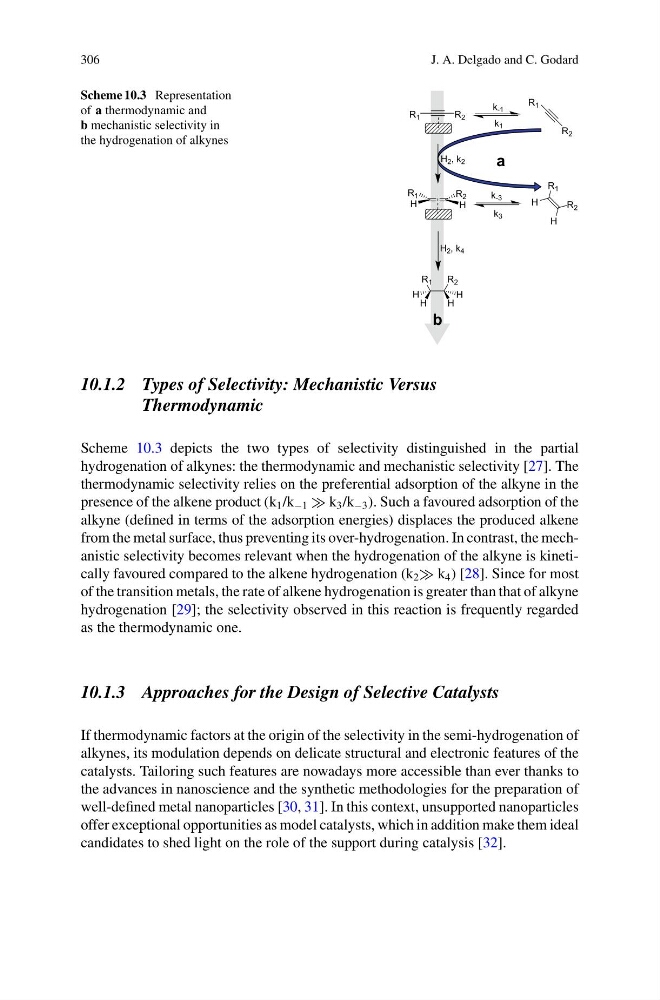
Scheme 10.3 Representation
of a thermodynamic and
b mechanistic selectivity in
the hydrogenation of alkynes
a
b
H 2 , k 2
k 1
k -1
k 3
k -3
H 2 , k 4
R 1
R 2
R 1
H
H
R 2
R 1
R 2
R 1
R 2
H
H
R 1
H
H
R 2
H
H
10.1.2 Types of Selectivity: Mechanistic Versus
Thermodynamic
Scheme 10.3 depicts the two types of selectivity distinguished in the partial
hydrogenation of alkynes: the thermodynamic and mechanistic selectivity [27]. The
thermodynamic selectivity relies on the preferential adsorption of the alkyne in the
presence of the alkene product (k 1 /k −1 k 3 /k −3 ). Such a favoured adsorption of the
alkyne (defined in terms of the adsorption energies) displaces the produced alkene
from the metal surface, thus preventing its over-hydrogenation. In contrast, the mechanistic selectivity becomes relevant when the hydrogenation of the alkyne is kinetically favoured compared to the alkene hydrogenation (k 2 k 4 ) [28]. Since for most
of the transition metals, the rate of alkene hydrogenation is greater than that of alkyne
hydrogenation [29]; the selectivity observed in this reaction is frequently regarded
as the thermodynamic one.
10.1.3 Approaches for the Design of Selective Catalysts
If thermodynamic factors at the origin of the selectivity in the semi-hydrogenation of
alkynes, its modulation depends on delicate structural and electronic features of the
catalysts. Tailoring such features are nowadays more accessible than ever thanks to
the advances in nanoscience and the synthetic methodologies for the preparation of
well-defined metal nanoparticles [30, 31]. In this context, unsupported nanoparticles
offer exceptional opportunities as model catalysts, which in addition make them ideal
candidates to shed light on the role of the support during catalysis [32].
J. A. Delgado and C. Godard
Scheme 10.3 Representation
of a thermodynamic and
b mechanistic selectivity in
the hydrogenation of alkynes
a
b
H 2 , k 2
k 1
k -1
k 3
k -3
H 2 , k 4
R 1
R 2
R 1
H
H
R 2
R 1
R 2
R 1
R 2
H
H
R 1
H
H
R 2
H
H
10.1.2 Types of Selectivity: Mechanistic Versus
Thermodynamic
Scheme 10.3 depicts the two types of selectivity distinguished in the partial
hydrogenation of alkynes: the thermodynamic and mechanistic selectivity [27]. The
thermodynamic selectivity relies on the preferential adsorption of the alkyne in the
presence of the alkene product (k 1 /k −1 k 3 /k −3 ). Such a favoured adsorption of the
alkyne (defined in terms of the adsorption energies) displaces the produced alkene
from the metal surface, thus preventing its over-hydrogenation. In contrast, the mechanistic selectivity becomes relevant when the hydrogenation of the alkyne is kinetically favoured compared to the alkene hydrogenation (k 2 k 4 ) [28]. Since for most
of the transition metals, the rate of alkene hydrogenation is greater than that of alkyne
hydrogenation [29]; the selectivity observed in this reaction is frequently regarded
as the thermodynamic one.
10.1.3 Approaches for the Design of Selective Catalysts
If thermodynamic factors at the origin of the selectivity in the semi-hydrogenation of
alkynes, its modulation depends on delicate structural and electronic features of the
catalysts. Tailoring such features are nowadays more accessible than ever thanks to
the advances in nanoscience and the synthetic methodologies for the preparation of
well-defined metal nanoparticles [30, 31]. In this context, unsupported nanoparticles
offer exceptional opportunities as model catalysts, which in addition make them ideal
candidates to shed light on the role of the support during catalysis [32].