

10 Progress in the Selective Semi-hydrogenation of Alkynes …
307
Parameters intrinsic to the colloidal chemistry by itself such as the size, shape
and composition of the metal nanoparticles, as well as the capping agent, the support
combined with parameters intrinsic to the hydrogenation reaction (e.g. conditions,
additives), make of the semi-hydrogenation reaction a complex multivariable equation. In the following sections, a comprehensive analysis of the principal structural, electronic and external effects that affect the catalytic performance in the
semi-hydrogenation of alkynes is presented.
10.2 Particle-Size Effect
The effect of the metal dispersion and the particle size was early recognized of
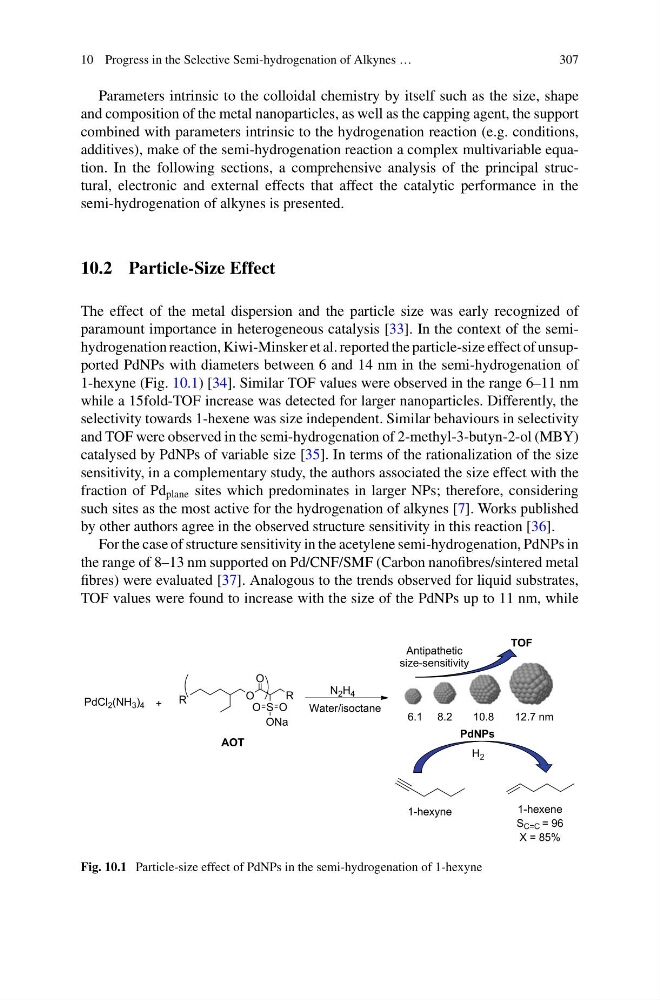
paramount importance in heterogeneous catalysis [33]. In the context of the semihydrogenation reaction, Kiwi-Minsker et al. reported the particle-size effect of unsupported PdNPs with diameters between 6 and 14 nm in the semi-hydrogenation of
1-hexyne (Fig. 10.1) [34]. Similar TOF values were observed in the range 6–11 nm
while a 15fold-TOF increase was detected for larger nanoparticles. Differently, the
selectivity towards 1-hexene was size independent. Similar behaviours in selectivity
and TOF were observed in the semi-hydrogenation of 2-methyl-3-butyn-2-ol (MBY)
catalysed by PdNPs of variable size [35]. In terms of the rationalization of the size
sensitivity, in a complementary study, the authors associated the size effect with the
fraction of Pd plane sites which predominates in larger NPs; therefore, considering
such sites as the most active for the hydrogenation of alkynes [7]. Works published
by other authors agree in the observed structure sensitivity in this reaction [36].
For the case of structure sensitivity in the acetylene semi-hydrogenation, PdNPs in
the range of 8–13 nm supported on Pd/CNF/SMF (Carbon nanofibres/sintered metal
fibres) were evaluated [37]. Analogous to the trends observed for liquid substrates,
TOF values were found to increase with the size of the PdNPs up to 11 nm, while
+
Water/isoctane
N 2 H 4
PdCl 2 (NH 3 ) 4
6.1 8.2
10.8
12.7 nm
O
R
O
S
O
O
ONa
AOT
R
H 2
1-hexyne
1-hexene
S C=C = 96
X = 85%
PdNPs
Antipathetic
size-sensitivity
TOF
Fig. 10.1 Particle-size effect of PdNPs in the semi-hydrogenation of 1-hexyne
307
Parameters intrinsic to the colloidal chemistry by itself such as the size, shape
and composition of the metal nanoparticles, as well as the capping agent, the support
combined with parameters intrinsic to the hydrogenation reaction (e.g. conditions,
additives), make of the semi-hydrogenation reaction a complex multivariable equation. In the following sections, a comprehensive analysis of the principal structural, electronic and external effects that affect the catalytic performance in the
semi-hydrogenation of alkynes is presented.
10.2 Particle-Size Effect
The effect of the metal dispersion and the particle size was early recognized of
paramount importance in heterogeneous catalysis [33]. In the context of the semihydrogenation reaction, Kiwi-Minsker et al. reported the particle-size effect of unsupported PdNPs with diameters between 6 and 14 nm in the semi-hydrogenation of
1-hexyne (Fig. 10.1) [34]. Similar TOF values were observed in the range 6–11 nm
while a 15fold-TOF increase was detected for larger nanoparticles. Differently, the
selectivity towards 1-hexene was size independent. Similar behaviours in selectivity
and TOF were observed in the semi-hydrogenation of 2-methyl-3-butyn-2-ol (MBY)
catalysed by PdNPs of variable size [35]. In terms of the rationalization of the size
sensitivity, in a complementary study, the authors associated the size effect with the
fraction of Pd plane sites which predominates in larger NPs; therefore, considering
such sites as the most active for the hydrogenation of alkynes [7]. Works published
by other authors agree in the observed structure sensitivity in this reaction [36].
For the case of structure sensitivity in the acetylene semi-hydrogenation, PdNPs in
the range of 8–13 nm supported on Pd/CNF/SMF (Carbon nanofibres/sintered metal
fibres) were evaluated [37]. Analogous to the trends observed for liquid substrates,
TOF values were found to increase with the size of the PdNPs up to 11 nm, while
+
Water/isoctane
N 2 H 4
PdCl 2 (NH 3 ) 4
6.1 8.2
10.8
12.7 nm
O
R
O
S
O
O
ONa
AOT
R
H 2
1-hexyne
1-hexene
S C=C = 96
X = 85%
PdNPs
Antipathetic
size-sensitivity
TOF
Fig. 10.1 Particle-size effect of PdNPs in the semi-hydrogenation of 1-hexyne