

10 Progress in the Selective Semi-hydrogenation of Alkynes …
305
characteristics linked to their sub-nanometre scale provide a typical performance in
terms of activity, selectivity and stability, relevant for challenging reactions such as
the semi-hydrogenation of acetylene [14, 15].
In the following sections, the literature on the selective hydrogenation of alkynes
catalysed by metal nanoparticles, metal clusters and single atom catalysts is analysed
in a comprehensive but not exhaustive manner, with a focus on materials prepared by
colloidal methodologies. This chapter aims at describing the potential and outlook of
the utilization of colloidal chemistry for the preparation of heterogeneous catalysts
for both fundamental understanding and industrial applications. For this purpose,
special attention is given to insights gained by combination of experimental with
DFT input. The scope of our analysis is limited to the systems that employ hydrogen
gas as the reducing agent in combination with a metallic phase. However, metal-free
catalytic systems [16], or the use of alternative reducing agents has also provided
promising results in the selective hydrogenation of alkynes [17–22].
10.1.1 General Reaction Mechanism
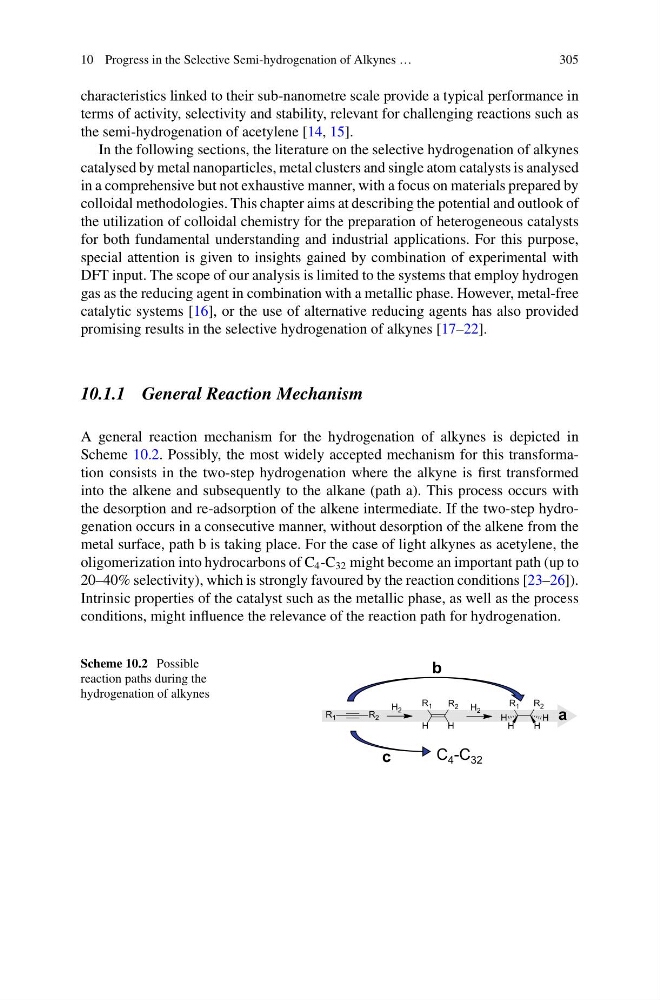
A general reaction mechanism for the hydrogenation of alkynes is depicted in
Scheme 10.2. Possibly, the most widely accepted mechanism for this transformation consists in the two-step hydrogenation where the alkyne is first transformed
into the alkene and subsequently to the alkane (path a). This process occurs with
the desorption and re-adsorption of the alkene intermediate. If the two-step hydrogenation occurs in a consecutive manner, without desorption of the alkene from the
metal surface, path b is taking place. For the case of light alkynes as acetylene, the
oligomerization into hydrocarbons of C 4 -C 32 might become an important path (up to
20–40% selectivity), which is strongly favoured by the reaction conditions [23–26]).
Intrinsic properties of the catalyst such as the metallic phase, as well as the process
conditions, might influence the relevance of the reaction path for hydrogenation.
Scheme 10.2 Possible
reaction paths during the
hydrogenation of alkynes
R 1
R 2
R 1
H
H
R 2
R 1
H
H
R 2
H
H
H 2
H 2
C 4 -C 32
b
a
c
305
characteristics linked to their sub-nanometre scale provide a typical performance in
terms of activity, selectivity and stability, relevant for challenging reactions such as
the semi-hydrogenation of acetylene [14, 15].
In the following sections, the literature on the selective hydrogenation of alkynes
catalysed by metal nanoparticles, metal clusters and single atom catalysts is analysed
in a comprehensive but not exhaustive manner, with a focus on materials prepared by
colloidal methodologies. This chapter aims at describing the potential and outlook of
the utilization of colloidal chemistry for the preparation of heterogeneous catalysts
for both fundamental understanding and industrial applications. For this purpose,
special attention is given to insights gained by combination of experimental with
DFT input. The scope of our analysis is limited to the systems that employ hydrogen
gas as the reducing agent in combination with a metallic phase. However, metal-free
catalytic systems [16], or the use of alternative reducing agents has also provided
promising results in the selective hydrogenation of alkynes [17–22].
10.1.1 General Reaction Mechanism
A general reaction mechanism for the hydrogenation of alkynes is depicted in
Scheme 10.2. Possibly, the most widely accepted mechanism for this transformation consists in the two-step hydrogenation where the alkyne is first transformed
into the alkene and subsequently to the alkane (path a). This process occurs with
the desorption and re-adsorption of the alkene intermediate. If the two-step hydrogenation occurs in a consecutive manner, without desorption of the alkene from the
metal surface, path b is taking place. For the case of light alkynes as acetylene, the
oligomerization into hydrocarbons of C 4 -C 32 might become an important path (up to
20–40% selectivity), which is strongly favoured by the reaction conditions [23–26]).
Intrinsic properties of the catalyst such as the metallic phase, as well as the process
conditions, might influence the relevance of the reaction path for hydrogenation.
Scheme 10.2 Possible
reaction paths during the
hydrogenation of alkynes
R 1
R 2
R 1
H
H
R 2
R 1
H
H
R 2
H
H
H 2
H 2
C 4 -C 32
b
a
c