

9 Metal Nanoparticles for Hydrogen Isotope Exchange
299
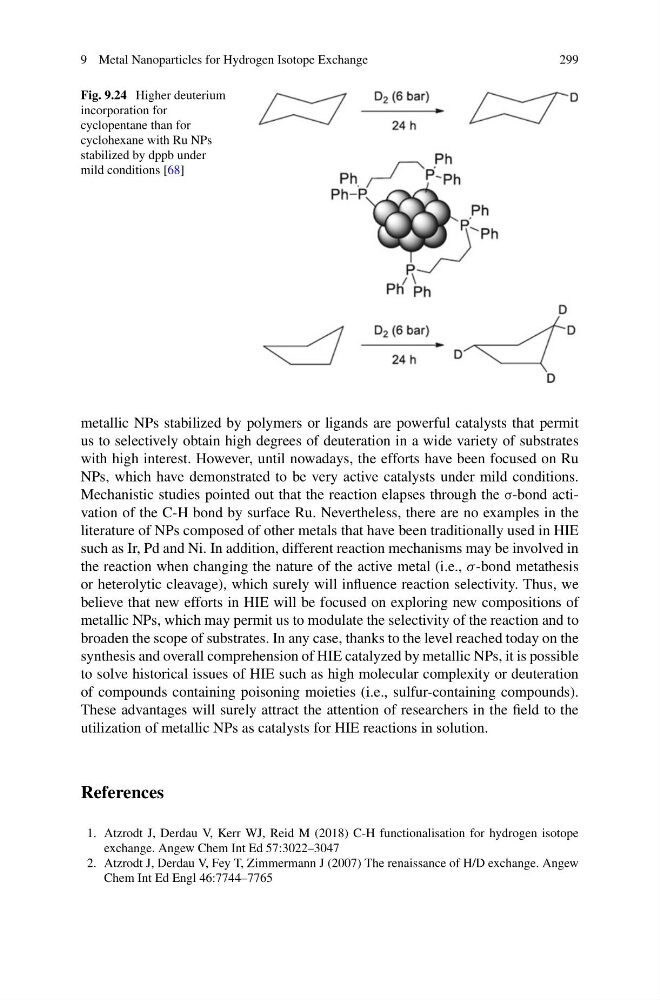
Fig. 9.24 Higher deuterium
incorporation for
cyclopentane than for
cyclohexane with Ru NPs
stabilized by dppb under
mild conditions [68]
metallic NPs stabilized by polymers or ligands are powerful catalysts that permit
us to selectively obtain high degrees of deuteration in a wide variety of substrates
with high interest. However, until nowadays, the efforts have been focused on Ru
NPs, which have demonstrated to be very active catalysts under mild conditions.
Mechanistic studies pointed out that the reaction elapses through the σ-bond activation of the C-H bond by surface Ru. Nevertheless, there are no examples in the
literature of NPs composed of other metals that have been traditionally used in HIE
such as Ir, Pd and Ni. In addition, different reaction mechanisms may be involved in
the reaction when changing the nature of the active metal (i.e., σ-bond metathesis
or heterolytic cleavage), which surely will influence reaction selectivity. Thus, we
believe that new efforts in HIE will be focused on exploring new compositions of
metallic NPs, which may permit us to modulate the selectivity of the reaction and to
broaden the scope of substrates. In any case, thanks to the level reached today on the
synthesis and overall comprehension of HIE catalyzed by metallic NPs, it is possible
to solve historical issues of HIE such as high molecular complexity or deuteration
of compounds containing poisoning moieties (i.e., sulfur-containing compounds).
These advantages will surely attract the attention of researchers in the field to the
utilization of metallic NPs as catalysts for HIE reactions in solution.
References
1. Atzrodt J, Derdau V, Kerr WJ, Reid M (2018) C-H functionalisation for hydrogen isotope
exchange. Angew Chem Int Ed 57:3022–3047
2. Atzrodt J, Derdau V, Fey T, Zimmermann J (2007) The renaissance of H/D exchange. Angew
Chem Int Ed Engl 46:7744–7765
299
Fig. 9.24 Higher deuterium
incorporation for
cyclopentane than for
cyclohexane with Ru NPs
stabilized by dppb under
mild conditions [68]
metallic NPs stabilized by polymers or ligands are powerful catalysts that permit
us to selectively obtain high degrees of deuteration in a wide variety of substrates
with high interest. However, until nowadays, the efforts have been focused on Ru
NPs, which have demonstrated to be very active catalysts under mild conditions.
Mechanistic studies pointed out that the reaction elapses through the σ-bond activation of the C-H bond by surface Ru. Nevertheless, there are no examples in the
literature of NPs composed of other metals that have been traditionally used in HIE
such as Ir, Pd and Ni. In addition, different reaction mechanisms may be involved in
the reaction when changing the nature of the active metal (i.e., σ-bond metathesis
or heterolytic cleavage), which surely will influence reaction selectivity. Thus, we
believe that new efforts in HIE will be focused on exploring new compositions of
metallic NPs, which may permit us to modulate the selectivity of the reaction and to
broaden the scope of substrates. In any case, thanks to the level reached today on the
synthesis and overall comprehension of HIE catalyzed by metallic NPs, it is possible
to solve historical issues of HIE such as high molecular complexity or deuteration
of compounds containing poisoning moieties (i.e., sulfur-containing compounds).
These advantages will surely attract the attention of researchers in the field to the
utilization of metallic NPs as catalysts for HIE reactions in solution.
References
1. Atzrodt J, Derdau V, Kerr WJ, Reid M (2018) C-H functionalisation for hydrogen isotope
exchange. Angew Chem Int Ed 57:3022–3047
2. Atzrodt J, Derdau V, Fey T, Zimmermann J (2007) The renaissance of H/D exchange. Angew
Chem Int Ed Engl 46:7744–7765