

298
A. Palazzolo et al.
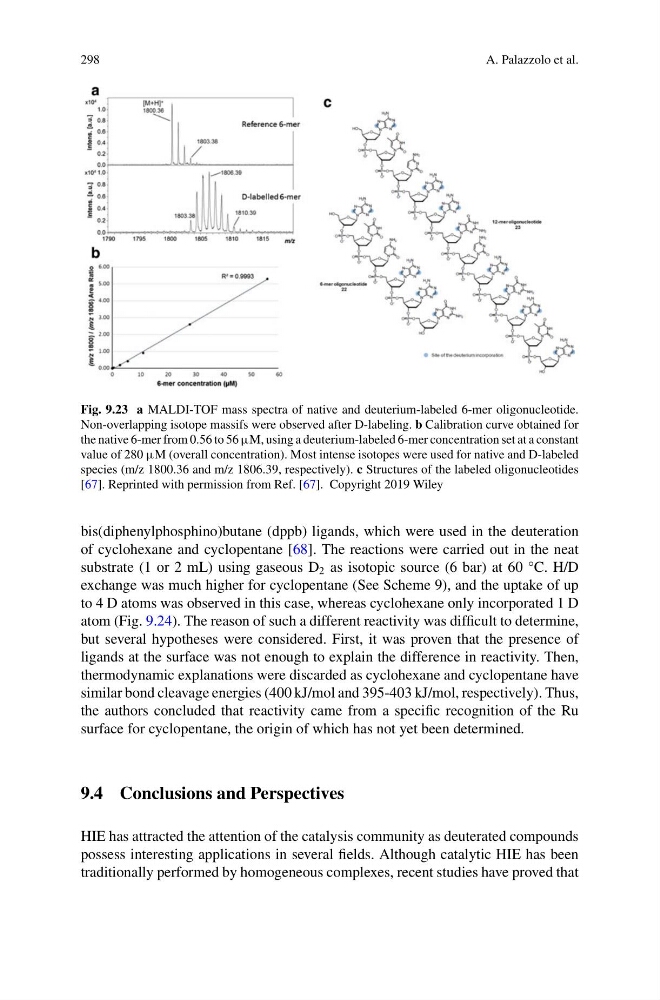
Fig. 9.23 a MALDI-TOF mass spectra of native and deuterium-labeled 6-mer oligonucleotide.
Non-overlapping isotope massifs were observed after D-labeling. b Calibration curve obtained for
the native 6-mer from 0.56 to 56 μM, using a deuterium-labeled 6-mer concentration set at a constant
value of 280 μM (overall concentration). Most intense isotopes were used for native and D-labeled
species (m/z 1800.36 and m/z 1806.39, respectively). c Structures of the labeled oligonucleotides
[67]. Reprinted with permission from Ref. [67]. Copyright 2019 Wiley
bis(diphenylphosphino)butane (dppb) ligands, which were used in the deuteration
of cyclohexane and cyclopentane [68]. The reactions were carried out in the neat
substrate (1 or 2 mL) using gaseous D 2 as isotopic source (6 bar) at 60 °C. H/D
exchange was much higher for cyclopentane (See Scheme 9), and the uptake of up
to 4 D atoms was observed in this case, whereas cyclohexane only incorporated 1 D
atom (Fig. 9.24). The reason of such a different reactivity was difficult to determine,
but several hypotheses were considered. First, it was proven that the presence of
ligands at the surface was not enough to explain the difference in reactivity. Then,
thermodynamic explanations were discarded as cyclohexane and cyclopentane have
similar bond cleavage energies (400 kJ/mol and 395-403 kJ/mol, respectively). Thus,
the authors concluded that reactivity came from a specific recognition of the Ru
surface for cyclopentane, the origin of which has not yet been determined.
9.4 Conclusions and Perspectives
HIE has attracted the attention of the catalysis community as deuterated compounds
possess interesting applications in several fields. Although catalytic HIE has been
traditionally performed by homogeneous complexes, recent studies have proved that
A. Palazzolo et al.
Fig. 9.23 a MALDI-TOF mass spectra of native and deuterium-labeled 6-mer oligonucleotide.
Non-overlapping isotope massifs were observed after D-labeling. b Calibration curve obtained for
the native 6-mer from 0.56 to 56 μM, using a deuterium-labeled 6-mer concentration set at a constant
value of 280 μM (overall concentration). Most intense isotopes were used for native and D-labeled
species (m/z 1800.36 and m/z 1806.39, respectively). c Structures of the labeled oligonucleotides
[67]. Reprinted with permission from Ref. [67]. Copyright 2019 Wiley
bis(diphenylphosphino)butane (dppb) ligands, which were used in the deuteration
of cyclohexane and cyclopentane [68]. The reactions were carried out in the neat
substrate (1 or 2 mL) using gaseous D 2 as isotopic source (6 bar) at 60 °C. H/D
exchange was much higher for cyclopentane (See Scheme 9), and the uptake of up
to 4 D atoms was observed in this case, whereas cyclohexane only incorporated 1 D
atom (Fig. 9.24). The reason of such a different reactivity was difficult to determine,
but several hypotheses were considered. First, it was proven that the presence of
ligands at the surface was not enough to explain the difference in reactivity. Then,
thermodynamic explanations were discarded as cyclohexane and cyclopentane have
similar bond cleavage energies (400 kJ/mol and 395-403 kJ/mol, respectively). Thus,
the authors concluded that reactivity came from a specific recognition of the Ru
surface for cyclopentane, the origin of which has not yet been determined.
9.4 Conclusions and Perspectives
HIE has attracted the attention of the catalysis community as deuterated compounds
possess interesting applications in several fields. Although catalytic HIE has been
traditionally performed by homogeneous complexes, recent studies have proved that