

9 Metal Nanoparticles for Hydrogen Isotope Exchange
297
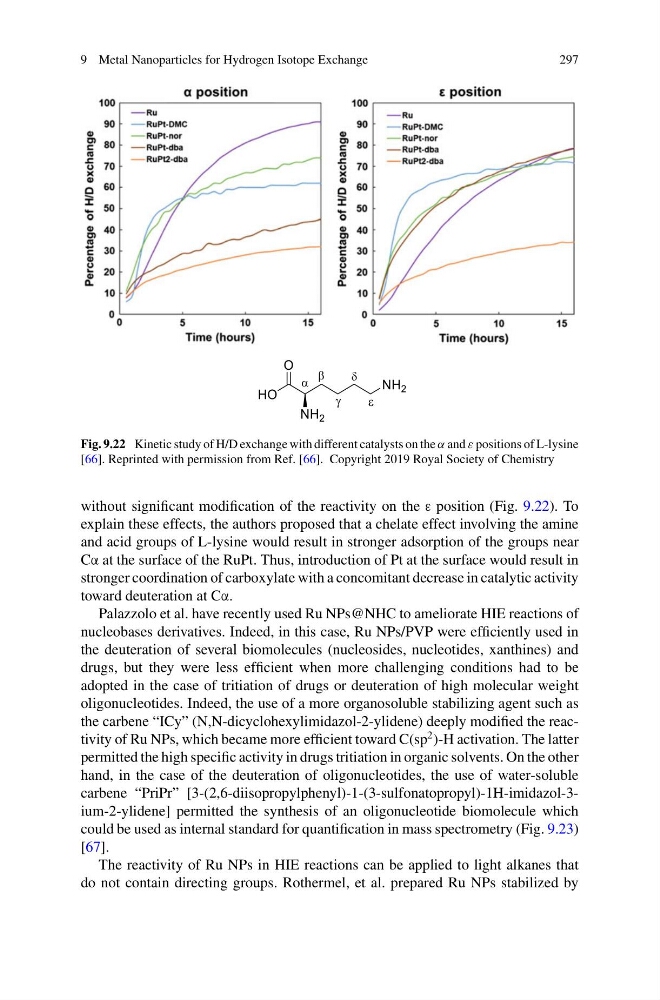
Fig. 9.22 Kinetic study of H/D exchange with different catalysts on the α and ε positions of L-lysine
[66]. Reprinted with permission from Ref. [66]. Copyright 2019 Royal Society of Chemistry
without significant modification of the reactivity on the ε position (Fig. 9.22). To
explain these effects, the authors proposed that a chelate effect involving the amine
and acid groups of L-lysine would result in stronger adsorption of the groups near
Cα at the surface of the RuPt. Thus, introduction of Pt at the surface would result in
stronger coordination of carboxylate with a concomitant decrease in catalytic activity
toward deuteration at Cα.
Palazzolo et al. have recently used Ru NPs@NHC to ameliorate HIE reactions of
nucleobases derivatives. Indeed, in this case, Ru NPs/PVP were efficiently used in
the deuteration of several biomolecules (nucleosides, nucleotides, xanthines) and
drugs, but they were less efficient when more challenging conditions had to be
adopted in the case of tritiation of drugs or deuteration of high molecular weight
oligonucleotides. Indeed, the use of a more organosoluble stabilizing agent such as
the carbene “ICy” (N,N-dicyclohexylimidazol-2-ylidene) deeply modified the reactivity of Ru NPs, which became more efficient toward C(sp
2 )-H activation. The latter
permitted the high specific activity in drugs tritiation in organic solvents. On the other
hand, in the case of the deuteration of oligonucleotides, the use of water-soluble
carbene “PriPr” [3-(2,6-diisopropylphenyl)-1-(3-sulfonatopropyl)-1H-imidazol-3ium-2-ylidene] permitted the synthesis of an oligonucleotide biomolecule which
could be used as internal standard for quantification in mass spectrometry (Fig. 9.23)
[67].
The reactivity of Ru NPs in HIE reactions can be applied to light alkanes that
do not contain directing groups. Rothermel, et al. prepared Ru NPs stabilized by
297
Fig. 9.22 Kinetic study of H/D exchange with different catalysts on the α and ε positions of L-lysine
[66]. Reprinted with permission from Ref. [66]. Copyright 2019 Royal Society of Chemistry
without significant modification of the reactivity on the ε position (Fig. 9.22). To
explain these effects, the authors proposed that a chelate effect involving the amine
and acid groups of L-lysine would result in stronger adsorption of the groups near
Cα at the surface of the RuPt. Thus, introduction of Pt at the surface would result in
stronger coordination of carboxylate with a concomitant decrease in catalytic activity
toward deuteration at Cα.
Palazzolo et al. have recently used Ru NPs@NHC to ameliorate HIE reactions of
nucleobases derivatives. Indeed, in this case, Ru NPs/PVP were efficiently used in
the deuteration of several biomolecules (nucleosides, nucleotides, xanthines) and
drugs, but they were less efficient when more challenging conditions had to be
adopted in the case of tritiation of drugs or deuteration of high molecular weight
oligonucleotides. Indeed, the use of a more organosoluble stabilizing agent such as
the carbene “ICy” (N,N-dicyclohexylimidazol-2-ylidene) deeply modified the reactivity of Ru NPs, which became more efficient toward C(sp
2 )-H activation. The latter
permitted the high specific activity in drugs tritiation in organic solvents. On the other
hand, in the case of the deuteration of oligonucleotides, the use of water-soluble
carbene “PriPr” [3-(2,6-diisopropylphenyl)-1-(3-sulfonatopropyl)-1H-imidazol-3ium-2-ylidene] permitted the synthesis of an oligonucleotide biomolecule which
could be used as internal standard for quantification in mass spectrometry (Fig. 9.23)
[67].
The reactivity of Ru NPs in HIE reactions can be applied to light alkanes that
do not contain directing groups. Rothermel, et al. prepared Ru NPs stabilized by