

9 Metal Nanoparticles for Hydrogen Isotope Exchange
289
Deuterium labeling position [X%] Isotopic enrichment
N
H
H
N
O
H 2 N
N
H
H
N
O
OH
O
NH
H 2 N
NH
S
O
NH
H
H
HN
S
[25%]
[18%]
[50%]
[45%]
[14%]
[30%]
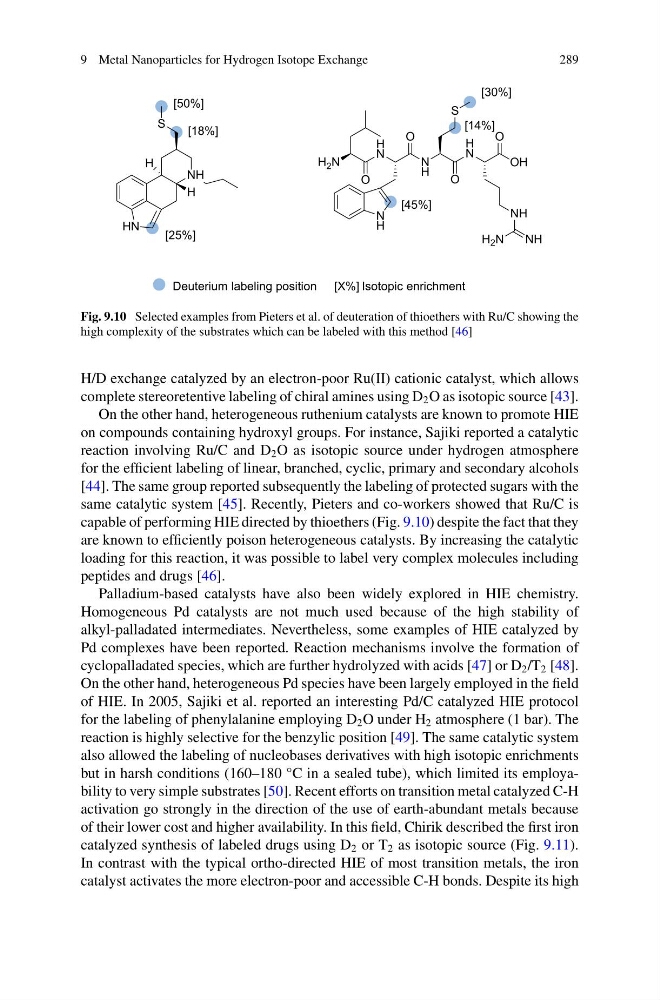
Fig. 9.10 Selected examples from Pieters et al. of deuteration of thioethers with Ru/C showing the
high complexity of the substrates which can be labeled with this method [46]
H/D exchange catalyzed by an electron-poor Ru(II) cationic catalyst, which allows
complete stereoretentive labeling of chiral amines using D 2 O as isotopic source [43].
On the other hand, heterogeneous ruthenium catalysts are known to promote HIE
on compounds containing hydroxyl groups. For instance, Sajiki reported a catalytic
reaction involving Ru/C and D 2 O as isotopic source under hydrogen atmosphere
for the efficient labeling of linear, branched, cyclic, primary and secondary alcohols
[44]. The same group reported subsequently the labeling of protected sugars with the
same catalytic system [45]. Recently, Pieters and co-workers showed that Ru/C is
capable of performing HIE directed by thioethers (Fig. 9.10) despite the fact that they
are known to efficiently poison heterogeneous catalysts. By increasing the catalytic
loading for this reaction, it was possible to label very complex molecules including
peptides and drugs [46].
Palladium-based catalysts have also been widely explored in HIE chemistry.
Homogeneous Pd catalysts are not much used because of the high stability of
alkyl-palladated intermediates. Nevertheless, some examples of HIE catalyzed by
Pd complexes have been reported. Reaction mechanisms involve the formation of
cyclopalladated species, which are further hydrolyzed with acids [47] or D 2 /T 2 [48].
On the other hand, heterogeneous Pd species have been largely employed in the field
of HIE. In 2005, Sajiki et al. reported an interesting Pd/C catalyzed HIE protocol
for the labeling of phenylalanine employing D 2 O under H 2 atmosphere (1 bar). The
reaction is highly selective for the benzylic position [49]. The same catalytic system
also allowed the labeling of nucleobases derivatives with high isotopic enrichments
but in harsh conditions (160–180 °C in a sealed tube), which limited its employability to very simple substrates [50]. Recent efforts on transition metal catalyzed C-H
activation go strongly in the direction of the use of earth-abundant metals because
of their lower cost and higher availability. In this field, Chirik described the first iron
catalyzed synthesis of labeled drugs using D 2 or T 2 as isotopic source (Fig. 9.11).
In contrast with the typical ortho-directed HIE of most transition metals, the iron
catalyst activates the more electron-poor and accessible C-H bonds. Despite its high
289
Deuterium labeling position [X%] Isotopic enrichment
N
H
H
N
O
H 2 N
N
H
H
N
O
OH
O
NH
H 2 N
NH
S
O
NH
H
H
HN
S
[25%]
[18%]
[50%]
[45%]
[14%]
[30%]
Fig. 9.10 Selected examples from Pieters et al. of deuteration of thioethers with Ru/C showing the
high complexity of the substrates which can be labeled with this method [46]
H/D exchange catalyzed by an electron-poor Ru(II) cationic catalyst, which allows
complete stereoretentive labeling of chiral amines using D 2 O as isotopic source [43].
On the other hand, heterogeneous ruthenium catalysts are known to promote HIE
on compounds containing hydroxyl groups. For instance, Sajiki reported a catalytic
reaction involving Ru/C and D 2 O as isotopic source under hydrogen atmosphere
for the efficient labeling of linear, branched, cyclic, primary and secondary alcohols
[44]. The same group reported subsequently the labeling of protected sugars with the
same catalytic system [45]. Recently, Pieters and co-workers showed that Ru/C is
capable of performing HIE directed by thioethers (Fig. 9.10) despite the fact that they
are known to efficiently poison heterogeneous catalysts. By increasing the catalytic
loading for this reaction, it was possible to label very complex molecules including
peptides and drugs [46].
Palladium-based catalysts have also been widely explored in HIE chemistry.
Homogeneous Pd catalysts are not much used because of the high stability of
alkyl-palladated intermediates. Nevertheless, some examples of HIE catalyzed by
Pd complexes have been reported. Reaction mechanisms involve the formation of
cyclopalladated species, which are further hydrolyzed with acids [47] or D 2 /T 2 [48].
On the other hand, heterogeneous Pd species have been largely employed in the field
of HIE. In 2005, Sajiki et al. reported an interesting Pd/C catalyzed HIE protocol
for the labeling of phenylalanine employing D 2 O under H 2 atmosphere (1 bar). The
reaction is highly selective for the benzylic position [49]. The same catalytic system
also allowed the labeling of nucleobases derivatives with high isotopic enrichments
but in harsh conditions (160–180 °C in a sealed tube), which limited its employability to very simple substrates [50]. Recent efforts on transition metal catalyzed C-H
activation go strongly in the direction of the use of earth-abundant metals because
of their lower cost and higher availability. In this field, Chirik described the first iron
catalyzed synthesis of labeled drugs using D 2 or T 2 as isotopic source (Fig. 9.11).
In contrast with the typical ortho-directed HIE of most transition metals, the iron
catalyst activates the more electron-poor and accessible C-H bonds. Despite its high