

9 Metal Nanoparticles for Hydrogen Isotope Exchange
283
kinetic constant of a reaction at 25 °C that involves a C-H bond breaking is, theoretically, around 6.5 times faster than the same reaction involving a C-D bond breaking
(Eq. 9.1).
k H
k D
= e
hc(v H −v D )
2kT
(9.1)
Equation 9.1, k H − k D kinetic constant for C-H and C-D bonds, h Planck’s
constant, c speed of the light, v H − v D elongation frequencies for C-H and C-D
bonds, k Boltzmann’s constant, T temperature.
One of the most classical (or common) applications of deuterated compounds is
their use as tools to understand reaction mechanisms. By observing the magnitudes
of isotope effects, it is possible to deduce which site might contribute to the chemical
mechanism of a reaction. Therefore, KIE can be used for:
1. determining the absolute rates in two parallel reactions,
2. distinguishing two chemical processes in competition experiments, when
“labeled” and “unlabeled” compounds are placed in the same flask,
3. assessing the reactivity of two different C-H bonds within the same molecule.
These techniques are used to study inter/intramolecular organic transformations
as well as enzymatic reactions [13–15] and organometallic processes. Additionally,
deuterium can be incorporated into metabolized sites of bioactive compounds in order
to alter their pharmacokinetic profiles [16–19]. Metabolic inactivation of drugs is one
of the main reasons of discard during drug development processes, because it can
potentially lead to the production of toxic metabolites, to the inactivation of the drug
or to too low concentrations in blood. On the other hand, deuterated drugs may possess
enhanced pharmacokinetic properties thanks to lower metabolic rates. Recently, FDA
has allowed the first deuterated drug to reach the market [20]. Tetrabenazine is a
vesicular monoamine transporter 2 (VMAT2) inhibitor, and it is used for the treatment
of chorea associated with Huntington disease. The active metabolite, issue from the
reduction of the carbonyl moiety, is rapidly oxidized on the cathecolic methoxy
groups and thus excreted. The deuteration of these positions increases the half-life
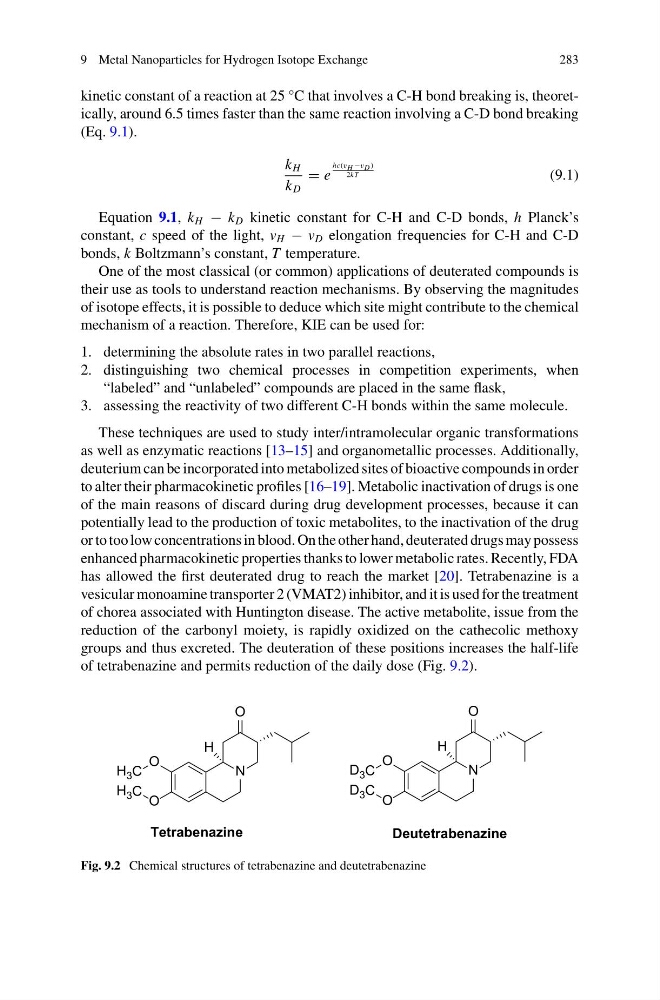
of tetrabenazine and permits reduction of the daily dose (Fig. 9.2).
N
H
O
O
H 3 C
O
H 3 C
Tetrabenazine
N
H
O
O
D 3 C
O
D 3 C
Deutetrabenazine
Fig. 9.2 Chemical structures of tetrabenazine and deutetrabenazine
283
kinetic constant of a reaction at 25 °C that involves a C-H bond breaking is, theoretically, around 6.5 times faster than the same reaction involving a C-D bond breaking
(Eq. 9.1).
k H
k D
= e
hc(v H −v D )
2kT
(9.1)
Equation 9.1, k H − k D kinetic constant for C-H and C-D bonds, h Planck’s
constant, c speed of the light, v H − v D elongation frequencies for C-H and C-D
bonds, k Boltzmann’s constant, T temperature.
One of the most classical (or common) applications of deuterated compounds is
their use as tools to understand reaction mechanisms. By observing the magnitudes
of isotope effects, it is possible to deduce which site might contribute to the chemical
mechanism of a reaction. Therefore, KIE can be used for:
1. determining the absolute rates in two parallel reactions,
2. distinguishing two chemical processes in competition experiments, when
“labeled” and “unlabeled” compounds are placed in the same flask,
3. assessing the reactivity of two different C-H bonds within the same molecule.
These techniques are used to study inter/intramolecular organic transformations
as well as enzymatic reactions [13–15] and organometallic processes. Additionally,
deuterium can be incorporated into metabolized sites of bioactive compounds in order
to alter their pharmacokinetic profiles [16–19]. Metabolic inactivation of drugs is one
of the main reasons of discard during drug development processes, because it can
potentially lead to the production of toxic metabolites, to the inactivation of the drug
or to too low concentrations in blood. On the other hand, deuterated drugs may possess
enhanced pharmacokinetic properties thanks to lower metabolic rates. Recently, FDA
has allowed the first deuterated drug to reach the market [20]. Tetrabenazine is a
vesicular monoamine transporter 2 (VMAT2) inhibitor, and it is used for the treatment
of chorea associated with Huntington disease. The active metabolite, issue from the
reduction of the carbonyl moiety, is rapidly oxidized on the cathecolic methoxy
groups and thus excreted. The deuteration of these positions increases the half-life
of tetrabenazine and permits reduction of the daily dose (Fig. 9.2).
N
H
O
O
H 3 C
O
H 3 C
Tetrabenazine
N
H
O
O
D 3 C
O
D 3 C
Deutetrabenazine
Fig. 9.2 Chemical structures of tetrabenazine and deutetrabenazine