

284
A. Palazzolo et al.
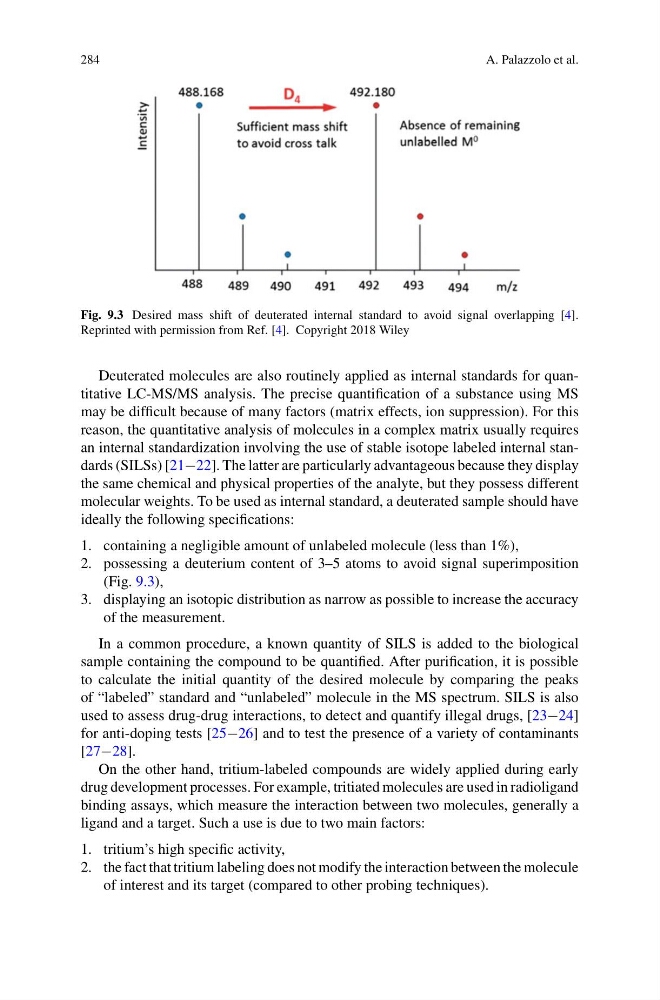
Fig. 9.3 Desired mass shift of deuterated internal standard to avoid signal overlapping [4].
Reprinted with permission from Ref. [4]. Copyright 2018 Wiley
Deuterated molecules are also routinely applied as internal standards for quantitative LC-MS/MS analysis. The precise quantification of a substance using MS
may be difficult because of many factors (matrix effects, ion suppression). For this
reason, the quantitative analysis of molecules in a complex matrix usually requires
an internal standardization involving the use of stable isotope labeled internal standards (SILSs) [21−22]. The latter are particularly advantageous because they display
the same chemical and physical properties of the analyte, but they possess different
molecular weights. To be used as internal standard, a deuterated sample should have
ideally the following specifications:
1. containing a negligible amount of unlabeled molecule (less than 1%),
2. possessing a deuterium content of 3–5 atoms to avoid signal superimposition
(Fig. 9.3),
3. displaying an isotopic distribution as narrow as possible to increase the accuracy
of the measurement.
In a common procedure, a known quantity of SILS is added to the biological
sample containing the compound to be quantified. After purification, it is possible
to calculate the initial quantity of the desired molecule by comparing the peaks
of “labeled” standard and “unlabeled” molecule in the MS spectrum. SILS is also
used to assess drug-drug interactions, to detect and quantify illegal drugs, [23−24]
for anti-doping tests [25−26] and to test the presence of a variety of contaminants
[27−28].
On the other hand, tritium-labeled compounds are widely applied during early
drug development processes. For example, tritiated molecules are used in radioligand
binding assays, which measure the interaction between two molecules, generally a
ligand and a target. Such a use is due to two main factors:
1. tritium’s high specific activity,
2. the fact that tritium labeling does not modify the interaction between the molecule
of interest and its target (compared to other probing techniques).
A. Palazzolo et al.
Fig. 9.3 Desired mass shift of deuterated internal standard to avoid signal overlapping [4].
Reprinted with permission from Ref. [4]. Copyright 2018 Wiley
Deuterated molecules are also routinely applied as internal standards for quantitative LC-MS/MS analysis. The precise quantification of a substance using MS
may be difficult because of many factors (matrix effects, ion suppression). For this
reason, the quantitative analysis of molecules in a complex matrix usually requires
an internal standardization involving the use of stable isotope labeled internal standards (SILSs) [21−22]. The latter are particularly advantageous because they display
the same chemical and physical properties of the analyte, but they possess different
molecular weights. To be used as internal standard, a deuterated sample should have
ideally the following specifications:
1. containing a negligible amount of unlabeled molecule (less than 1%),
2. possessing a deuterium content of 3–5 atoms to avoid signal superimposition
(Fig. 9.3),
3. displaying an isotopic distribution as narrow as possible to increase the accuracy
of the measurement.
In a common procedure, a known quantity of SILS is added to the biological
sample containing the compound to be quantified. After purification, it is possible
to calculate the initial quantity of the desired molecule by comparing the peaks
of “labeled” standard and “unlabeled” molecule in the MS spectrum. SILS is also
used to assess drug-drug interactions, to detect and quantify illegal drugs, [23−24]
for anti-doping tests [25−26] and to test the presence of a variety of contaminants
[27−28].
On the other hand, tritium-labeled compounds are widely applied during early
drug development processes. For example, tritiated molecules are used in radioligand
binding assays, which measure the interaction between two molecules, generally a
ligand and a target. Such a use is due to two main factors:
1. tritium’s high specific activity,
2. the fact that tritium labeling does not modify the interaction between the molecule
of interest and its target (compared to other probing techniques).