

282
A. Palazzolo et al.
9.1 Utilization of Protium Isotopes
Deuterium and tritium are nowadays employed in several research fields spanning
drug development processes, material chemistry and fundamental mechanistic investigations [4]. Deuterium is a stable isotope of hydrogen that contains one proton, one
electron and one neutron; thus, it is stated as both
2 H and D (IUPAC). Deuterium was
discovered in 1931 by Urey et al. [5]. Its name was derived from the Greek deuteros,
namely second [6]. Tritium is a radioactive isotope of hydrogen that contains one
proton, one electron and two neutrons. Thus, it is stated as both
3 H and T (IUPAC).
Firstly produced by Oliphant, Harteck and Rutherford bombarding deuterated inorganic salts with deuterium ions, [7] tritium has a half-life of 12.32 years and decays
to
3 He emitting low-energy β
− particles [8]. One of the most important characteristics of hydrogen isotopes is their strong kinetic isotope effect (KIE). Primary
KIE is defined as “the ratio between the kinetic constants of a chemical transformation when one of the atoms of a reactant is substituted by one of its isotopes”
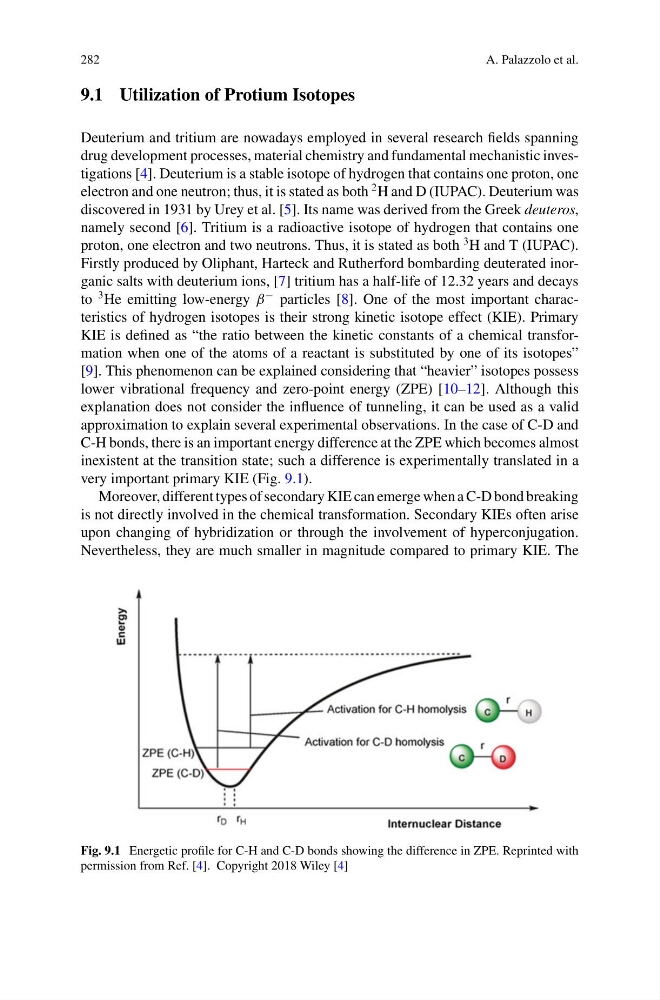
[9]. This phenomenon can be explained considering that “heavier” isotopes possess
lower vibrational frequency and zero-point energy (ZPE) [10–12]. Although this
explanation does not consider the influence of tunneling, it can be used as a valid
approximation to explain several experimental observations. In the case of C-D and
C-H bonds, there is an important energy difference at the ZPE which becomes almost
inexistent at the transition state; such a difference is experimentally translated in a
very important primary KIE (Fig. 9.1).
Moreover, different types of secondary KIE can emerge when a C-D bond breaking
is not directly involved in the chemical transformation. Secondary KIEs often arise
upon changing of hybridization or through the involvement of hyperconjugation.
Nevertheless, they are much smaller in magnitude compared to primary KIE. The
Fig. 9.1 Energetic profile for C-H and C-D bonds showing the difference in ZPE. Reprinted with
permission from Ref. [4]. Copyright 2018 Wiley [4]
A. Palazzolo et al.
9.1 Utilization of Protium Isotopes
Deuterium and tritium are nowadays employed in several research fields spanning
drug development processes, material chemistry and fundamental mechanistic investigations [4]. Deuterium is a stable isotope of hydrogen that contains one proton, one
electron and one neutron; thus, it is stated as both
2 H and D (IUPAC). Deuterium was
discovered in 1931 by Urey et al. [5]. Its name was derived from the Greek deuteros,
namely second [6]. Tritium is a radioactive isotope of hydrogen that contains one
proton, one electron and two neutrons. Thus, it is stated as both
3 H and T (IUPAC).
Firstly produced by Oliphant, Harteck and Rutherford bombarding deuterated inorganic salts with deuterium ions, [7] tritium has a half-life of 12.32 years and decays
to
3 He emitting low-energy β
− particles [8]. One of the most important characteristics of hydrogen isotopes is their strong kinetic isotope effect (KIE). Primary
KIE is defined as “the ratio between the kinetic constants of a chemical transformation when one of the atoms of a reactant is substituted by one of its isotopes”
[9]. This phenomenon can be explained considering that “heavier” isotopes possess
lower vibrational frequency and zero-point energy (ZPE) [10–12]. Although this
explanation does not consider the influence of tunneling, it can be used as a valid
approximation to explain several experimental observations. In the case of C-D and
C-H bonds, there is an important energy difference at the ZPE which becomes almost
inexistent at the transition state; such a difference is experimentally translated in a
very important primary KIE (Fig. 9.1).
Moreover, different types of secondary KIE can emerge when a C-D bond breaking
is not directly involved in the chemical transformation. Secondary KIEs often arise
upon changing of hybridization or through the involvement of hyperconjugation.
Nevertheless, they are much smaller in magnitude compared to primary KIE. The
Fig. 9.1 Energetic profile for C-H and C-D bonds showing the difference in ZPE. Reprinted with
permission from Ref. [4]. Copyright 2018 Wiley [4]