

8 Earth-Abundant d-Block Metal Nanocatalysis for Coupling …
265
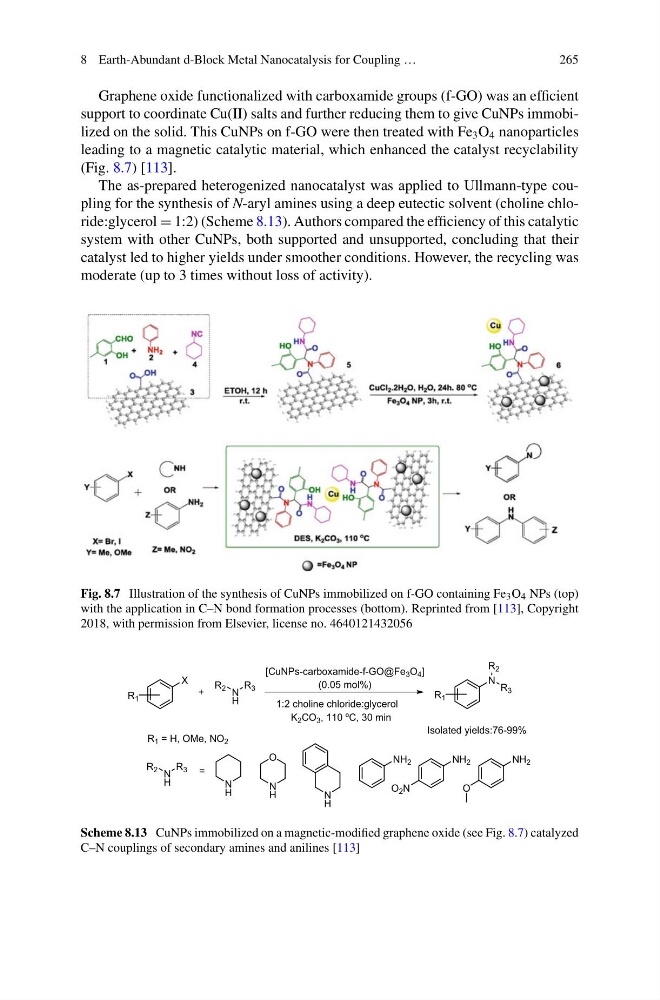
Graphene oxide functionalized with carboxamide groups (f-GO) was an efficient
support to coordinate Cu(II) salts and further reducing them to give CuNPs immobilized on the solid. This CuNPs on f-GO were then treated with Fe 3 O 4 nanoparticles
leading to a magnetic catalytic material, which enhanced the catalyst recyclability
(Fig. 8.7) [113].
The as-prepared heterogenized nanocatalyst was applied to Ullmann-type coupling for the synthesis of N-aryl amines using a deep eutectic solvent (choline chloride:glycerol = 1:2) (Scheme 8.13). Authors compared the efficiency of this catalytic
system with other CuNPs, both supported and unsupported, concluding that their
catalyst led to higher yields under smoother conditions. However, the recycling was
moderate (up to 3 times without loss of activity).
Fig. 8.7 Illustration of the synthesis of CuNPs immobilized on f-GO containing Fe 3 O 4 NPs (top)
with the application in C–N bond formation processes (bottom). Reprinted from [113], Copyright
2018, with permission from Elsevier, license no. 4640121432056
X
N
H
R 3
R 2
+
N R 3
R 2
R 1
R 1
Isolated yields:76-99%
[CuNPs-carboxamide-f-GO@Fe 3 O 4 ]
(0.05 mol%)
1:2 choline chloride:glycerol
K 2 CO 3 , 110 ºC, 30 min
R 1 = H, OMe, NO 2
N
H
R 3
R 2
=
N
H
O
N
H
N
H
NH 2
NH 2
NH 2
O 2 N
O
Scheme 8.13 CuNPs immobilized on a magnetic-modified graphene oxide (see Fig. 8.7) catalyzed
C–N couplings of secondary amines and anilines [113]
265
Graphene oxide functionalized with carboxamide groups (f-GO) was an efficient
support to coordinate Cu(II) salts and further reducing them to give CuNPs immobilized on the solid. This CuNPs on f-GO were then treated with Fe 3 O 4 nanoparticles
leading to a magnetic catalytic material, which enhanced the catalyst recyclability
(Fig. 8.7) [113].
The as-prepared heterogenized nanocatalyst was applied to Ullmann-type coupling for the synthesis of N-aryl amines using a deep eutectic solvent (choline chloride:glycerol = 1:2) (Scheme 8.13). Authors compared the efficiency of this catalytic
system with other CuNPs, both supported and unsupported, concluding that their
catalyst led to higher yields under smoother conditions. However, the recycling was
moderate (up to 3 times without loss of activity).
Fig. 8.7 Illustration of the synthesis of CuNPs immobilized on f-GO containing Fe 3 O 4 NPs (top)
with the application in C–N bond formation processes (bottom). Reprinted from [113], Copyright
2018, with permission from Elsevier, license no. 4640121432056
X
N
H
R 3
R 2
+
N R 3
R 2
R 1
R 1
Isolated yields:76-99%
[CuNPs-carboxamide-f-GO@Fe 3 O 4 ]
(0.05 mol%)
1:2 choline chloride:glycerol
K 2 CO 3 , 110 ºC, 30 min
R 1 = H, OMe, NO 2
N
H
R 3
R 2
=
N
H
O
N
H
N
H
NH 2
NH 2
NH 2
O 2 N
O
Scheme 8.13 CuNPs immobilized on a magnetic-modified graphene oxide (see Fig. 8.7) catalyzed
C–N couplings of secondary amines and anilines [113]