

266
M. Camats et al.
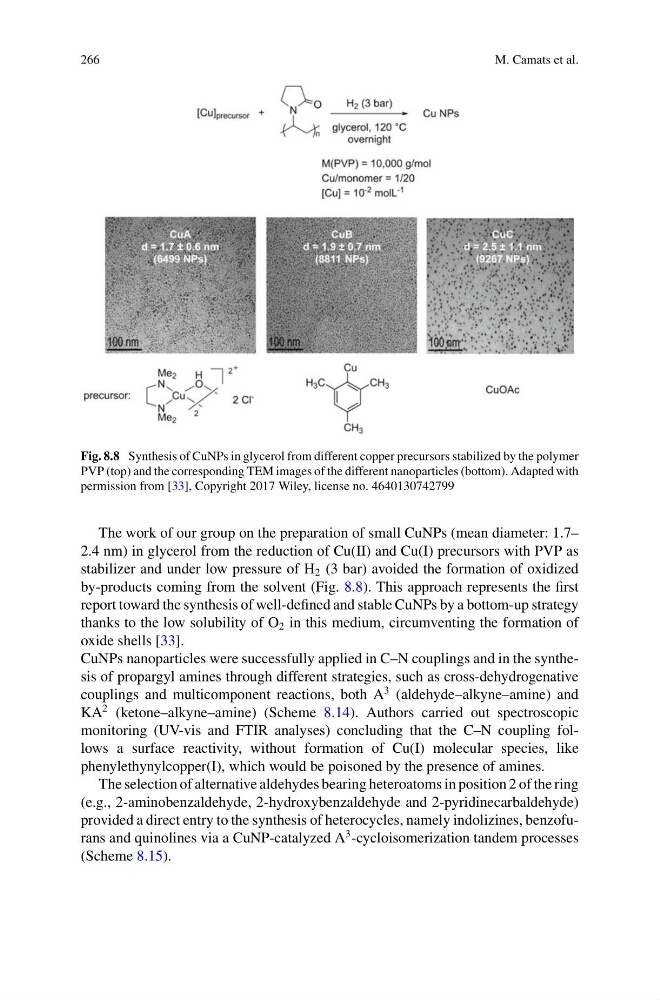
Fig. 8.8 Synthesis of CuNPs in glycerol from different copper precursors stabilized by the polymer
PVP (top) and the corresponding TEM images of the different nanoparticles (bottom). Adapted with
permission from [33], Copyright 2017 Wiley, license no. 4640130742799
The work of our group on the preparation of small CuNPs (mean diameter: 1.7–
2.4 nm) in glycerol from the reduction of Cu(II) and Cu(I) precursors with PVP as
stabilizer and under low pressure of H 2 (3 bar) avoided the formation of oxidized
by-products coming from the solvent (Fig. 8.8). This approach represents the first
report toward the synthesis of well-defined and stable CuNPs by a bottom-up strategy
thanks to the low solubility of O 2 in this medium, circumventing the formation of
oxide shells [33].
CuNPs nanoparticles were successfully applied in C–N couplings and in the synthesis of propargyl amines through different strategies, such as cross-dehydrogenative
couplings and multicomponent reactions, both A
3 (aldehyde–alkyne–amine) and
KA
2 (ketone–alkyne–amine) (Scheme 8.14). Authors carried out spectroscopic
monitoring (UV-vis and FTIR analyses) concluding that the C–N coupling follows a surface reactivity, without formation of Cu(I) molecular species, like
phenylethynylcopper(I), which would be poisoned by the presence of amines.
The selection of alternative aldehydes bearing heteroatoms in position 2 of the ring
(e.g., 2-aminobenzaldehyde, 2-hydroxybenzaldehyde and 2-pyridinecarbaldehyde)
provided a direct entry to the synthesis of heterocycles, namely indolizines, benzofurans and quinolines via a CuNP-catalyzed A
3 -cycloisomerization tandem processes
(Scheme 8.15).
M. Camats et al.
Fig. 8.8 Synthesis of CuNPs in glycerol from different copper precursors stabilized by the polymer
PVP (top) and the corresponding TEM images of the different nanoparticles (bottom). Adapted with
permission from [33], Copyright 2017 Wiley, license no. 4640130742799
The work of our group on the preparation of small CuNPs (mean diameter: 1.7–
2.4 nm) in glycerol from the reduction of Cu(II) and Cu(I) precursors with PVP as
stabilizer and under low pressure of H 2 (3 bar) avoided the formation of oxidized
by-products coming from the solvent (Fig. 8.8). This approach represents the first
report toward the synthesis of well-defined and stable CuNPs by a bottom-up strategy
thanks to the low solubility of O 2 in this medium, circumventing the formation of
oxide shells [33].
CuNPs nanoparticles were successfully applied in C–N couplings and in the synthesis of propargyl amines through different strategies, such as cross-dehydrogenative
couplings and multicomponent reactions, both A
3 (aldehyde–alkyne–amine) and
KA
2 (ketone–alkyne–amine) (Scheme 8.14). Authors carried out spectroscopic
monitoring (UV-vis and FTIR analyses) concluding that the C–N coupling follows a surface reactivity, without formation of Cu(I) molecular species, like
phenylethynylcopper(I), which would be poisoned by the presence of amines.
The selection of alternative aldehydes bearing heteroatoms in position 2 of the ring
(e.g., 2-aminobenzaldehyde, 2-hydroxybenzaldehyde and 2-pyridinecarbaldehyde)
provided a direct entry to the synthesis of heterocycles, namely indolizines, benzofurans and quinolines via a CuNP-catalyzed A
3 -cycloisomerization tandem processes
(Scheme 8.15).