

264
M. Camats et al.
8.3 Carbon–Heteroatom Bond Formation
The activation of C–halogen bonds has been overwhelmingly used in the functionalization of arenes. Since the discovery of Ullmann’s coupling in 1901, copper has
been one of the most used earth-abundant metals in both C–C and C–heteroatom
couplings (original paper of Ullmann: [125]; recent reviews: [14, 94, 109]). However, many applications of this reactivity are especially limited due to the use of
hazardous solvents such as DMF and DMSO. A lot of interest has been put into
transforming this reactivity into greener approaches. In this context, considerable
efforts have been recently developed in nanocatalytic systems capable of working
in friendly environmental conditions [68, 127], polyols being alternative solvents of
interest [41].
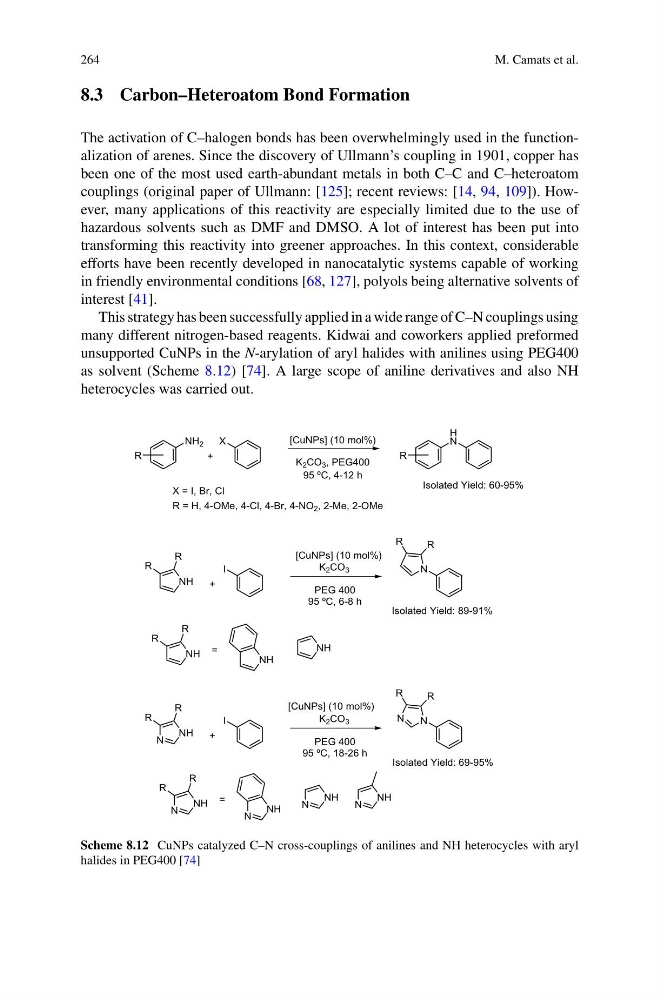
This strategy has been successfully applied in a wide range of C–N couplings using
many different nitrogen-based reagents. Kidwai and coworkers applied preformed
unsupported CuNPs in the N-arylation of aryl halides with anilines using PEG400
as solvent (Scheme 8.12) [74]. A large scope of aniline derivatives and also NH
heterocycles was carried out.
N
I
+
[CuNPs] (10 mol%)
PEG 400
95 ºC, 6-8 h
Isolated Yield: 89-91%
NH
R
R
R
R
K 2 CO 3
N
I
+
PEG 400
95 ºC, 18-26 h
Isolated Yield: 69-95%
N
NH
R
R
N
R
R
K 2 CO 3
NH
R
R
=
NH
NH
N
NH
R
R
=
N
NH
N
NH
N
NH
[CuNPs] (10 mol%)
H
N
R
R
X
NH 2
+
[CuNPs] (10 mol%)
K 2 CO 3 , PEG400
95 ºC, 4-12 h
Isolated Yield: 60-95%
X = I, Br, Cl
R = H, 4-OMe, 4-Cl, 4-Br, 4-NO 2 , 2-Me, 2-OMe
Scheme 8.12 CuNPs catalyzed C–N cross-couplings of anilines and NH heterocycles with aryl
halides in PEG400 [74]
M. Camats et al.
8.3 Carbon–Heteroatom Bond Formation
The activation of C–halogen bonds has been overwhelmingly used in the functionalization of arenes. Since the discovery of Ullmann’s coupling in 1901, copper has
been one of the most used earth-abundant metals in both C–C and C–heteroatom
couplings (original paper of Ullmann: [125]; recent reviews: [14, 94, 109]). However, many applications of this reactivity are especially limited due to the use of
hazardous solvents such as DMF and DMSO. A lot of interest has been put into
transforming this reactivity into greener approaches. In this context, considerable
efforts have been recently developed in nanocatalytic systems capable of working
in friendly environmental conditions [68, 127], polyols being alternative solvents of
interest [41].
This strategy has been successfully applied in a wide range of C–N couplings using
many different nitrogen-based reagents. Kidwai and coworkers applied preformed
unsupported CuNPs in the N-arylation of aryl halides with anilines using PEG400
as solvent (Scheme 8.12) [74]. A large scope of aniline derivatives and also NH
heterocycles was carried out.
N
I
+
[CuNPs] (10 mol%)
PEG 400
95 ºC, 6-8 h
Isolated Yield: 89-91%
NH
R
R
R
R
K 2 CO 3
N
I
+
PEG 400
95 ºC, 18-26 h
Isolated Yield: 69-95%
N
NH
R
R
N
R
R
K 2 CO 3
NH
R
R
=
NH
NH
N
NH
R
R
=
N
NH
N
NH
N
NH
[CuNPs] (10 mol%)
H
N
R
R
X
NH 2
+
[CuNPs] (10 mol%)
K 2 CO 3 , PEG400
95 ºC, 4-12 h
Isolated Yield: 60-95%
X = I, Br, Cl
R = H, 4-OMe, 4-Cl, 4-Br, 4-NO 2 , 2-Me, 2-OMe
Scheme 8.12 CuNPs catalyzed C–N cross-couplings of anilines and NH heterocycles with aryl
halides in PEG400 [74]