

258
M. Camats et al.
R
H
X
[Fe 3 O 4 NPs] (5 mol%)
K 2 CO 3
EG
125 ºC, 20-72 h
R
1
R
1
X = I, Br
S
S
85%
86%
N
N
N
80%
76%
78%
R
1 = 4-OMe, 4-NO 2 , 4-Me, 4-Br, 4-OH, 2-Me, 2-OMe
R
2 = Ph, 4-MePh, n-C 6 H 13
8 examples
Isolated Yield: 76-92%
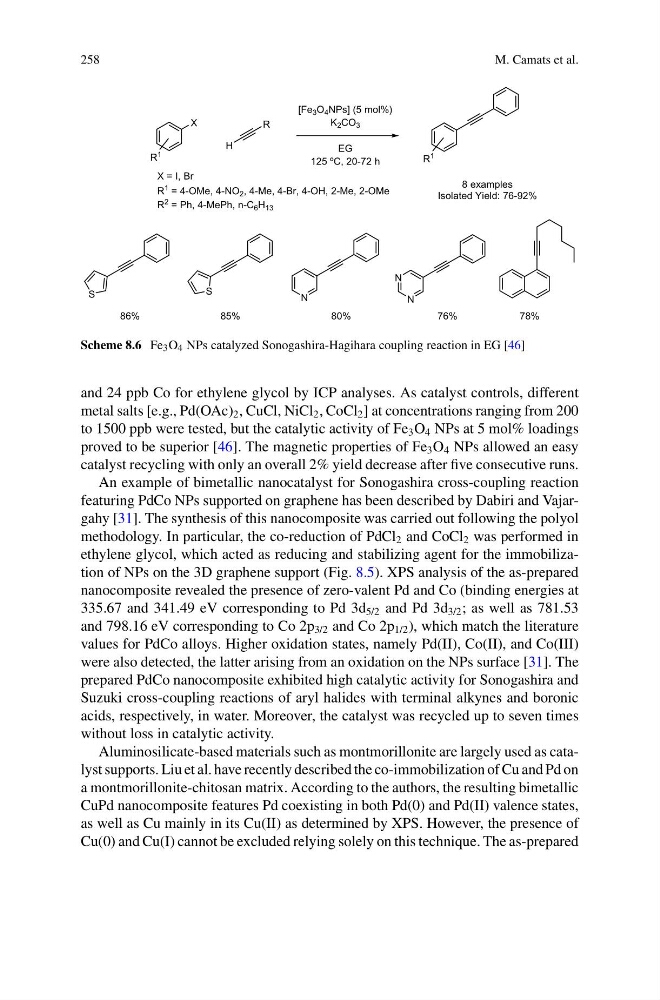
Scheme 8.6 Fe 3 O 4 NPs catalyzed Sonogashira-Hagihara coupling reaction in EG [46]
and 24 ppb Co for ethylene glycol by ICP analyses. As catalyst controls, different
metal salts [e.g., Pd(OAc) 2 , CuCl, NiCl 2 , CoCl 2 ] at concentrations ranging from 200
to 1500 ppb were tested, but the catalytic activity of Fe 3 O 4 NPs at 5 mol% loadings
proved to be superior [46]. The magnetic properties of Fe 3 O 4 NPs allowed an easy
catalyst recycling with only an overall 2% yield decrease after five consecutive runs.
An example of bimetallic nanocatalyst for Sonogashira cross-coupling reaction
featuring PdCo NPs supported on graphene has been described by Dabiri and Vajargahy [31]. The synthesis of this nanocomposite was carried out following the polyol
methodology. In particular, the co-reduction of PdCl 2 and CoCl 2 was performed in
ethylene glycol, which acted as reducing and stabilizing agent for the immobilization of NPs on the 3D graphene support (Fig. 8.5). XPS analysis of the as-prepared
nanocomposite revealed the presence of zero-valent Pd and Co (binding energies at
335.67 and 341.49 eV corresponding to Pd 3d 5/2 and Pd 3d 3/2 ; as well as 781.53
and 798.16 eV corresponding to Co 2p 3/2 and Co 2p 1/2 ), which match the literature
values for PdCo alloys. Higher oxidation states, namely Pd(II), Co(II), and Co(III)
were also detected, the latter arising from an oxidation on the NPs surface [31]. The
prepared PdCo nanocomposite exhibited high catalytic activity for Sonogashira and
Suzuki cross-coupling reactions of aryl halides with terminal alkynes and boronic
acids, respectively, in water. Moreover, the catalyst was recycled up to seven times
without loss in catalytic activity.
Aluminosilicate-based materials such as montmorillonite are largely used as catalyst supports. Liu et al. have recently described the co-immobilization of Cu and Pd on
a montmorillonite-chitosan matrix. According to the authors, the resulting bimetallic
CuPd nanocomposite features Pd coexisting in both Pd(0) and Pd(II) valence states,
as well as Cu mainly in its Cu(II) as determined by XPS. However, the presence of
Cu(0) and Cu(I) cannot be excluded relying solely on this technique. The as-prepared
M. Camats et al.
R
H
X
[Fe 3 O 4 NPs] (5 mol%)
K 2 CO 3
EG
125 ºC, 20-72 h
R
1
R
1
X = I, Br
S
S
85%
86%
N
N
N
80%
76%
78%
R
1 = 4-OMe, 4-NO 2 , 4-Me, 4-Br, 4-OH, 2-Me, 2-OMe
R
2 = Ph, 4-MePh, n-C 6 H 13
8 examples
Isolated Yield: 76-92%
Scheme 8.6 Fe 3 O 4 NPs catalyzed Sonogashira-Hagihara coupling reaction in EG [46]
and 24 ppb Co for ethylene glycol by ICP analyses. As catalyst controls, different
metal salts [e.g., Pd(OAc) 2 , CuCl, NiCl 2 , CoCl 2 ] at concentrations ranging from 200
to 1500 ppb were tested, but the catalytic activity of Fe 3 O 4 NPs at 5 mol% loadings
proved to be superior [46]. The magnetic properties of Fe 3 O 4 NPs allowed an easy
catalyst recycling with only an overall 2% yield decrease after five consecutive runs.
An example of bimetallic nanocatalyst for Sonogashira cross-coupling reaction
featuring PdCo NPs supported on graphene has been described by Dabiri and Vajargahy [31]. The synthesis of this nanocomposite was carried out following the polyol
methodology. In particular, the co-reduction of PdCl 2 and CoCl 2 was performed in
ethylene glycol, which acted as reducing and stabilizing agent for the immobilization of NPs on the 3D graphene support (Fig. 8.5). XPS analysis of the as-prepared
nanocomposite revealed the presence of zero-valent Pd and Co (binding energies at
335.67 and 341.49 eV corresponding to Pd 3d 5/2 and Pd 3d 3/2 ; as well as 781.53
and 798.16 eV corresponding to Co 2p 3/2 and Co 2p 1/2 ), which match the literature
values for PdCo alloys. Higher oxidation states, namely Pd(II), Co(II), and Co(III)
were also detected, the latter arising from an oxidation on the NPs surface [31]. The
prepared PdCo nanocomposite exhibited high catalytic activity for Sonogashira and
Suzuki cross-coupling reactions of aryl halides with terminal alkynes and boronic
acids, respectively, in water. Moreover, the catalyst was recycled up to seven times
without loss in catalytic activity.
Aluminosilicate-based materials such as montmorillonite are largely used as catalyst supports. Liu et al. have recently described the co-immobilization of Cu and Pd on
a montmorillonite-chitosan matrix. According to the authors, the resulting bimetallic
CuPd nanocomposite features Pd coexisting in both Pd(0) and Pd(II) valence states,
as well as Cu mainly in its Cu(II) as determined by XPS. However, the presence of
Cu(0) and Cu(I) cannot be excluded relying solely on this technique. The as-prepared