

8 Earth-Abundant d-Block Metal Nanocatalysis for Coupling …
257
interesting transformations for the synthesis of propargylic compounds [35]. The
search of catalytic versions is key for exploiting the privileged reactivity of this
metal from the point of view of sustainability [38]. Recent reports on the singular
π-activation of alkynes leveraged by zero-valent CuNPs reveal the importance of
this coordination in catalysis [33, 97].
In this context, the cross-coupling of terminal alkynes and acyl chlorides has been
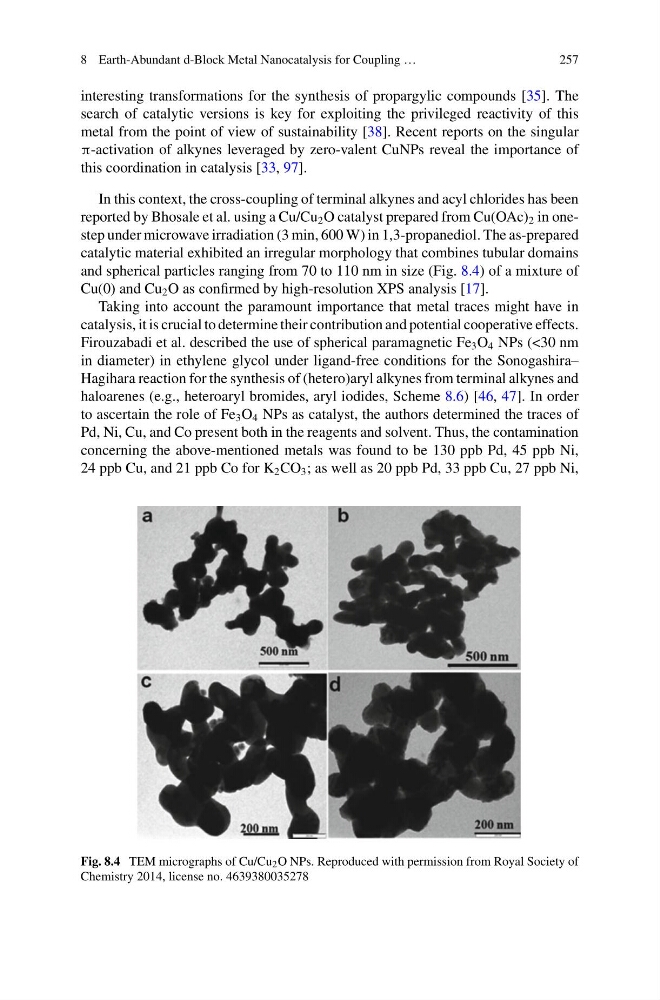
reported by Bhosale et al. using a Cu/Cu 2 O catalyst prepared from Cu(OAc) 2 in onestep under microwave irradiation (3 min, 600 W) in 1,3-propanediol. The as-prepared
catalytic material exhibited an irregular morphology that combines tubular domains
and spherical particles ranging from 70 to 110 nm in size (Fig. 8.4) of a mixture of
Cu(0) and Cu 2 O as confirmed by high-resolution XPS analysis [17].
Taking into account the paramount importance that metal traces might have in
catalysis, it is crucial to determine their contribution and potential cooperative effects.
Firouzabadi et al. described the use of spherical paramagnetic Fe 3 O 4 NPs (<30 nm
in diameter) in ethylene glycol under ligand-free conditions for the Sonogashira–
Hagihara reaction for the synthesis of (hetero)aryl alkynes from terminal alkynes and
haloarenes (e.g., heteroaryl bromides, aryl iodides, Scheme 8.6) [46, 47]. In order
to ascertain the role of Fe 3 O 4 NPs as catalyst, the authors determined the traces of
Pd, Ni, Cu, and Co present both in the reagents and solvent. Thus, the contamination
concerning the above-mentioned metals was found to be 130 ppb Pd, 45 ppb Ni,
24 ppb Cu, and 21 ppb Co for K 2 CO 3 ; as well as 20 ppb Pd, 33 ppb Cu, 27 ppb Ni,
Fig. 8.4 TEM micrographs of Cu/Cu 2 O NPs. Reproduced with permission from Royal Society of
Chemistry 2014, license no. 4639380035278
257
interesting transformations for the synthesis of propargylic compounds [35]. The
search of catalytic versions is key for exploiting the privileged reactivity of this
metal from the point of view of sustainability [38]. Recent reports on the singular
π-activation of alkynes leveraged by zero-valent CuNPs reveal the importance of
this coordination in catalysis [33, 97].
In this context, the cross-coupling of terminal alkynes and acyl chlorides has been
reported by Bhosale et al. using a Cu/Cu 2 O catalyst prepared from Cu(OAc) 2 in onestep under microwave irradiation (3 min, 600 W) in 1,3-propanediol. The as-prepared
catalytic material exhibited an irregular morphology that combines tubular domains
and spherical particles ranging from 70 to 110 nm in size (Fig. 8.4) of a mixture of
Cu(0) and Cu 2 O as confirmed by high-resolution XPS analysis [17].
Taking into account the paramount importance that metal traces might have in
catalysis, it is crucial to determine their contribution and potential cooperative effects.
Firouzabadi et al. described the use of spherical paramagnetic Fe 3 O 4 NPs (<30 nm
in diameter) in ethylene glycol under ligand-free conditions for the Sonogashira–
Hagihara reaction for the synthesis of (hetero)aryl alkynes from terminal alkynes and
haloarenes (e.g., heteroaryl bromides, aryl iodides, Scheme 8.6) [46, 47]. In order
to ascertain the role of Fe 3 O 4 NPs as catalyst, the authors determined the traces of
Pd, Ni, Cu, and Co present both in the reagents and solvent. Thus, the contamination
concerning the above-mentioned metals was found to be 130 ppb Pd, 45 ppb Ni,
24 ppb Cu, and 21 ppb Co for K 2 CO 3 ; as well as 20 ppb Pd, 33 ppb Cu, 27 ppb Ni,
Fig. 8.4 TEM micrographs of Cu/Cu 2 O NPs. Reproduced with permission from Royal Society of
Chemistry 2014, license no. 4639380035278