

256
M. Camats et al.
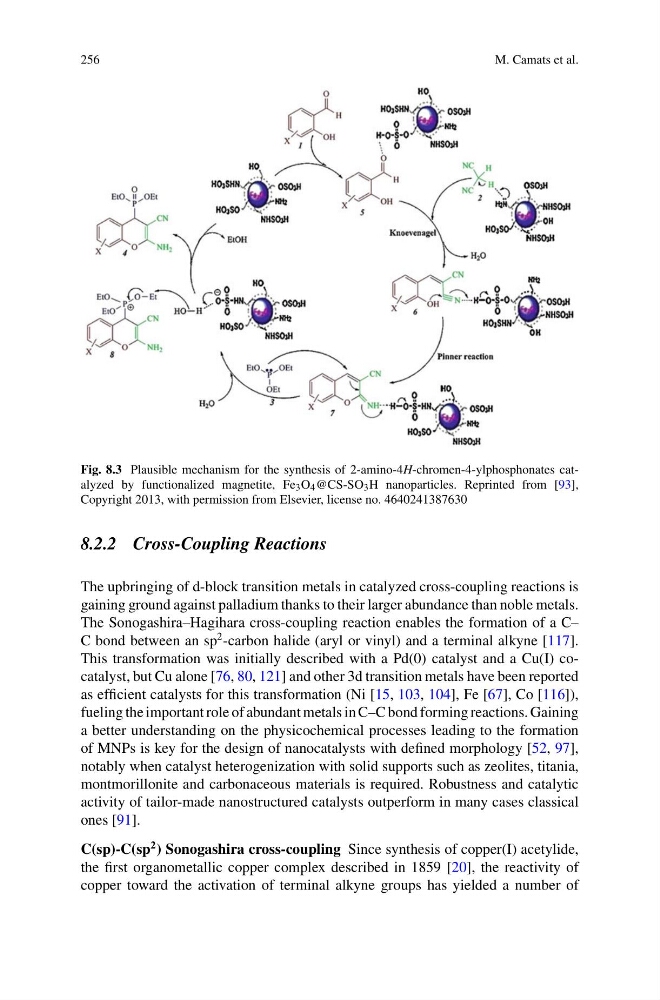
Fig. 8.3 Plausible mechanism for the synthesis of 2-amino-4H-chromen-4-ylphosphonates catalyzed by functionalized magnetite, Fe 3 O 4 @CS-SO 3 H nanoparticles. Reprinted from [93],
Copyright 2013, with permission from Elsevier, license no. 4640241387630
8.2.2 Cross-Coupling Reactions
The upbringing of d-block transition metals in catalyzed cross-coupling reactions is
gaining ground against palladium thanks to their larger abundance than noble metals.
The Sonogashira–Hagihara cross-coupling reaction enables the formation of a C–
C bond between an sp
2 -carbon halide (aryl or vinyl) and a terminal alkyne [117].
This transformation was initially described with a Pd(0) catalyst and a Cu(I) cocatalyst, but Cu alone [76, 80, 121] and other 3d transition metals have been reported
as efficient catalysts for this transformation (Ni [15, 103, 104], Fe [67], Co [116]),
fueling the important role of abundant metals in C–C bond forming reactions. Gaining
a better understanding on the physicochemical processes leading to the formation
of MNPs is key for the design of nanocatalysts with defined morphology [52, 97],
notably when catalyst heterogenization with solid supports such as zeolites, titania,
montmorillonite and carbonaceous materials is required. Robustness and catalytic
activity of tailor-made nanostructured catalysts outperform in many cases classical
ones [91].
C(sp)-C(sp
2 ) Sonogashira cross-coupling Since synthesis of copper(I) acetylide,
the first organometallic copper complex described in 1859 [20], the reactivity of
copper toward the activation of terminal alkyne groups has yielded a number of
M. Camats et al.
Fig. 8.3 Plausible mechanism for the synthesis of 2-amino-4H-chromen-4-ylphosphonates catalyzed by functionalized magnetite, Fe 3 O 4 @CS-SO 3 H nanoparticles. Reprinted from [93],
Copyright 2013, with permission from Elsevier, license no. 4640241387630
8.2.2 Cross-Coupling Reactions
The upbringing of d-block transition metals in catalyzed cross-coupling reactions is
gaining ground against palladium thanks to their larger abundance than noble metals.
The Sonogashira–Hagihara cross-coupling reaction enables the formation of a C–
C bond between an sp
2 -carbon halide (aryl or vinyl) and a terminal alkyne [117].
This transformation was initially described with a Pd(0) catalyst and a Cu(I) cocatalyst, but Cu alone [76, 80, 121] and other 3d transition metals have been reported
as efficient catalysts for this transformation (Ni [15, 103, 104], Fe [67], Co [116]),
fueling the important role of abundant metals in C–C bond forming reactions. Gaining
a better understanding on the physicochemical processes leading to the formation
of MNPs is key for the design of nanocatalysts with defined morphology [52, 97],
notably when catalyst heterogenization with solid supports such as zeolites, titania,
montmorillonite and carbonaceous materials is required. Robustness and catalytic
activity of tailor-made nanostructured catalysts outperform in many cases classical
ones [91].
C(sp)-C(sp
2 ) Sonogashira cross-coupling Since synthesis of copper(I) acetylide,
the first organometallic copper complex described in 1859 [20], the reactivity of
copper toward the activation of terminal alkyne groups has yielded a number of