

8 Earth-Abundant d-Block Metal Nanocatalysis for Coupling …
255
condensation between the aromatic aldehyde and dimedone; the resulting α,βunsaturated ketone reacts with the 2-aminobenzimidazole or its corresponding thioderivative via a Michael addition, giving an acyclic compound which undergoes a further intramolecular cyclization. Similar catalysts were also applied for the synthesis
of 2-amino-4H-chromenes [108] and highly substituted pyridines [85].
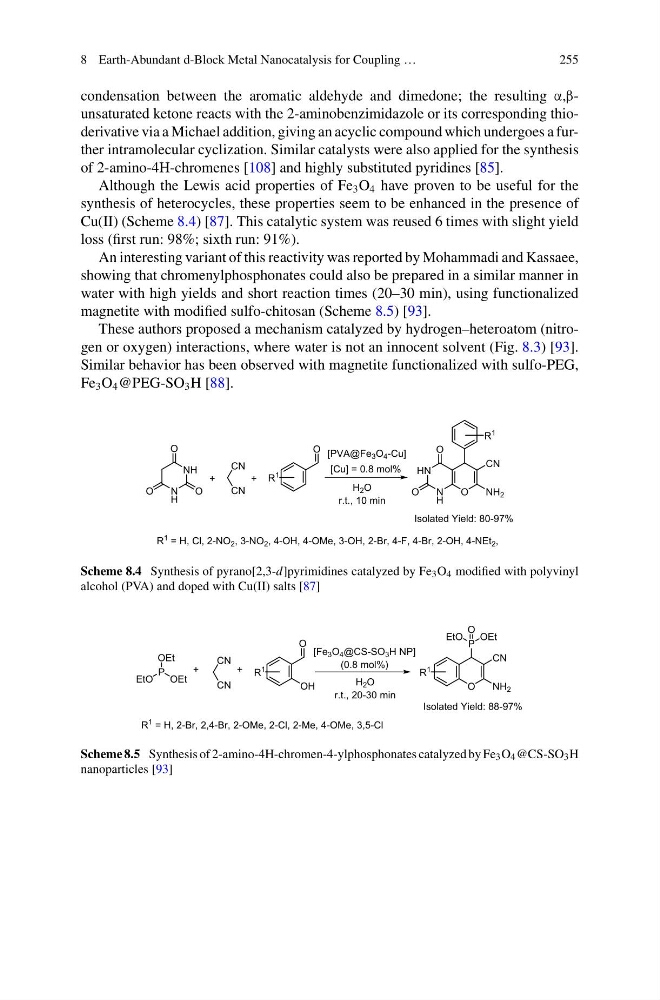
Although the Lewis acid properties of Fe 3 O 4 have proven to be useful for the
synthesis of heterocycles, these properties seem to be enhanced in the presence of
Cu(II) (Scheme 8.4) [87]. This catalytic system was reused 6 times with slight yield
loss (first run: 98%; sixth run: 91%).
An interesting variant of this reactivity was reported by Mohammadi and Kassaee,
showing that chromenylphosphonates could also be prepared in a similar manner in
water with high yields and short reaction times (20–30 min), using functionalized
magnetite with modified sulfo-chitosan (Scheme 8.5) [93].
These authors proposed a mechanism catalyzed by hydrogen–heteroatom (nitrogen or oxygen) interactions, where water is not an innocent solvent (Fig. 8.3) [93].
Similar behavior has been observed with magnetite functionalized with sulfo-PEG,
Fe 3 O 4 @PEG-SO 3 H [88].
N
H
NH
O
O
O
CN
CN
O
HN
N
H
O
CN
NH 2
O
O
R
1
R
1
+
+
[PVA@Fe 3 O 4 -Cu]
H 2 O
r.t., 10 min
[Cu] = 0.8 mol%
Isolated Yield: 80-97%
R
1 = H, Cl, 2-NO 2 , 3-NO 2 , 4-OH, 4-OMe, 3-OH, 2-Br, 4-F, 4-Br, 2-OH, 4-NEt 2 ,
Scheme 8.4 Synthesis of pyrano[2,3-d]pyrimidines catalyzed by Fe 3 O 4 modified with polyvinyl
alcohol (PVA) and doped with Cu(II) salts [87]
CN
CN
O
O
P
CN
NH 2
R
1
+
+
[Fe 3 O 4 @CS-SO 3 H NP]
(0.8 mol%)
H 2 O
r.t., 20-30 min
EtO
P OEt
OEt
EtO
OEt
O
OH
Isolated Yield: 88-97%
R
1
R
1 = H, 2-Br, 2,4-Br, 2-OMe, 2-Cl, 2-Me, 4-OMe, 3,5-Cl
Scheme 8.5 Synthesis of 2-amino-4H-chromen-4-ylphosphonates catalyzed by Fe 3 O 4 @CS-SO 3 H
nanoparticles [93]
255
condensation between the aromatic aldehyde and dimedone; the resulting α,βunsaturated ketone reacts with the 2-aminobenzimidazole or its corresponding thioderivative via a Michael addition, giving an acyclic compound which undergoes a further intramolecular cyclization. Similar catalysts were also applied for the synthesis
of 2-amino-4H-chromenes [108] and highly substituted pyridines [85].
Although the Lewis acid properties of Fe 3 O 4 have proven to be useful for the
synthesis of heterocycles, these properties seem to be enhanced in the presence of
Cu(II) (Scheme 8.4) [87]. This catalytic system was reused 6 times with slight yield
loss (first run: 98%; sixth run: 91%).
An interesting variant of this reactivity was reported by Mohammadi and Kassaee,
showing that chromenylphosphonates could also be prepared in a similar manner in
water with high yields and short reaction times (20–30 min), using functionalized
magnetite with modified sulfo-chitosan (Scheme 8.5) [93].
These authors proposed a mechanism catalyzed by hydrogen–heteroatom (nitrogen or oxygen) interactions, where water is not an innocent solvent (Fig. 8.3) [93].
Similar behavior has been observed with magnetite functionalized with sulfo-PEG,
Fe 3 O 4 @PEG-SO 3 H [88].
N
H
NH
O
O
O
CN
CN
O
HN
N
H
O
CN
NH 2
O
O
R
1
R
1
+
+
[PVA@Fe 3 O 4 -Cu]
H 2 O
r.t., 10 min
[Cu] = 0.8 mol%
Isolated Yield: 80-97%
R
1 = H, Cl, 2-NO 2 , 3-NO 2 , 4-OH, 4-OMe, 3-OH, 2-Br, 4-F, 4-Br, 2-OH, 4-NEt 2 ,
Scheme 8.4 Synthesis of pyrano[2,3-d]pyrimidines catalyzed by Fe 3 O 4 modified with polyvinyl
alcohol (PVA) and doped with Cu(II) salts [87]
CN
CN
O
O
P
CN
NH 2
R
1
+
+
[Fe 3 O 4 @CS-SO 3 H NP]
(0.8 mol%)
H 2 O
r.t., 20-30 min
EtO
P OEt
OEt
EtO
OEt
O
OH
Isolated Yield: 88-97%
R
1
R
1 = H, 2-Br, 2,4-Br, 2-OMe, 2-Cl, 2-Me, 4-OMe, 3,5-Cl
Scheme 8.5 Synthesis of 2-amino-4H-chromen-4-ylphosphonates catalyzed by Fe 3 O 4 @CS-SO 3 H
nanoparticles [93]