

242
A. Dhakshinamoorthy and H. Garcia
CH 2 OH
CHO
COOMe
Pd/O 2
Base
MeOH/Pd/O 2
acid/base
Catalyst
Conversion (%)
Yield (%)
C 6 H 5 CHO
C 6 H 5 COOMe
Pd/MOF-808a
Pd/MOF-808a-2
nd use
Pd/MOF-808a-3
rd use
Pd/MIL-101
Pd/UiO-66
>99
98.6
96.1
89
95
23
75
22.9
76
21.5
75.2
33
50
77
18
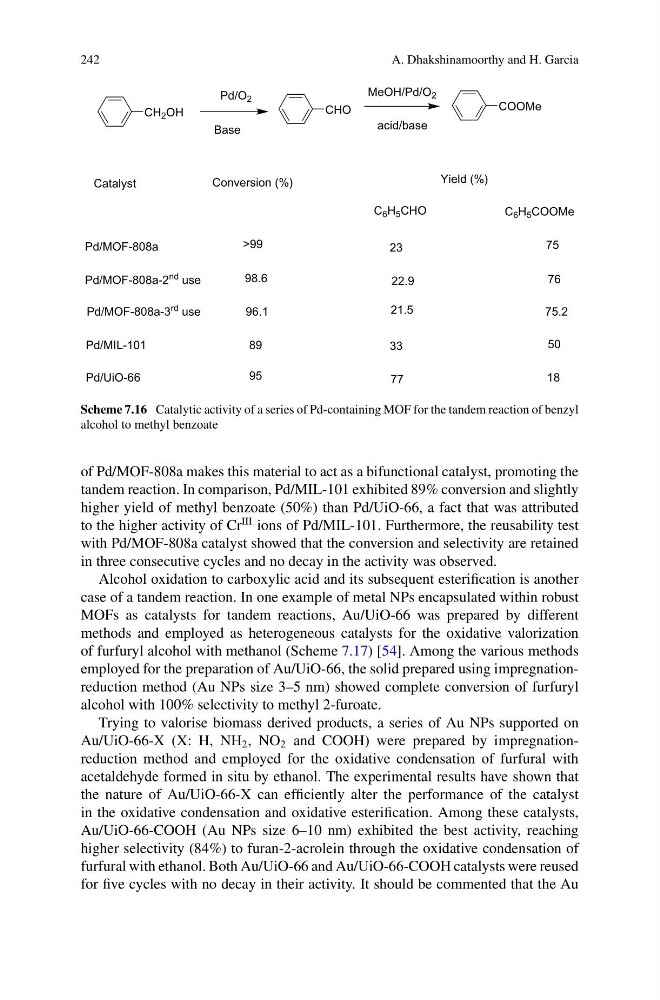
Scheme 7.16 Catalytic activity of a series of Pd-containing MOF for the tandem reaction of benzyl
alcohol to methyl benzoate
of Pd/MOF-808a makes this material to act as a bifunctional catalyst, promoting the
tandem reaction. In comparison, Pd/MIL-101 exhibited 89% conversion and slightly
higher yield of methyl benzoate (50%) than Pd/UiO-66, a fact that was attributed
to the higher activity of Cr
III ions of Pd/MIL-101. Furthermore, the reusability test
with Pd/MOF-808a catalyst showed that the conversion and selectivity are retained
in three consecutive cycles and no decay in the activity was observed.
Alcohol oxidation to carboxylic acid and its subsequent esterification is another
case of a tandem reaction. In one example of metal NPs encapsulated within robust
MOFs as catalysts for tandem reactions, Au/UiO-66 was prepared by different
methods and employed as heterogeneous catalysts for the oxidative valorization
of furfuryl alcohol with methanol (Scheme 7.17) [54]. Among the various methods
employed for the preparation of Au/UiO-66, the solid prepared using impregnationreduction method (Au NPs size 3–5 nm) showed complete conversion of furfuryl
alcohol with 100% selectivity to methyl 2-furoate.
Trying to valorise biomass derived products, a series of Au NPs supported on
Au/UiO-66-X (X: H, NH 2 , NO 2 and COOH) were prepared by impregnationreduction method and employed for the oxidative condensation of furfural with
acetaldehyde formed in situ by ethanol. The experimental results have shown that
the nature of Au/UiO-66-X can efficiently alter the performance of the catalyst
in the oxidative condensation and oxidative esterification. Among these catalysts,
Au/UiO-66-COOH (Au NPs size 6–10 nm) exhibited the best activity, reaching
higher selectivity (84%) to furan-2-acrolein through the oxidative condensation of
furfural with ethanol. Both Au/UiO-66 and Au/UiO-66-COOH catalysts were reused
for five cycles with no decay in their activity. It should be commented that the Au
A. Dhakshinamoorthy and H. Garcia
CH 2 OH
CHO
COOMe
Pd/O 2
Base
MeOH/Pd/O 2
acid/base
Catalyst
Conversion (%)
Yield (%)
C 6 H 5 CHO
C 6 H 5 COOMe
Pd/MOF-808a
Pd/MOF-808a-2
nd use
Pd/MOF-808a-3
rd use
Pd/MIL-101
Pd/UiO-66
>99
98.6
96.1
89
95
23
75
22.9
76
21.5
75.2
33
50
77
18
Scheme 7.16 Catalytic activity of a series of Pd-containing MOF for the tandem reaction of benzyl
alcohol to methyl benzoate
of Pd/MOF-808a makes this material to act as a bifunctional catalyst, promoting the
tandem reaction. In comparison, Pd/MIL-101 exhibited 89% conversion and slightly
higher yield of methyl benzoate (50%) than Pd/UiO-66, a fact that was attributed
to the higher activity of Cr
III ions of Pd/MIL-101. Furthermore, the reusability test
with Pd/MOF-808a catalyst showed that the conversion and selectivity are retained
in three consecutive cycles and no decay in the activity was observed.
Alcohol oxidation to carboxylic acid and its subsequent esterification is another
case of a tandem reaction. In one example of metal NPs encapsulated within robust
MOFs as catalysts for tandem reactions, Au/UiO-66 was prepared by different
methods and employed as heterogeneous catalysts for the oxidative valorization
of furfuryl alcohol with methanol (Scheme 7.17) [54]. Among the various methods
employed for the preparation of Au/UiO-66, the solid prepared using impregnationreduction method (Au NPs size 3–5 nm) showed complete conversion of furfuryl
alcohol with 100% selectivity to methyl 2-furoate.
Trying to valorise biomass derived products, a series of Au NPs supported on
Au/UiO-66-X (X: H, NH 2 , NO 2 and COOH) were prepared by impregnationreduction method and employed for the oxidative condensation of furfural with
acetaldehyde formed in situ by ethanol. The experimental results have shown that
the nature of Au/UiO-66-X can efficiently alter the performance of the catalyst
in the oxidative condensation and oxidative esterification. Among these catalysts,
Au/UiO-66-COOH (Au NPs size 6–10 nm) exhibited the best activity, reaching
higher selectivity (84%) to furan-2-acrolein through the oxidative condensation of
furfural with ethanol. Both Au/UiO-66 and Au/UiO-66-COOH catalysts were reused
for five cycles with no decay in their activity. It should be commented that the Au