

7 Catalysis by Metal Nanoparticles Encapsulated …
243
O
O
Au/UiO-66
Au/UiO-66-COOH
MeOH, O 2
O
O
O
O
CHO
EtOH, O 2
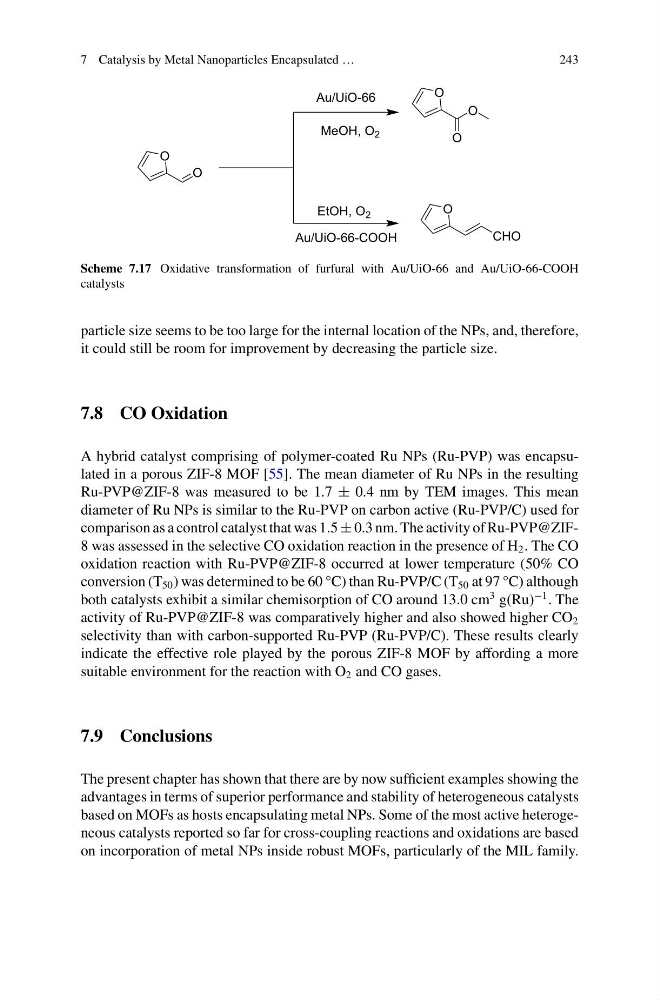
Scheme 7.17 Oxidative transformation of furfural with Au/UiO-66 and Au/UiO-66-COOH
catalysts
particle size seems to be too large for the internal location of the NPs, and, therefore,
it could still be room for improvement by decreasing the particle size.
7.8 CO Oxidation
A hybrid catalyst comprising of polymer-coated Ru NPs (Ru-PVP) was encapsulated in a porous ZIF-8 MOF [55]. The mean diameter of Ru NPs in the resulting
Ru-PVP@ZIF-8 was measured to be 1.7 ± 0.4 nm by TEM images. This mean
diameter of Ru NPs is similar to the Ru-PVP on carbon active (Ru-PVP/C) used for
comparison as a control catalyst that was 1.5 ± 0.3 nm. The activity of Ru-PVP@ZIF8 was assessed in the selective CO oxidation reaction in the presence of H 2 . The CO
oxidation reaction with Ru-PVP@ZIF-8 occurred at lower temperature (50% CO
conversion (T 50 ) was determined to be 60 °C) than Ru-PVP/C (T 50 at 97 °C) although
both catalysts exhibit a similar chemisorption of CO around 13.0 cm
3 g(Ru)
−1 . The
activity of Ru-PVP@ZIF-8 was comparatively higher and also showed higher CO 2
selectivity than with carbon-supported Ru-PVP (Ru-PVP/C). These results clearly
indicate the effective role played by the porous ZIF-8 MOF by affording a more
suitable environment for the reaction with O 2 and CO gases.
7.9 Conclusions
The present chapter has shown that there are by now sufficient examples showing the
advantages in terms of superior performance and stability of heterogeneous catalysts
based on MOFs as hosts encapsulating metal NPs. Some of the most active heterogeneous catalysts reported so far for cross-coupling reactions and oxidations are based
on incorporation of metal NPs inside robust MOFs, particularly of the MIL family.
243
O
O
Au/UiO-66
Au/UiO-66-COOH
MeOH, O 2
O
O
O
O
CHO
EtOH, O 2
Scheme 7.17 Oxidative transformation of furfural with Au/UiO-66 and Au/UiO-66-COOH
catalysts
particle size seems to be too large for the internal location of the NPs, and, therefore,
it could still be room for improvement by decreasing the particle size.
7.8 CO Oxidation
A hybrid catalyst comprising of polymer-coated Ru NPs (Ru-PVP) was encapsulated in a porous ZIF-8 MOF [55]. The mean diameter of Ru NPs in the resulting
Ru-PVP@ZIF-8 was measured to be 1.7 ± 0.4 nm by TEM images. This mean
diameter of Ru NPs is similar to the Ru-PVP on carbon active (Ru-PVP/C) used for
comparison as a control catalyst that was 1.5 ± 0.3 nm. The activity of Ru-PVP@ZIF8 was assessed in the selective CO oxidation reaction in the presence of H 2 . The CO
oxidation reaction with Ru-PVP@ZIF-8 occurred at lower temperature (50% CO
conversion (T 50 ) was determined to be 60 °C) than Ru-PVP/C (T 50 at 97 °C) although
both catalysts exhibit a similar chemisorption of CO around 13.0 cm
3 g(Ru)
−1 . The
activity of Ru-PVP@ZIF-8 was comparatively higher and also showed higher CO 2
selectivity than with carbon-supported Ru-PVP (Ru-PVP/C). These results clearly
indicate the effective role played by the porous ZIF-8 MOF by affording a more
suitable environment for the reaction with O 2 and CO gases.
7.9 Conclusions
The present chapter has shown that there are by now sufficient examples showing the
advantages in terms of superior performance and stability of heterogeneous catalysts
based on MOFs as hosts encapsulating metal NPs. Some of the most active heterogeneous catalysts reported so far for cross-coupling reactions and oxidations are based
on incorporation of metal NPs inside robust MOFs, particularly of the MIL family.