

7 Catalysis by Metal Nanoparticles Encapsulated …
241
HKUST-1@Fe 3 O 4
TBHP
O
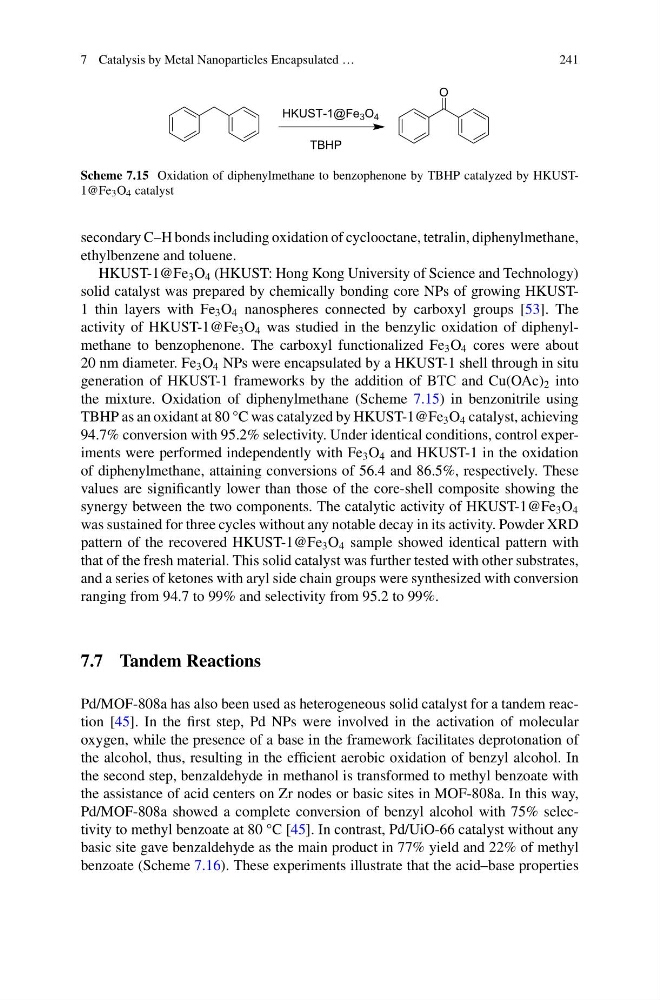
Scheme 7.15 Oxidation of diphenylmethane to benzophenone by TBHP catalyzed by HKUST1@Fe 3 O 4 catalyst
secondary C–H bonds including oxidation of cyclooctane, tetralin, diphenylmethane,
ethylbenzene and toluene.
HKUST-1@Fe 3 O 4 (HKUST: Hong Kong University of Science and Technology)
solid catalyst was prepared by chemically bonding core NPs of growing HKUST1 thin layers with Fe 3 O 4 nanospheres connected by carboxyl groups [53]. The
activity of HKUST-1@Fe 3 O 4 was studied in the benzylic oxidation of diphenylmethane to benzophenone. The carboxyl functionalized Fe 3 O 4 cores were about
20 nm diameter. Fe 3 O 4 NPs were encapsulated by a HKUST-1 shell through in situ
generation of HKUST-1 frameworks by the addition of BTC and Cu(OAc) 2 into
the mixture. Oxidation of diphenylmethane (Scheme 7.15) in benzonitrile using
TBHP as an oxidant at 80 °C was catalyzed by HKUST-1@Fe 3 O 4 catalyst, achieving
94.7% conversion with 95.2% selectivity. Under identical conditions, control experiments were performed independently with Fe 3 O 4 and HKUST-1 in the oxidation
of diphenylmethane, attaining conversions of 56.4 and 86.5%, respectively. These
values are significantly lower than those of the core-shell composite showing the
synergy between the two components. The catalytic activity of HKUST-1@Fe 3 O 4
was sustained for three cycles without any notable decay in its activity. Powder XRD
pattern of the recovered HKUST-1@Fe 3 O 4 sample showed identical pattern with
that of the fresh material. This solid catalyst was further tested with other substrates,
and a series of ketones with aryl side chain groups were synthesized with conversion
ranging from 94.7 to 99% and selectivity from 95.2 to 99%.
7.7 Tandem Reactions
Pd/MOF-808a has also been used as heterogeneous solid catalyst for a tandem reaction [45]. In the first step, Pd NPs were involved in the activation of molecular
oxygen, while the presence of a base in the framework facilitates deprotonation of
the alcohol, thus, resulting in the efficient aerobic oxidation of benzyl alcohol. In
the second step, benzaldehyde in methanol is transformed to methyl benzoate with
the assistance of acid centers on Zr nodes or basic sites in MOF-808a. In this way,
Pd/MOF-808a showed a complete conversion of benzyl alcohol with 75% selectivity to methyl benzoate at 80 °C [45]. In contrast, Pd/UiO-66 catalyst without any
basic site gave benzaldehyde as the main product in 77% yield and 22% of methyl
benzoate (Scheme 7.16). These experiments illustrate that the acid–base properties
241
HKUST-1@Fe 3 O 4
TBHP
O
Scheme 7.15 Oxidation of diphenylmethane to benzophenone by TBHP catalyzed by HKUST1@Fe 3 O 4 catalyst
secondary C–H bonds including oxidation of cyclooctane, tetralin, diphenylmethane,
ethylbenzene and toluene.
HKUST-1@Fe 3 O 4 (HKUST: Hong Kong University of Science and Technology)
solid catalyst was prepared by chemically bonding core NPs of growing HKUST1 thin layers with Fe 3 O 4 nanospheres connected by carboxyl groups [53]. The
activity of HKUST-1@Fe 3 O 4 was studied in the benzylic oxidation of diphenylmethane to benzophenone. The carboxyl functionalized Fe 3 O 4 cores were about
20 nm diameter. Fe 3 O 4 NPs were encapsulated by a HKUST-1 shell through in situ
generation of HKUST-1 frameworks by the addition of BTC and Cu(OAc) 2 into
the mixture. Oxidation of diphenylmethane (Scheme 7.15) in benzonitrile using
TBHP as an oxidant at 80 °C was catalyzed by HKUST-1@Fe 3 O 4 catalyst, achieving
94.7% conversion with 95.2% selectivity. Under identical conditions, control experiments were performed independently with Fe 3 O 4 and HKUST-1 in the oxidation
of diphenylmethane, attaining conversions of 56.4 and 86.5%, respectively. These
values are significantly lower than those of the core-shell composite showing the
synergy between the two components. The catalytic activity of HKUST-1@Fe 3 O 4
was sustained for three cycles without any notable decay in its activity. Powder XRD
pattern of the recovered HKUST-1@Fe 3 O 4 sample showed identical pattern with
that of the fresh material. This solid catalyst was further tested with other substrates,
and a series of ketones with aryl side chain groups were synthesized with conversion
ranging from 94.7 to 99% and selectivity from 95.2 to 99%.
7.7 Tandem Reactions
Pd/MOF-808a has also been used as heterogeneous solid catalyst for a tandem reaction [45]. In the first step, Pd NPs were involved in the activation of molecular
oxygen, while the presence of a base in the framework facilitates deprotonation of
the alcohol, thus, resulting in the efficient aerobic oxidation of benzyl alcohol. In
the second step, benzaldehyde in methanol is transformed to methyl benzoate with
the assistance of acid centers on Zr nodes or basic sites in MOF-808a. In this way,
Pd/MOF-808a showed a complete conversion of benzyl alcohol with 75% selectivity to methyl benzoate at 80 °C [45]. In contrast, Pd/UiO-66 catalyst without any
basic site gave benzaldehyde as the main product in 77% yield and 22% of methyl
benzoate (Scheme 7.16). These experiments illustrate that the acid–base properties