

7 Catalysis by Metal Nanoparticles Encapsulated …
239
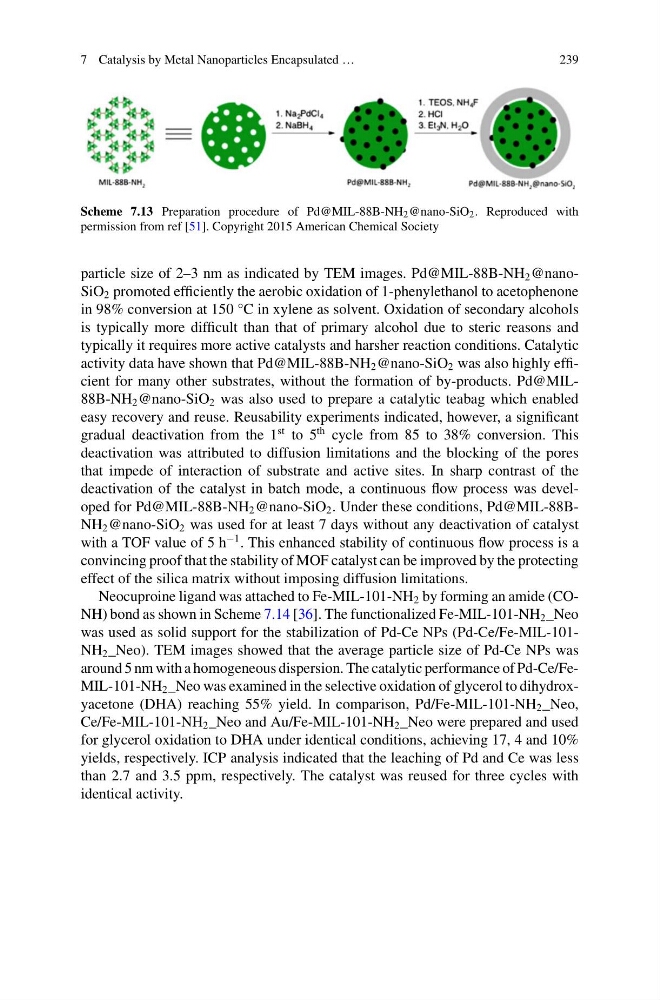
Scheme 7.13 Preparation procedure of Pd@MIL-88B-NH 2 @nano-SiO 2 . Reproduced with
permission from ref [51]. Copyright 2015 American Chemical Society
particle size of 2–3 nm as indicated by TEM images. Pd@MIL-88B-NH 2 @nanoSiO 2 promoted efficiently the aerobic oxidation of 1-phenylethanol to acetophenone
in 98% conversion at 150 °C in xylene as solvent. Oxidation of secondary alcohols
is typically more difficult than that of primary alcohol due to steric reasons and
typically it requires more active catalysts and harsher reaction conditions. Catalytic
activity data have shown that Pd@MIL-88B-NH 2 @nano-SiO 2 was also highly efficient for many other substrates, without the formation of by-products. Pd@MIL88B-NH 2 @nano-SiO 2 was also used to prepare a catalytic teabag which enabled
easy recovery and reuse. Reusability experiments indicated, however, a significant
gradual deactivation from the 1
st to 5
th cycle from 85 to 38% conversion. This
deactivation was attributed to diffusion limitations and the blocking of the pores
that impede of interaction of substrate and active sites. In sharp contrast of the
deactivation of the catalyst in batch mode, a continuous flow process was developed for Pd@MIL-88B-NH 2 @nano-SiO 2 . Under these conditions, Pd@MIL-88BNH 2 @nano-SiO 2 was used for at least 7 days without any deactivation of catalyst
with a TOF value of 5 h
−1 . This enhanced stability of continuous flow process is a
convincing proof that the stability of MOF catalyst can be improved by the protecting
effect of the silica matrix without imposing diffusion limitations.
Neocuproine ligand was attached to Fe-MIL-101-NH 2 by forming an amide (CONH) bond as shown in Scheme 7.14 [36]. The functionalized Fe-MIL-101-NH 2 _Neo
was used as solid support for the stabilization of Pd-Ce NPs (Pd-Ce/Fe-MIL-101NH 2 _Neo). TEM images showed that the average particle size of Pd-Ce NPs was
around 5 nm with a homogeneous dispersion. The catalytic performance of Pd-Ce/FeMIL-101-NH 2 _Neo was examined in the selective oxidation of glycerol to dihydroxyacetone (DHA) reaching 55% yield. In comparison, Pd/Fe-MIL-101-NH 2 _Neo,
Ce/Fe-MIL-101-NH 2 _Neo and Au/Fe-MIL-101-NH 2 _Neo were prepared and used
for glycerol oxidation to DHA under identical conditions, achieving 17, 4 and 10%
yields, respectively. ICP analysis indicated that the leaching of Pd and Ce was less
than 2.7 and 3.5 ppm, respectively. The catalyst was reused for three cycles with
identical activity.
239
Scheme 7.13 Preparation procedure of Pd@MIL-88B-NH 2 @nano-SiO 2 . Reproduced with
permission from ref [51]. Copyright 2015 American Chemical Society
particle size of 2–3 nm as indicated by TEM images. Pd@MIL-88B-NH 2 @nanoSiO 2 promoted efficiently the aerobic oxidation of 1-phenylethanol to acetophenone
in 98% conversion at 150 °C in xylene as solvent. Oxidation of secondary alcohols
is typically more difficult than that of primary alcohol due to steric reasons and
typically it requires more active catalysts and harsher reaction conditions. Catalytic
activity data have shown that Pd@MIL-88B-NH 2 @nano-SiO 2 was also highly efficient for many other substrates, without the formation of by-products. Pd@MIL88B-NH 2 @nano-SiO 2 was also used to prepare a catalytic teabag which enabled
easy recovery and reuse. Reusability experiments indicated, however, a significant
gradual deactivation from the 1
st to 5
th cycle from 85 to 38% conversion. This
deactivation was attributed to diffusion limitations and the blocking of the pores
that impede of interaction of substrate and active sites. In sharp contrast of the
deactivation of the catalyst in batch mode, a continuous flow process was developed for Pd@MIL-88B-NH 2 @nano-SiO 2 . Under these conditions, Pd@MIL-88BNH 2 @nano-SiO 2 was used for at least 7 days without any deactivation of catalyst
with a TOF value of 5 h
−1 . This enhanced stability of continuous flow process is a
convincing proof that the stability of MOF catalyst can be improved by the protecting
effect of the silica matrix without imposing diffusion limitations.
Neocuproine ligand was attached to Fe-MIL-101-NH 2 by forming an amide (CONH) bond as shown in Scheme 7.14 [36]. The functionalized Fe-MIL-101-NH 2 _Neo
was used as solid support for the stabilization of Pd-Ce NPs (Pd-Ce/Fe-MIL-101NH 2 _Neo). TEM images showed that the average particle size of Pd-Ce NPs was
around 5 nm with a homogeneous dispersion. The catalytic performance of Pd-Ce/FeMIL-101-NH 2 _Neo was examined in the selective oxidation of glycerol to dihydroxyacetone (DHA) reaching 55% yield. In comparison, Pd/Fe-MIL-101-NH 2 _Neo,
Ce/Fe-MIL-101-NH 2 _Neo and Au/Fe-MIL-101-NH 2 _Neo were prepared and used
for glycerol oxidation to DHA under identical conditions, achieving 17, 4 and 10%
yields, respectively. ICP analysis indicated that the leaching of Pd and Ce was less
than 2.7 and 3.5 ppm, respectively. The catalyst was reused for three cycles with
identical activity.