

238
A. Dhakshinamoorthy and H. Garcia
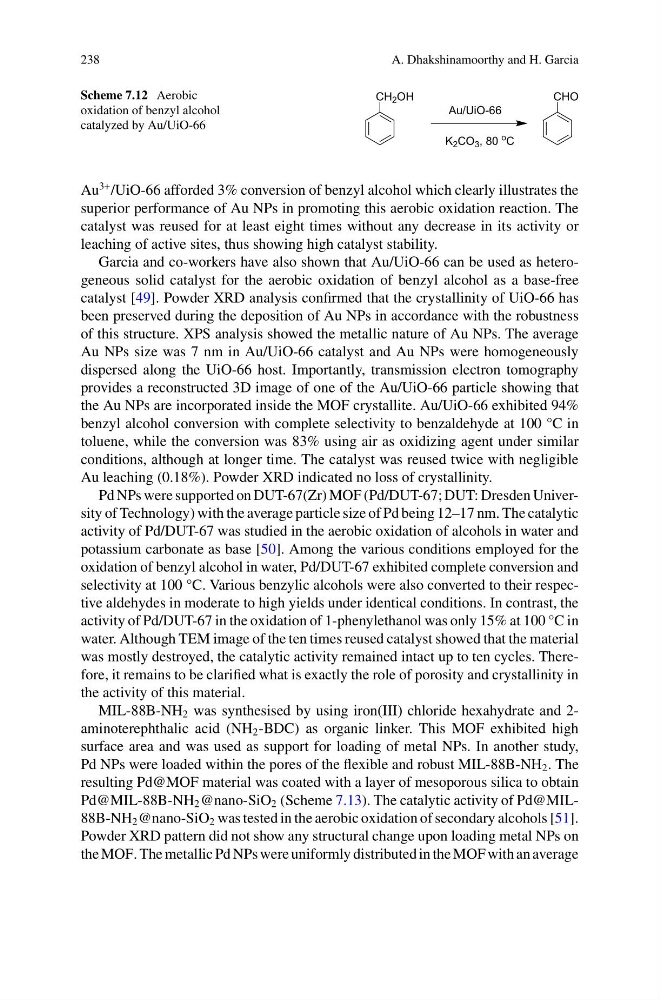
Scheme 7.12 Aerobic
oxidation of benzyl alcohol
catalyzed by Au/UiO-66
CH 2 OH
Au/UiO-66
K 2 CO 3 , 80
o C
CHO
Au
3+ /UiO-66 afforded 3% conversion of benzyl alcohol which clearly illustrates the
superior performance of Au NPs in promoting this aerobic oxidation reaction. The
catalyst was reused for at least eight times without any decrease in its activity or
leaching of active sites, thus showing high catalyst stability.
Garcia and co-workers have also shown that Au/UiO-66 can be used as heterogeneous solid catalyst for the aerobic oxidation of benzyl alcohol as a base-free
catalyst [49]. Powder XRD analysis confirmed that the crystallinity of UiO-66 has
been preserved during the deposition of Au NPs in accordance with the robustness
of this structure. XPS analysis showed the metallic nature of Au NPs. The average
Au NPs size was 7 nm in Au/UiO-66 catalyst and Au NPs were homogeneously
dispersed along the UiO-66 host. Importantly, transmission electron tomography
provides a reconstructed 3D image of one of the Au/UiO-66 particle showing that
the Au NPs are incorporated inside the MOF crystallite. Au/UiO-66 exhibited 94%
benzyl alcohol conversion with complete selectivity to benzaldehyde at 100 °C in
toluene, while the conversion was 83% using air as oxidizing agent under similar
conditions, although at longer time. The catalyst was reused twice with negligible
Au leaching (0.18%). Powder XRD indicated no loss of crystallinity.
Pd NPs were supported on DUT-67(Zr) MOF (Pd/DUT-67; DUT: Dresden University of Technology) with the average particle size of Pd being 12–17 nm. The catalytic
activity of Pd/DUT-67 was studied in the aerobic oxidation of alcohols in water and
potassium carbonate as base [50]. Among the various conditions employed for the
oxidation of benzyl alcohol in water, Pd/DUT-67 exhibited complete conversion and
selectivity at 100 °C. Various benzylic alcohols were also converted to their respective aldehydes in moderate to high yields under identical conditions. In contrast, the
activity of Pd/DUT-67 in the oxidation of 1-phenylethanol was only 15% at 100 °C in
water. Although TEM image of the ten times reused catalyst showed that the material
was mostly destroyed, the catalytic activity remained intact up to ten cycles. Therefore, it remains to be clarified what is exactly the role of porosity and crystallinity in
the activity of this material.
MIL-88B-NH 2 was synthesised by using iron(III) chloride hexahydrate and 2aminoterephthalic acid (NH 2 -BDC) as organic linker. This MOF exhibited high
surface area and was used as support for loading of metal NPs. In another study,
Pd NPs were loaded within the pores of the flexible and robust MIL-88B-NH 2 . The
resulting Pd@MOF material was coated with a layer of mesoporous silica to obtain
Pd@MIL-88B-NH 2 @nano-SiO 2 (Scheme 7.13). The catalytic activity of Pd@MIL88B-NH 2 @nano-SiO 2 was tested in the aerobic oxidation of secondary alcohols [51].
Powder XRD pattern did not show any structural change upon loading metal NPs on
the MOF. The metallic Pd NPs were uniformly distributed in the MOF with an average
A. Dhakshinamoorthy and H. Garcia
Scheme 7.12 Aerobic
oxidation of benzyl alcohol
catalyzed by Au/UiO-66
CH 2 OH
Au/UiO-66
K 2 CO 3 , 80
o C
CHO
Au
3+ /UiO-66 afforded 3% conversion of benzyl alcohol which clearly illustrates the
superior performance of Au NPs in promoting this aerobic oxidation reaction. The
catalyst was reused for at least eight times without any decrease in its activity or
leaching of active sites, thus showing high catalyst stability.
Garcia and co-workers have also shown that Au/UiO-66 can be used as heterogeneous solid catalyst for the aerobic oxidation of benzyl alcohol as a base-free
catalyst [49]. Powder XRD analysis confirmed that the crystallinity of UiO-66 has
been preserved during the deposition of Au NPs in accordance with the robustness
of this structure. XPS analysis showed the metallic nature of Au NPs. The average
Au NPs size was 7 nm in Au/UiO-66 catalyst and Au NPs were homogeneously
dispersed along the UiO-66 host. Importantly, transmission electron tomography
provides a reconstructed 3D image of one of the Au/UiO-66 particle showing that
the Au NPs are incorporated inside the MOF crystallite. Au/UiO-66 exhibited 94%
benzyl alcohol conversion with complete selectivity to benzaldehyde at 100 °C in
toluene, while the conversion was 83% using air as oxidizing agent under similar
conditions, although at longer time. The catalyst was reused twice with negligible
Au leaching (0.18%). Powder XRD indicated no loss of crystallinity.
Pd NPs were supported on DUT-67(Zr) MOF (Pd/DUT-67; DUT: Dresden University of Technology) with the average particle size of Pd being 12–17 nm. The catalytic
activity of Pd/DUT-67 was studied in the aerobic oxidation of alcohols in water and
potassium carbonate as base [50]. Among the various conditions employed for the
oxidation of benzyl alcohol in water, Pd/DUT-67 exhibited complete conversion and
selectivity at 100 °C. Various benzylic alcohols were also converted to their respective aldehydes in moderate to high yields under identical conditions. In contrast, the
activity of Pd/DUT-67 in the oxidation of 1-phenylethanol was only 15% at 100 °C in
water. Although TEM image of the ten times reused catalyst showed that the material
was mostly destroyed, the catalytic activity remained intact up to ten cycles. Therefore, it remains to be clarified what is exactly the role of porosity and crystallinity in
the activity of this material.
MIL-88B-NH 2 was synthesised by using iron(III) chloride hexahydrate and 2aminoterephthalic acid (NH 2 -BDC) as organic linker. This MOF exhibited high
surface area and was used as support for loading of metal NPs. In another study,
Pd NPs were loaded within the pores of the flexible and robust MIL-88B-NH 2 . The
resulting Pd@MOF material was coated with a layer of mesoporous silica to obtain
Pd@MIL-88B-NH 2 @nano-SiO 2 (Scheme 7.13). The catalytic activity of Pd@MIL88B-NH 2 @nano-SiO 2 was tested in the aerobic oxidation of secondary alcohols [51].
Powder XRD pattern did not show any structural change upon loading metal NPs on
the MOF. The metallic Pd NPs were uniformly distributed in the MOF with an average