

7 Catalysis by Metal Nanoparticles Encapsulated …
237
for aerobic oxidations. In particular, Au NPs/MOF can catalyze the aerobic alcohol
oxidation.
In one of the seminal works, Au NPs were deposited by a colloidal method with
polyvinylpyrrolidone (PVP) as protecting agent on the pores of MIL-101(Cr) to
obtain Au/MIL-101(Cr) and its catalytic performance was assessed in the aerobic
oxidation of alcohols [32]. Characterization data indicated that Au NPs are uniformly
distributed over MIL-101 with the mean diameter of Au NPs of 2.3 ± 1.1 nm.
Powder XRD indicated that the crystallinity of the MOF has been preserved during
the loading of Au NPs in agreement with the robust nature of MIL-101(Cr). The
aerobic oxidation of benzyl alcohol using Au/MIL-101(Cr) as solid catalyst at 80 °C
under base-free conditions afforded 99% conversion with quantitative selectivity
to benzaldehyde in toluene. Under base-free condition, Au/MOF-5 catalyst gave
31% yield of benzaldehyde at about 69% conversion in the oxidation of benzyl
alcohol. This superior activity of Au/MIL-101 was due to the high dispersion of
Au NPs and to the nature of support. Reusability experiments were performed with
4-methoxybenzyl alcohol and the conversion was steadily of 99% after six cycles.
TEM images of the reused catalyst showed identical particle size of Au NPs than
the fresh material, thus proving the ability of MIL-101 to preserve Au NPs without
agglomeration. Hot filtration experiment confirmed the heterogeneity of the process.
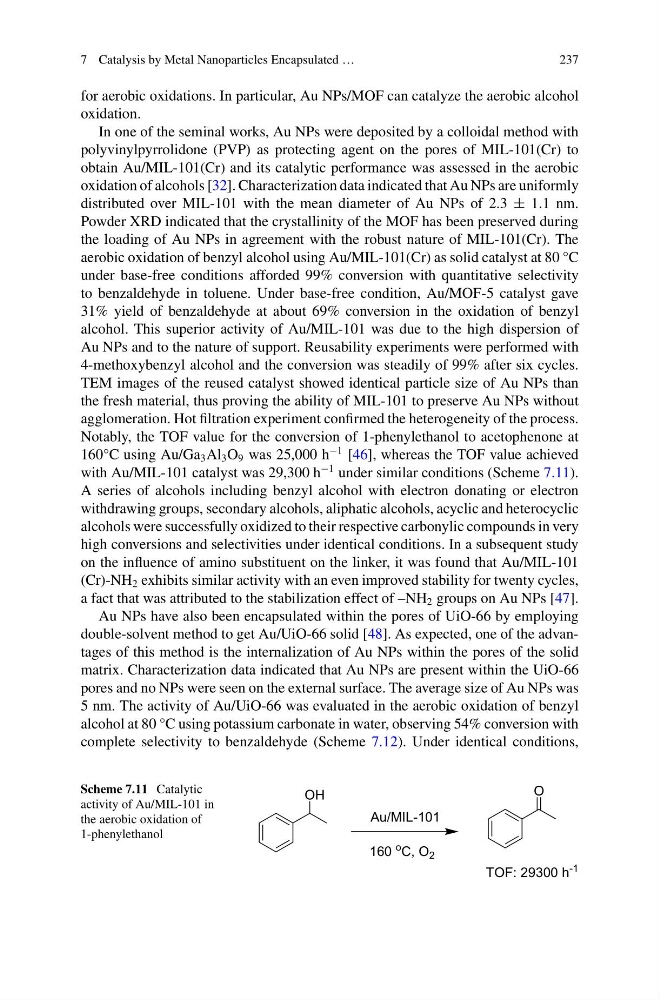
Notably, the TOF value for the conversion of 1-phenylethanol to acetophenone at
160°C using Au/Ga 3 Al 3 O 9 was 25,000 h
−1 [46], whereas the TOF value achieved
with Au/MIL-101 catalyst was 29,300 h
−1 under similar conditions (Scheme 7.11).
A series of alcohols including benzyl alcohol with electron donating or electron
withdrawing groups, secondary alcohols, aliphatic alcohols, acyclic and heterocyclic
alcohols were successfully oxidized to their respective carbonylic compounds in very
high conversions and selectivities under identical conditions. In a subsequent study
on the influence of amino substituent on the linker, it was found that Au/MIL-101
(Cr)-NH 2 exhibits similar activity with an even improved stability for twenty cycles,
a fact that was attributed to the stabilization effect of –NH 2 groups on Au NPs [47].
Au NPs have also been encapsulated within the pores of UiO-66 by employing
double-solvent method to get Au/UiO-66 solid [48]. As expected, one of the advantages of this method is the internalization of Au NPs within the pores of the solid
matrix. Characterization data indicated that Au NPs are present within the UiO-66
pores and no NPs were seen on the external surface. The average size of Au NPs was
5 nm. The activity of Au/UiO-66 was evaluated in the aerobic oxidation of benzyl
alcohol at 80 °C using potassium carbonate in water, observing 54% conversion with
complete selectivity to benzaldehyde (Scheme 7.12). Under identical conditions,
Scheme 7.11 Catalytic
activity of Au/MIL-101 in
the aerobic oxidation of
1-phenylethanol
OH
Au/MIL-101
160
o C, O 2
O
TOF: 29300 h
-1
237
for aerobic oxidations. In particular, Au NPs/MOF can catalyze the aerobic alcohol
oxidation.
In one of the seminal works, Au NPs were deposited by a colloidal method with
polyvinylpyrrolidone (PVP) as protecting agent on the pores of MIL-101(Cr) to
obtain Au/MIL-101(Cr) and its catalytic performance was assessed in the aerobic
oxidation of alcohols [32]. Characterization data indicated that Au NPs are uniformly
distributed over MIL-101 with the mean diameter of Au NPs of 2.3 ± 1.1 nm.
Powder XRD indicated that the crystallinity of the MOF has been preserved during
the loading of Au NPs in agreement with the robust nature of MIL-101(Cr). The
aerobic oxidation of benzyl alcohol using Au/MIL-101(Cr) as solid catalyst at 80 °C
under base-free conditions afforded 99% conversion with quantitative selectivity
to benzaldehyde in toluene. Under base-free condition, Au/MOF-5 catalyst gave
31% yield of benzaldehyde at about 69% conversion in the oxidation of benzyl
alcohol. This superior activity of Au/MIL-101 was due to the high dispersion of
Au NPs and to the nature of support. Reusability experiments were performed with
4-methoxybenzyl alcohol and the conversion was steadily of 99% after six cycles.
TEM images of the reused catalyst showed identical particle size of Au NPs than
the fresh material, thus proving the ability of MIL-101 to preserve Au NPs without
agglomeration. Hot filtration experiment confirmed the heterogeneity of the process.
Notably, the TOF value for the conversion of 1-phenylethanol to acetophenone at
160°C using Au/Ga 3 Al 3 O 9 was 25,000 h
−1 [46], whereas the TOF value achieved
with Au/MIL-101 catalyst was 29,300 h
−1 under similar conditions (Scheme 7.11).
A series of alcohols including benzyl alcohol with electron donating or electron
withdrawing groups, secondary alcohols, aliphatic alcohols, acyclic and heterocyclic
alcohols were successfully oxidized to their respective carbonylic compounds in very
high conversions and selectivities under identical conditions. In a subsequent study
on the influence of amino substituent on the linker, it was found that Au/MIL-101
(Cr)-NH 2 exhibits similar activity with an even improved stability for twenty cycles,
a fact that was attributed to the stabilization effect of –NH 2 groups on Au NPs [47].
Au NPs have also been encapsulated within the pores of UiO-66 by employing
double-solvent method to get Au/UiO-66 solid [48]. As expected, one of the advantages of this method is the internalization of Au NPs within the pores of the solid
matrix. Characterization data indicated that Au NPs are present within the UiO-66
pores and no NPs were seen on the external surface. The average size of Au NPs was
5 nm. The activity of Au/UiO-66 was evaluated in the aerobic oxidation of benzyl
alcohol at 80 °C using potassium carbonate in water, observing 54% conversion with
complete selectivity to benzaldehyde (Scheme 7.12). Under identical conditions,
Scheme 7.11 Catalytic
activity of Au/MIL-101 in
the aerobic oxidation of
1-phenylethanol
OH
Au/MIL-101
160
o C, O 2
O
TOF: 29300 h
-1