

226
A. Dhakshinamoorthy and H. Garcia
reversed by lowering the temperature under appropriate conditions. UiO-66(Zr) is
also chemically stable in many solvents and reagents. The large cavities of dimensions
about 10 nm allow the inclusion of guest, particularly metal NPs.
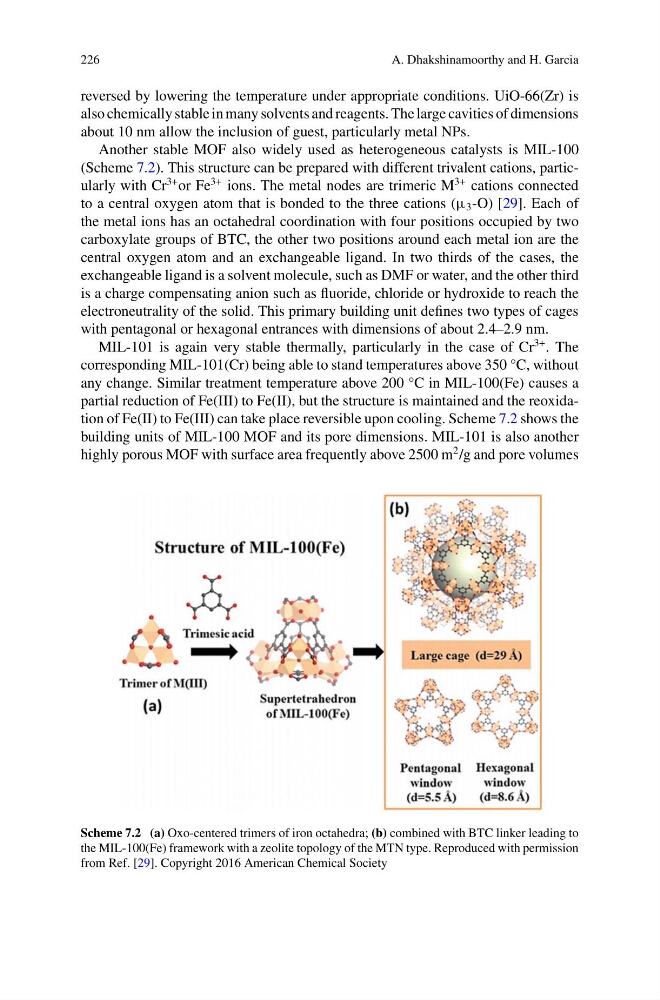
Another stable MOF also widely used as heterogeneous catalysts is MIL-100
(Scheme 7.2). This structure can be prepared with different trivalent cations, particularly with Cr
3+ or Fe
3+ ions. The metal nodes are trimeric M
3+ cations connected
to a central oxygen atom that is bonded to the three cations (µ 3 -O) [29]. Each of
the metal ions has an octahedral coordination with four positions occupied by two
carboxylate groups of BTC, the other two positions around each metal ion are the
central oxygen atom and an exchangeable ligand. In two thirds of the cases, the
exchangeable ligand is a solvent molecule, such as DMF or water, and the other third
is a charge compensating anion such as fluoride, chloride or hydroxide to reach the
electroneutrality of the solid. This primary building unit defines two types of cages
with pentagonal or hexagonal entrances with dimensions of about 2.4–2.9 nm.
MIL-101 is again very stable thermally, particularly in the case of Cr
3+ . The
corresponding MIL-101(Cr) being able to stand temperatures above 350 °C, without
any change. Similar treatment temperature above 200 °C in MIL-100(Fe) causes a
partial reduction of Fe(III) to Fe(II), but the structure is maintained and the reoxidation of Fe(II) to Fe(III) can take place reversible upon cooling. Scheme 7.2 shows the
building units of MIL-100 MOF and its pore dimensions. MIL-101 is also another
highly porous MOF with surface area frequently above 2500 m
2 /g and pore volumes
Scheme 7.2 (a) Oxo-centered trimers of iron octahedra; (b) combined with BTC linker leading to
the MIL-100(Fe) framework with a zeolite topology of the MTN type. Reproduced with permission
from Ref. [29]. Copyright 2016 American Chemical Society
A. Dhakshinamoorthy and H. Garcia
reversed by lowering the temperature under appropriate conditions. UiO-66(Zr) is
also chemically stable in many solvents and reagents. The large cavities of dimensions
about 10 nm allow the inclusion of guest, particularly metal NPs.
Another stable MOF also widely used as heterogeneous catalysts is MIL-100
(Scheme 7.2). This structure can be prepared with different trivalent cations, particularly with Cr
3+ or Fe
3+ ions. The metal nodes are trimeric M
3+ cations connected
to a central oxygen atom that is bonded to the three cations (µ 3 -O) [29]. Each of
the metal ions has an octahedral coordination with four positions occupied by two
carboxylate groups of BTC, the other two positions around each metal ion are the
central oxygen atom and an exchangeable ligand. In two thirds of the cases, the
exchangeable ligand is a solvent molecule, such as DMF or water, and the other third
is a charge compensating anion such as fluoride, chloride or hydroxide to reach the
electroneutrality of the solid. This primary building unit defines two types of cages
with pentagonal or hexagonal entrances with dimensions of about 2.4–2.9 nm.
MIL-101 is again very stable thermally, particularly in the case of Cr
3+ . The
corresponding MIL-101(Cr) being able to stand temperatures above 350 °C, without
any change. Similar treatment temperature above 200 °C in MIL-100(Fe) causes a
partial reduction of Fe(III) to Fe(II), but the structure is maintained and the reoxidation of Fe(II) to Fe(III) can take place reversible upon cooling. Scheme 7.2 shows the
building units of MIL-100 MOF and its pore dimensions. MIL-101 is also another
highly porous MOF with surface area frequently above 2500 m
2 /g and pore volumes
Scheme 7.2 (a) Oxo-centered trimers of iron octahedra; (b) combined with BTC linker leading to
the MIL-100(Fe) framework with a zeolite topology of the MTN type. Reproduced with permission
from Ref. [29]. Copyright 2016 American Chemical Society