

7 Catalysis by Metal Nanoparticles Encapsulated …
225
Although by now there is a large number of MOFs that have been reported, only a
handful of them have been widely employed, particularly in the field of heterogeneous
catalysis [19–21]. Among the main reasons that justify the limited number of MOFs
that have been most frequently preferred in catalysis, the major ones are the easy and
reproducible preparation procedure from available precursors, but most importantly
the chemical and physical stability of the framework. Generally, due to the nature
of the metal–ligand bonds, MOFs are comparatively less robust than other purely
inorganic porous materials, such as zeolites or porous aluminosilicates. In this way,
particularly MOFs with divalent cations, such as Zn
2+ and Cu
2+ , are in general
not very stable either thermally or in the presence of solvents or reagents. Thus,
for instance, MOF-5 that is a zinc-terephthalate MOF becomes transformed into
other materials, such as MOF-5
of undefined structure upon storage [22]. Similarly,
Cu 3 (BTC) 2 (BTC: 1,3,5-benzenetricarboxylate) cannot stand certain solvents and
reagents such as amines or thiols [23]. For these reasons, there is a general believe
that MOFs are not very stable porous materials, but there are certain MOF structure
that exhibit a remarkable chemical and thermal stability that can be maintained
unaltered during liquid-phase reactions.
Thus, in contrast to the case of MOFs of divalent cations [24], there are several
MOFs that are extremely stable and enjoy a very robust lattice. Among them, MIL101(Fe), MIL-100(Cr) and UiO-66(Zr) MOFs are remarkably stable and for these
reasons they have been most frequently used as heterogeneous catalysts [25, 26]. Due
to their robustness, these MOFs are also among the most used hosts to encapsulate
metal NPs, immobilizing them and maintain a constant particle size under reaction
condition. In the following paragraphs, we will comment briefly on the structure and
properties of these robust MOFs.
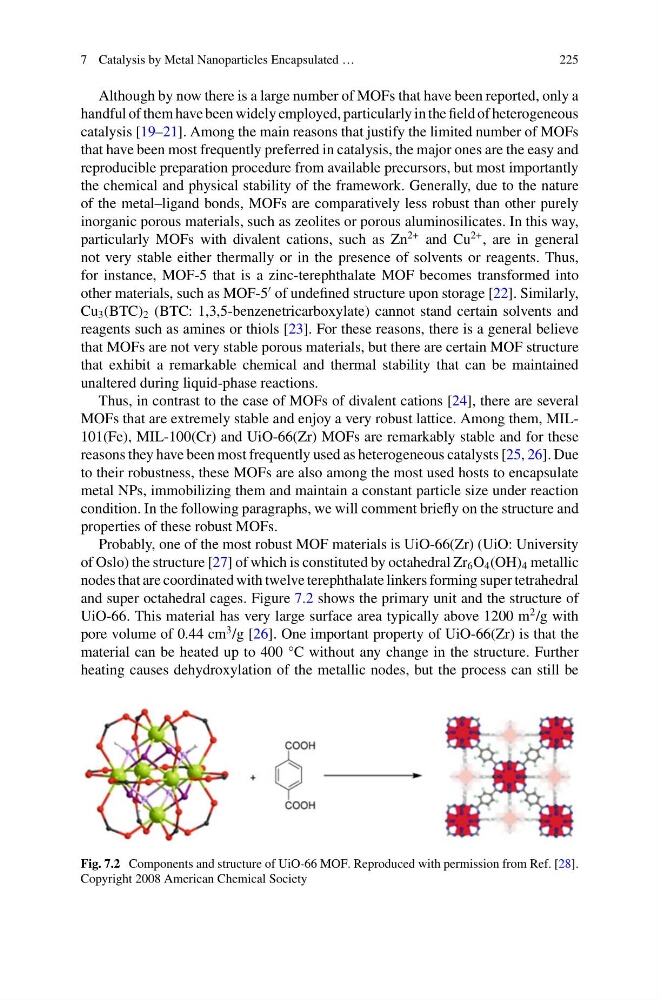
Probably, one of the most robust MOF materials is UiO-66(Zr) (UiO: University
of Oslo) the structure [27] of which is constituted by octahedral Zr 6 O 4 (OH) 4 metallic
nodes that are coordinated with twelve terephthalate linkers forming super tetrahedral
and super octahedral cages. Figure 7.2 shows the primary unit and the structure of
UiO-66. This material has very large surface area typically above 1200 m
2 /g with
pore volume of 0.44 cm
3 /g [26]. One important property of UiO-66(Zr) is that the
material can be heated up to 400 °C without any change in the structure. Further
heating causes dehydroxylation of the metallic nodes, but the process can still be
Fig. 7.2 Components and structure of UiO-66 MOF. Reproduced with permission from Ref. [28].
Copyright 2008 American Chemical Society
225
Although by now there is a large number of MOFs that have been reported, only a
handful of them have been widely employed, particularly in the field of heterogeneous
catalysis [19–21]. Among the main reasons that justify the limited number of MOFs
that have been most frequently preferred in catalysis, the major ones are the easy and
reproducible preparation procedure from available precursors, but most importantly
the chemical and physical stability of the framework. Generally, due to the nature
of the metal–ligand bonds, MOFs are comparatively less robust than other purely
inorganic porous materials, such as zeolites or porous aluminosilicates. In this way,
particularly MOFs with divalent cations, such as Zn
2+ and Cu
2+ , are in general
not very stable either thermally or in the presence of solvents or reagents. Thus,
for instance, MOF-5 that is a zinc-terephthalate MOF becomes transformed into
other materials, such as MOF-5
of undefined structure upon storage [22]. Similarly,
Cu 3 (BTC) 2 (BTC: 1,3,5-benzenetricarboxylate) cannot stand certain solvents and
reagents such as amines or thiols [23]. For these reasons, there is a general believe
that MOFs are not very stable porous materials, but there are certain MOF structure
that exhibit a remarkable chemical and thermal stability that can be maintained
unaltered during liquid-phase reactions.
Thus, in contrast to the case of MOFs of divalent cations [24], there are several
MOFs that are extremely stable and enjoy a very robust lattice. Among them, MIL101(Fe), MIL-100(Cr) and UiO-66(Zr) MOFs are remarkably stable and for these
reasons they have been most frequently used as heterogeneous catalysts [25, 26]. Due
to their robustness, these MOFs are also among the most used hosts to encapsulate
metal NPs, immobilizing them and maintain a constant particle size under reaction
condition. In the following paragraphs, we will comment briefly on the structure and
properties of these robust MOFs.
Probably, one of the most robust MOF materials is UiO-66(Zr) (UiO: University
of Oslo) the structure [27] of which is constituted by octahedral Zr 6 O 4 (OH) 4 metallic
nodes that are coordinated with twelve terephthalate linkers forming super tetrahedral
and super octahedral cages. Figure 7.2 shows the primary unit and the structure of
UiO-66. This material has very large surface area typically above 1200 m
2 /g with
pore volume of 0.44 cm
3 /g [26]. One important property of UiO-66(Zr) is that the
material can be heated up to 400 °C without any change in the structure. Further
heating causes dehydroxylation of the metallic nodes, but the process can still be
Fig. 7.2 Components and structure of UiO-66 MOF. Reproduced with permission from Ref. [28].
Copyright 2008 American Chemical Society