

224
A. Dhakshinamoorthy and H. Garcia
In the next section, we will describe briefly the structure and composition of MOFs,
paying particular attention to their stability, porosity and their ability to incorporate
guests and particularly metal NPs. It should be commented that the support on which
metal NPs are deposited or occluded can play other roles besides stabilization of
metal NP size. In this way, it is well known in the area that samples having particles
of the same size can exhibit contrasting catalytic activity and even selectivity as
a function of the nature of the support. In some reaction mechanisms, it has been
proposed that the support plays an active role not only by adsorbing reagents, but
also by participating in some steps of the reaction mechanism. This active role of the
support is particularly relevant in the present case since frequently MOFs have sites
that have intrinsic catalytic activity, particularly as Lewis acids promoting cascade
and oxidation reactions, due to the presence of coordinatively unsaturated positions
at the metal nodes. As will be commented in other sections, the use of MOFs as
support for metal NPs enables the development of multifunctional catalysts and more
specifically catalysts having sites on the MOFs and sites on the occluded metal NPs.
These types of multifunctional catalysts are especially relevant for the development
of tandem reactions in where more than one elementary process occur simultaneously
during the reaction.
7.2 MOFs Structure and Properties
MOFs are crystalline porous materials constituted by unit cells built of metallic nodes
and multipodal rigid organic connectors. The nodes can be single metal ions, like
Al
3+ in MIL-53(Al) [17], or can be few metal atoms connected or not by oxygen or
hydroxyl groups, such as the case of MIL-100(Fe) [18] that contains nodes of three
Fe
3+ ions connected to a central oxygen (Fe 3 -µ-O). These metal nodes establish
strong directional metal–ligand coordinative bonds with the organic linkers. Among
them, aromatic di- or tricarboxylic acids are widely used to prepare a large variety
of MOFs. The lattice and porosity derives from the directionality of the coordination
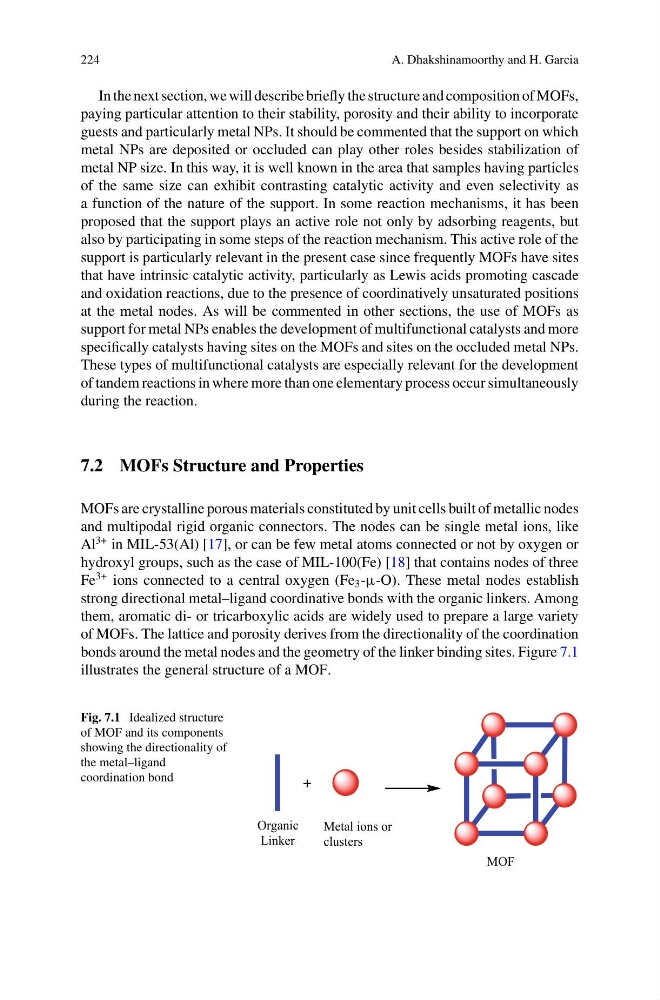
bonds around the metal nodes and the geometry of the linker binding sites. Figure 7.1
illustrates the general structure of a MOF.
Fig. 7.1 Idealized structure
of MOF and its components
showing the directionality of
the metal–ligand
coordination bond
Organic
Linker
Metal ions or
clusters
MOF
A. Dhakshinamoorthy and H. Garcia
In the next section, we will describe briefly the structure and composition of MOFs,
paying particular attention to their stability, porosity and their ability to incorporate
guests and particularly metal NPs. It should be commented that the support on which
metal NPs are deposited or occluded can play other roles besides stabilization of
metal NP size. In this way, it is well known in the area that samples having particles
of the same size can exhibit contrasting catalytic activity and even selectivity as
a function of the nature of the support. In some reaction mechanisms, it has been
proposed that the support plays an active role not only by adsorbing reagents, but
also by participating in some steps of the reaction mechanism. This active role of the
support is particularly relevant in the present case since frequently MOFs have sites
that have intrinsic catalytic activity, particularly as Lewis acids promoting cascade
and oxidation reactions, due to the presence of coordinatively unsaturated positions
at the metal nodes. As will be commented in other sections, the use of MOFs as
support for metal NPs enables the development of multifunctional catalysts and more
specifically catalysts having sites on the MOFs and sites on the occluded metal NPs.
These types of multifunctional catalysts are especially relevant for the development
of tandem reactions in where more than one elementary process occur simultaneously
during the reaction.
7.2 MOFs Structure and Properties
MOFs are crystalline porous materials constituted by unit cells built of metallic nodes
and multipodal rigid organic connectors. The nodes can be single metal ions, like
Al
3+ in MIL-53(Al) [17], or can be few metal atoms connected or not by oxygen or
hydroxyl groups, such as the case of MIL-100(Fe) [18] that contains nodes of three
Fe
3+ ions connected to a central oxygen (Fe 3 -µ-O). These metal nodes establish
strong directional metal–ligand coordinative bonds with the organic linkers. Among
them, aromatic di- or tricarboxylic acids are widely used to prepare a large variety
of MOFs. The lattice and porosity derives from the directionality of the coordination
bonds around the metal nodes and the geometry of the linker binding sites. Figure 7.1
illustrates the general structure of a MOF.
Fig. 7.1 Idealized structure
of MOF and its components
showing the directionality of
the metal–ligand
coordination bond
Organic
Linker
Metal ions or
clusters
MOF