

7 Catalysis by Metal Nanoparticles Encapsulated …
223
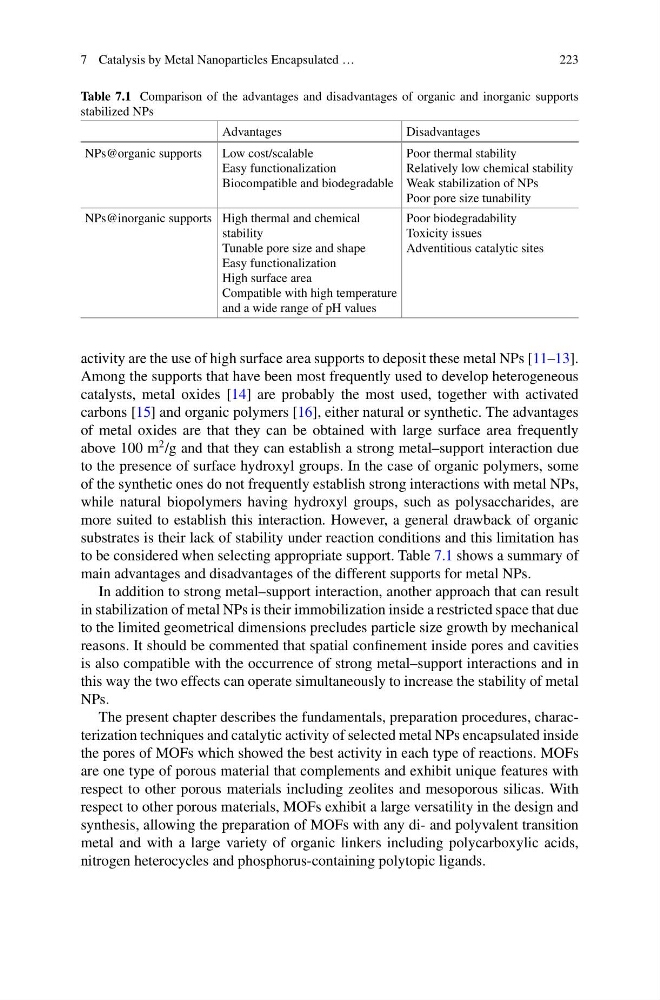
Table 7.1 Comparison of the advantages and disadvantages of organic and inorganic supports
stabilized NPs
Advantages
Disadvantages
NPs@organic supports
Low cost/scalable
Easy functionalization
Biocompatible and biodegradable
Poor thermal stability
Relatively low chemical stability
Weak stabilization of NPs
Poor pore size tunability
NPs@inorganic supports High thermal and chemical
stability
Tunable pore size and shape
Easy functionalization
High surface area
Compatible with high temperature
and a wide range of pH values
Poor biodegradability
Toxicity issues
Adventitious catalytic sites
activity are the use of high surface area supports to deposit these metal NPs [11–13].
Among the supports that have been most frequently used to develop heterogeneous
catalysts, metal oxides [14] are probably the most used, together with activated
carbons [15] and organic polymers [16], either natural or synthetic. The advantages
of metal oxides are that they can be obtained with large surface area frequently
above 100 m
2 /g and that they can establish a strong metal–support interaction due
to the presence of surface hydroxyl groups. In the case of organic polymers, some
of the synthetic ones do not frequently establish strong interactions with metal NPs,
while natural biopolymers having hydroxyl groups, such as polysaccharides, are
more suited to establish this interaction. However, a general drawback of organic
substrates is their lack of stability under reaction conditions and this limitation has
to be considered when selecting appropriate support. Table 7.1 shows a summary of
main advantages and disadvantages of the different supports for metal NPs.
In addition to strong metal–support interaction, another approach that can result
in stabilization of metal NPs is their immobilization inside a restricted space that due
to the limited geometrical dimensions precludes particle size growth by mechanical
reasons. It should be commented that spatial confinement inside pores and cavities
is also compatible with the occurrence of strong metal–support interactions and in
this way the two effects can operate simultaneously to increase the stability of metal
NPs.
The present chapter describes the fundamentals, preparation procedures, characterization techniques and catalytic activity of selected metal NPs encapsulated inside
the pores of MOFs which showed the best activity in each type of reactions. MOFs
are one type of porous material that complements and exhibit unique features with
respect to other porous materials including zeolites and mesoporous silicas. With
respect to other porous materials, MOFs exhibit a large versatility in the design and
synthesis, allowing the preparation of MOFs with any di- and polyvalent transition
metal and with a large variety of organic linkers including polycarboxylic acids,
nitrogen heterocycles and phosphorus-containing polytopic ligands.
223
Table 7.1 Comparison of the advantages and disadvantages of organic and inorganic supports
stabilized NPs
Advantages
Disadvantages
NPs@organic supports
Low cost/scalable
Easy functionalization
Biocompatible and biodegradable
Poor thermal stability
Relatively low chemical stability
Weak stabilization of NPs
Poor pore size tunability
NPs@inorganic supports High thermal and chemical
stability
Tunable pore size and shape
Easy functionalization
High surface area
Compatible with high temperature
and a wide range of pH values
Poor biodegradability
Toxicity issues
Adventitious catalytic sites
activity are the use of high surface area supports to deposit these metal NPs [11–13].
Among the supports that have been most frequently used to develop heterogeneous
catalysts, metal oxides [14] are probably the most used, together with activated
carbons [15] and organic polymers [16], either natural or synthetic. The advantages
of metal oxides are that they can be obtained with large surface area frequently
above 100 m
2 /g and that they can establish a strong metal–support interaction due
to the presence of surface hydroxyl groups. In the case of organic polymers, some
of the synthetic ones do not frequently establish strong interactions with metal NPs,
while natural biopolymers having hydroxyl groups, such as polysaccharides, are
more suited to establish this interaction. However, a general drawback of organic
substrates is their lack of stability under reaction conditions and this limitation has
to be considered when selecting appropriate support. Table 7.1 shows a summary of
main advantages and disadvantages of the different supports for metal NPs.
In addition to strong metal–support interaction, another approach that can result
in stabilization of metal NPs is their immobilization inside a restricted space that due
to the limited geometrical dimensions precludes particle size growth by mechanical
reasons. It should be commented that spatial confinement inside pores and cavities
is also compatible with the occurrence of strong metal–support interactions and in
this way the two effects can operate simultaneously to increase the stability of metal
NPs.
The present chapter describes the fundamentals, preparation procedures, characterization techniques and catalytic activity of selected metal NPs encapsulated inside
the pores of MOFs which showed the best activity in each type of reactions. MOFs
are one type of porous material that complements and exhibit unique features with
respect to other porous materials including zeolites and mesoporous silicas. With
respect to other porous materials, MOFs exhibit a large versatility in the design and
synthesis, allowing the preparation of MOFs with any di- and polyvalent transition
metal and with a large variety of organic linkers including polycarboxylic acids,
nitrogen heterocycles and phosphorus-containing polytopic ligands.