

222
A. Dhakshinamoorthy and H. Garcia
activity of surface metal atoms increases as its coordination number decreases from
highly packed facets to less packed planes, edges, and particularly atoms at the vertex
being particularly reactive [4, 5]. For these reasons, it is a general observation that
the catalytic activity of metal NPs correlates well with the average particle size,
decreasing in activity as the particle size increases [6–8].
One aspect related with the presence of coordinatively unsaturated metal atoms
on the surface that, as just commented, are the active catalytic centers is the surface
energy of the NPs. This surface energy indicates the stability that can be gained
if these surface atoms would become fully coordinated. In this regard, the surface
energy of small NPs is very large, rendering them very unstable. Due to this instability, the natural tendency of metal NPs is to undergo agglomeration to increase
the percentage of saturated surface atoms, thereby reducing the surface energy. This
tendency to grow makes small NPs difficult to stabilize, since they will aggregate
spontaneously until dimensions of few micrometers are achieved. In view of the
above considerations and the contradiction between catalytic activity of metal NPs
and their stability, it is extremely important to develop strategies to stabilize metal
NPs without affecting their catalytic activity.
One of the ways to minimize the growth of metal NPs in colloidal solutions is
the use of ligands that by interacting with the surface atoms thwarts their growth
[9]. However, the penalty of this methodology is that the ligands also block the
catalytically most active centers of the metal NP and generally the gain in stability
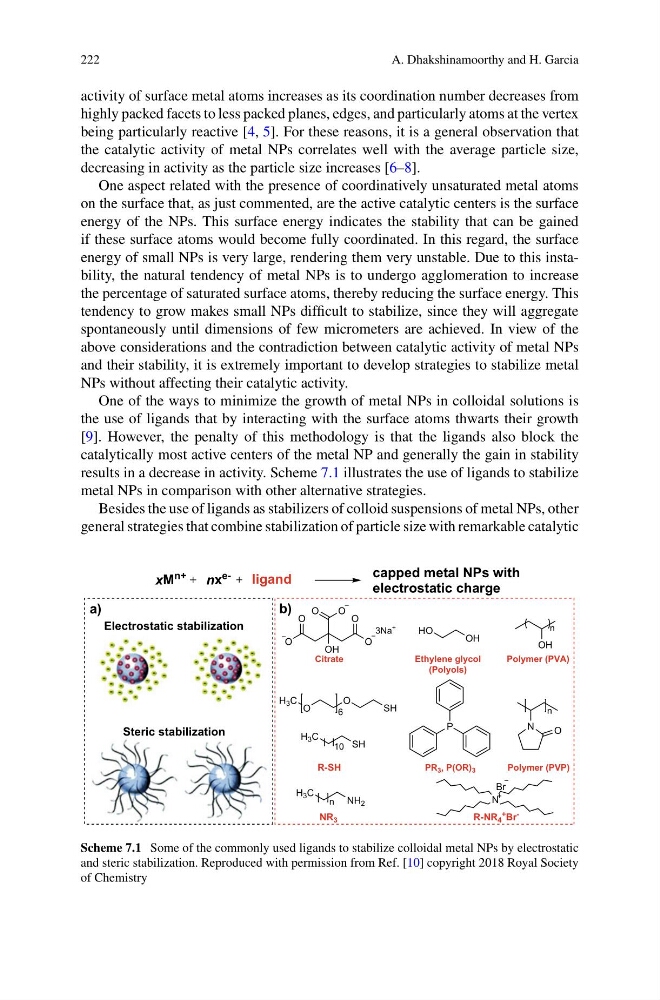
results in a decrease in activity. Scheme 7.1 illustrates the use of ligands to stabilize
metal NPs in comparison with other alternative strategies.
Besides the use of ligands as stabilizers of colloid suspensions of metal NPs, other
general strategies that combine stabilization of particle size with remarkable catalytic
P
N
n
O
O
H 3 C
6
OH
HO
OH
n
O
O
O
O
O
O
OH
3Na
+
NH 2
H 3 C
n
N
Br
H 3 C
SH
10
NR 3
R-NR 4
+ Br
-
R-SH
PR 3 , P(OR) 3
Polymer (PVP)
Citrate
Ethylene glycol
(Polyols)
Polymer (PVA)
b)
xM
n+
nx
eligand
capped metal NPs with
electrostatic charge
O
Steric stabilization
a)
Electrostatic stabilization
SH
Scheme 7.1 Some of the commonly used ligands to stabilize colloidal metal NPs by electrostatic
and steric stabilization. Reproduced with permission from Ref. [10] copyright 2018 Royal Society
of Chemistry
A. Dhakshinamoorthy and H. Garcia
activity of surface metal atoms increases as its coordination number decreases from
highly packed facets to less packed planes, edges, and particularly atoms at the vertex
being particularly reactive [4, 5]. For these reasons, it is a general observation that
the catalytic activity of metal NPs correlates well with the average particle size,
decreasing in activity as the particle size increases [6–8].
One aspect related with the presence of coordinatively unsaturated metal atoms
on the surface that, as just commented, are the active catalytic centers is the surface
energy of the NPs. This surface energy indicates the stability that can be gained
if these surface atoms would become fully coordinated. In this regard, the surface
energy of small NPs is very large, rendering them very unstable. Due to this instability, the natural tendency of metal NPs is to undergo agglomeration to increase
the percentage of saturated surface atoms, thereby reducing the surface energy. This
tendency to grow makes small NPs difficult to stabilize, since they will aggregate
spontaneously until dimensions of few micrometers are achieved. In view of the
above considerations and the contradiction between catalytic activity of metal NPs
and their stability, it is extremely important to develop strategies to stabilize metal
NPs without affecting their catalytic activity.
One of the ways to minimize the growth of metal NPs in colloidal solutions is
the use of ligands that by interacting with the surface atoms thwarts their growth
[9]. However, the penalty of this methodology is that the ligands also block the
catalytically most active centers of the metal NP and generally the gain in stability
results in a decrease in activity. Scheme 7.1 illustrates the use of ligands to stabilize
metal NPs in comparison with other alternative strategies.
Besides the use of ligands as stabilizers of colloid suspensions of metal NPs, other
general strategies that combine stabilization of particle size with remarkable catalytic
P
N
n
O
O
H 3 C
6
OH
HO
OH
n
O
O
O
O
O
O
OH
3Na
+
NH 2
H 3 C
n
N
Br
H 3 C
SH
10
NR 3
R-NR 4
+ Br
-
R-SH
PR 3 , P(OR) 3
Polymer (PVP)
Citrate
Ethylene glycol
(Polyols)
Polymer (PVA)
b)
xM
n+
nx
eligand
capped metal NPs with
electrostatic charge
O
Steric stabilization
a)
Electrostatic stabilization
SH
Scheme 7.1 Some of the commonly used ligands to stabilize colloidal metal NPs by electrostatic
and steric stabilization. Reproduced with permission from Ref. [10] copyright 2018 Royal Society
of Chemistry