

7 Catalysis by Metal Nanoparticles Encapsulated …
227
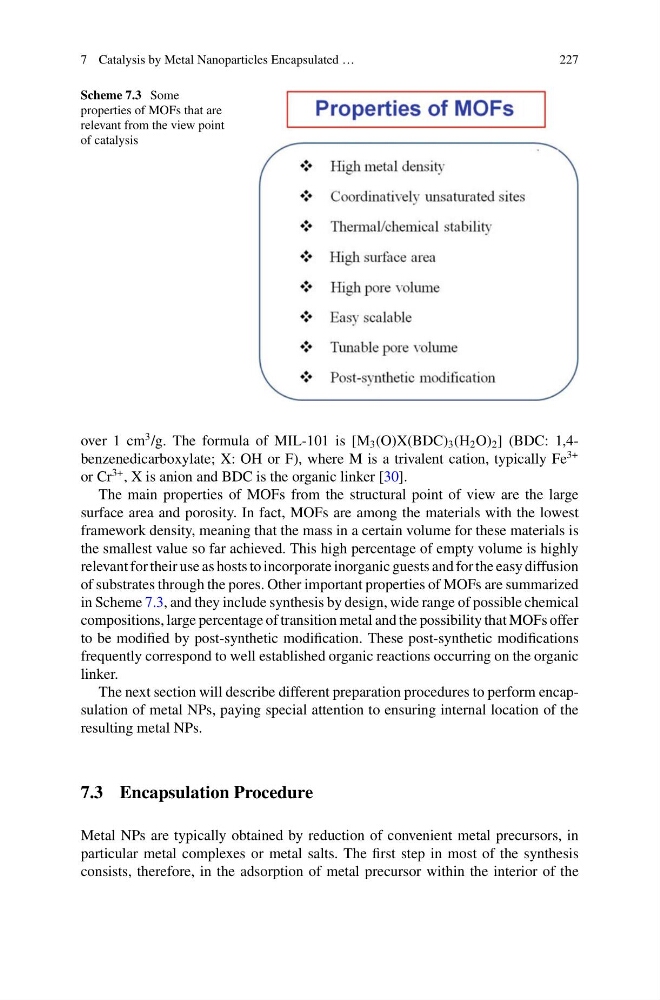
Scheme 7.3 Some
properties of MOFs that are
relevant from the view point
of catalysis
over 1 cm
3 /g. The formula of MIL-101 is [M 3 (O)X(BDC) 3 (H 2 O) 2 ] (BDC: 1,4benzenedicarboxylate; X: OH or F), where M is a trivalent cation, typically Fe
3+
or Cr
3+ , X is anion and BDC is the organic linker [30].
The main properties of MOFs from the structural point of view are the large
surface area and porosity. In fact, MOFs are among the materials with the lowest
framework density, meaning that the mass in a certain volume for these materials is
the smallest value so far achieved. This high percentage of empty volume is highly
relevant for their use as hosts to incorporate inorganic guests and for the easy diffusion
of substrates through the pores. Other important properties of MOFs are summarized
in Scheme 7.3, and they include synthesis by design, wide range of possible chemical
compositions, large percentage of transition metal and the possibility that MOFs offer
to be modified by post-synthetic modification. These post-synthetic modifications
frequently correspond to well established organic reactions occurring on the organic
linker.
The next section will describe different preparation procedures to perform encapsulation of metal NPs, paying special attention to ensuring internal location of the
resulting metal NPs.
7.3 Encapsulation Procedure
Metal NPs are typically obtained by reduction of convenient metal precursors, in
particular metal complexes or metal salts. The first step in most of the synthesis
consists, therefore, in the adsorption of metal precursor within the interior of the
227
Scheme 7.3 Some
properties of MOFs that are
relevant from the view point
of catalysis
over 1 cm
3 /g. The formula of MIL-101 is [M 3 (O)X(BDC) 3 (H 2 O) 2 ] (BDC: 1,4benzenedicarboxylate; X: OH or F), where M is a trivalent cation, typically Fe
3+
or Cr
3+ , X is anion and BDC is the organic linker [30].
The main properties of MOFs from the structural point of view are the large
surface area and porosity. In fact, MOFs are among the materials with the lowest
framework density, meaning that the mass in a certain volume for these materials is
the smallest value so far achieved. This high percentage of empty volume is highly
relevant for their use as hosts to incorporate inorganic guests and for the easy diffusion
of substrates through the pores. Other important properties of MOFs are summarized
in Scheme 7.3, and they include synthesis by design, wide range of possible chemical
compositions, large percentage of transition metal and the possibility that MOFs offer
to be modified by post-synthetic modification. These post-synthetic modifications
frequently correspond to well established organic reactions occurring on the organic
linker.
The next section will describe different preparation procedures to perform encapsulation of metal NPs, paying special attention to ensuring internal location of the
resulting metal NPs.
7.3 Encapsulation Procedure
Metal NPs are typically obtained by reduction of convenient metal precursors, in
particular metal complexes or metal salts. The first step in most of the synthesis
consists, therefore, in the adsorption of metal precursor within the interior of the