

5 Covalent Assemblies of Metal Nanoparticles—Strategies …
173
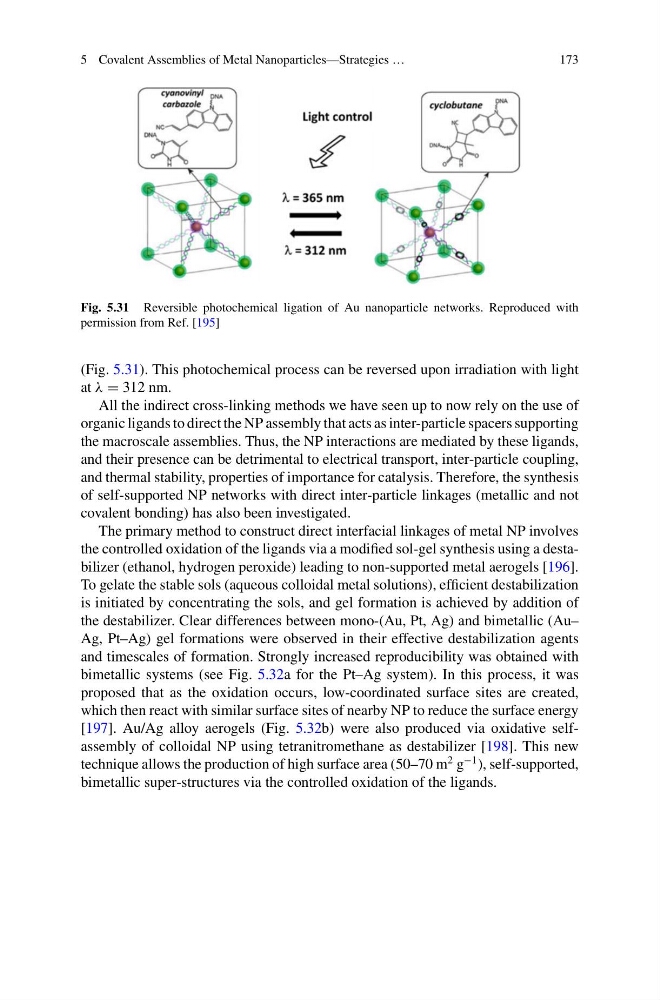
Fig. 5.31 Reversible photochemical ligation of Au nanoparticle networks. Reproduced with
permission from Ref. [195]
(Fig. 5.31). This photochemical process can be reversed upon irradiation with light
at λ = 312 nm.
All the indirect cross-linking methods we have seen up to now rely on the use of
organic ligands to direct the NP assembly that acts as inter-particle spacers supporting
the macroscale assemblies. Thus, the NP interactions are mediated by these ligands,
and their presence can be detrimental to electrical transport, inter-particle coupling,
and thermal stability, properties of importance for catalysis. Therefore, the synthesis
of self-supported NP networks with direct inter-particle linkages (metallic and not
covalent bonding) has also been investigated.
The primary method to construct direct interfacial linkages of metal NP involves
the controlled oxidation of the ligands via a modified sol-gel synthesis using a destabilizer (ethanol, hydrogen peroxide) leading to non-supported metal aerogels [196].
To gelate the stable sols (aqueous colloidal metal solutions), efficient destabilization
is initiated by concentrating the sols, and gel formation is achieved by addition of
the destabilizer. Clear differences between mono-(Au, Pt, Ag) and bimetallic (Au–
Ag, Pt–Ag) gel formations were observed in their effective destabilization agents
and timescales of formation. Strongly increased reproducibility was obtained with
bimetallic systems (see Fig. 5.32a for the Pt–Ag system). In this process, it was
proposed that as the oxidation occurs, low-coordinated surface sites are created,
which then react with similar surface sites of nearby NP to reduce the surface energy
[197]. Au/Ag alloy aerogels (Fig. 5.32b) were also produced via oxidative selfassembly of colloidal NP using tetranitromethane as destabilizer [198]. This new
technique allows the production of high surface area (50–70 m
2 g
−1 ), self-supported,
bimetallic super-structures via the controlled oxidation of the ligands.
173
Fig. 5.31 Reversible photochemical ligation of Au nanoparticle networks. Reproduced with
permission from Ref. [195]
(Fig. 5.31). This photochemical process can be reversed upon irradiation with light
at λ = 312 nm.
All the indirect cross-linking methods we have seen up to now rely on the use of
organic ligands to direct the NP assembly that acts as inter-particle spacers supporting
the macroscale assemblies. Thus, the NP interactions are mediated by these ligands,
and their presence can be detrimental to electrical transport, inter-particle coupling,
and thermal stability, properties of importance for catalysis. Therefore, the synthesis
of self-supported NP networks with direct inter-particle linkages (metallic and not
covalent bonding) has also been investigated.
The primary method to construct direct interfacial linkages of metal NP involves
the controlled oxidation of the ligands via a modified sol-gel synthesis using a destabilizer (ethanol, hydrogen peroxide) leading to non-supported metal aerogels [196].
To gelate the stable sols (aqueous colloidal metal solutions), efficient destabilization
is initiated by concentrating the sols, and gel formation is achieved by addition of
the destabilizer. Clear differences between mono-(Au, Pt, Ag) and bimetallic (Au–
Ag, Pt–Ag) gel formations were observed in their effective destabilization agents
and timescales of formation. Strongly increased reproducibility was obtained with
bimetallic systems (see Fig. 5.32a for the Pt–Ag system). In this process, it was
proposed that as the oxidation occurs, low-coordinated surface sites are created,
which then react with similar surface sites of nearby NP to reduce the surface energy
[197]. Au/Ag alloy aerogels (Fig. 5.32b) were also produced via oxidative selfassembly of colloidal NP using tetranitromethane as destabilizer [198]. This new
technique allows the production of high surface area (50–70 m
2 g
−1 ), self-supported,
bimetallic super-structures via the controlled oxidation of the ligands.