

172
Y. Min et al.
5.2.3.3 Dynamic Covalent Chemistry Assisted by Light as Physical
Stimulus
The use of light-induced reactions as external stimuli offers rapid and precise spatial
control in closed systems [190]. A simple way to render NP photoresponsive is
to functionalize their surface with ligands terminated by light-switchable moieties,
which can lead to light-induced reversible self-assembly (LIRSA). Photoreversible
[2 + 2] photocycloaddition [190, 191] or reversible Diels–Alder reaction employing
a diarylethene as the diene and a maleimide as the dienophile [192] have been used
for exerting photocontrol over the connection and disconnection of dynamic covalent
bonds.
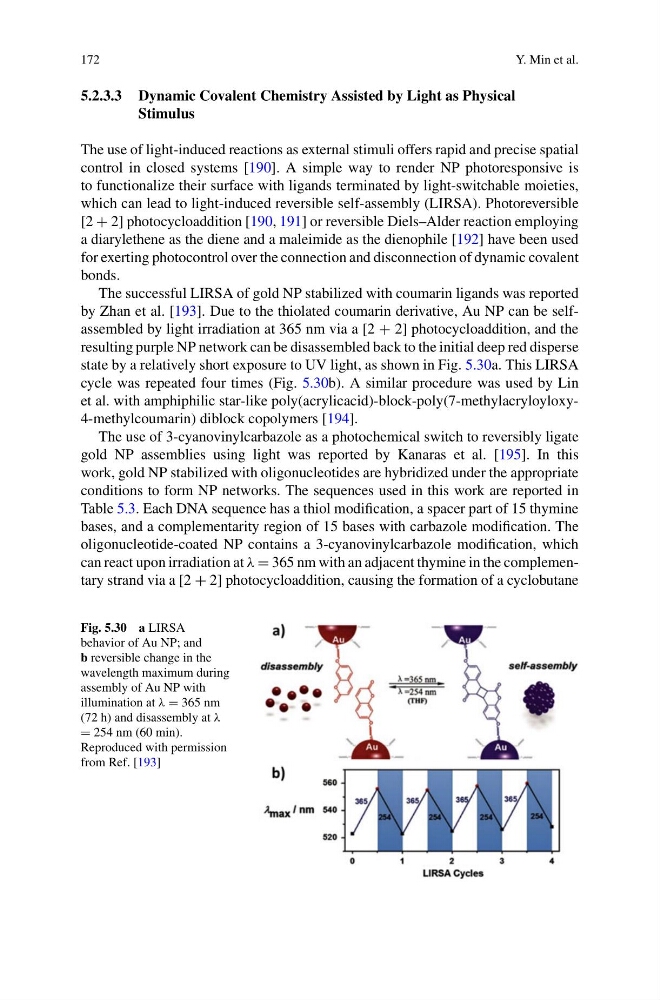
The successful LIRSA of gold NP stabilized with coumarin ligands was reported
by Zhan et al. [193]. Due to the thiolated coumarin derivative, Au NP can be selfassembled by light irradiation at 365 nm via a [2 + 2] photocycloaddition, and the
resulting purple NP network can be disassembled back to the initial deep red disperse
state by a relatively short exposure to UV light, as shown in Fig. 5.30a. This LIRSA
cycle was repeated four times (Fig. 5.30b). A similar procedure was used by Lin
et al. with amphiphilic star-like poly(acrylicacid)-block-poly(7-methylacryloyloxy4-methylcoumarin) diblock copolymers [194].
The use of 3-cyanovinylcarbazole as a photochemical switch to reversibly ligate
gold NP assemblies using light was reported by Kanaras et al. [195]. In this
work, gold NP stabilized with oligonucleotides are hybridized under the appropriate
conditions to form NP networks. The sequences used in this work are reported in
Table 5.3. Each DNA sequence has a thiol modification, a spacer part of 15 thymine
bases, and a complementarity region of 15 bases with carbazole modification. The
oligonucleotide-coated NP contains a 3-cyanovinylcarbazole modification, which
can react upon irradiation at λ = 365 nm with an adjacent thymine in the complementary strand via a [2 + 2] photocycloaddition, causing the formation of a cyclobutane
Fig. 5.30 a LIRSA
behavior of Au NP; and
b reversible change in the
wavelength maximum during
assembly of Au NP with
illumination at λ = 365 nm
(72 h) and disassembly at λ
= 254 nm (60 min).
Reproduced with permission
from Ref. [193]
Y. Min et al.
5.2.3.3 Dynamic Covalent Chemistry Assisted by Light as Physical
Stimulus
The use of light-induced reactions as external stimuli offers rapid and precise spatial
control in closed systems [190]. A simple way to render NP photoresponsive is
to functionalize their surface with ligands terminated by light-switchable moieties,
which can lead to light-induced reversible self-assembly (LIRSA). Photoreversible
[2 + 2] photocycloaddition [190, 191] or reversible Diels–Alder reaction employing
a diarylethene as the diene and a maleimide as the dienophile [192] have been used
for exerting photocontrol over the connection and disconnection of dynamic covalent
bonds.
The successful LIRSA of gold NP stabilized with coumarin ligands was reported
by Zhan et al. [193]. Due to the thiolated coumarin derivative, Au NP can be selfassembled by light irradiation at 365 nm via a [2 + 2] photocycloaddition, and the
resulting purple NP network can be disassembled back to the initial deep red disperse
state by a relatively short exposure to UV light, as shown in Fig. 5.30a. This LIRSA
cycle was repeated four times (Fig. 5.30b). A similar procedure was used by Lin
et al. with amphiphilic star-like poly(acrylicacid)-block-poly(7-methylacryloyloxy4-methylcoumarin) diblock copolymers [194].
The use of 3-cyanovinylcarbazole as a photochemical switch to reversibly ligate
gold NP assemblies using light was reported by Kanaras et al. [195]. In this
work, gold NP stabilized with oligonucleotides are hybridized under the appropriate
conditions to form NP networks. The sequences used in this work are reported in
Table 5.3. Each DNA sequence has a thiol modification, a spacer part of 15 thymine
bases, and a complementarity region of 15 bases with carbazole modification. The
oligonucleotide-coated NP contains a 3-cyanovinylcarbazole modification, which
can react upon irradiation at λ = 365 nm with an adjacent thymine in the complementary strand via a [2 + 2] photocycloaddition, causing the formation of a cyclobutane
Fig. 5.30 a LIRSA
behavior of Au NP; and
b reversible change in the
wavelength maximum during
assembly of Au NP with
illumination at λ = 365 nm
(72 h) and disassembly at λ
= 254 nm (60 min).
Reproduced with permission
from Ref. [193]