

144
Y. Min et al.
had comparable electrical properties to those prepared by the LBL method. The
ligand exchange process took place in 1,9-nonanedithiol solution with 2 and 5 nm
decanethiol capped Au NP, followed by loading on a support, which resulted in
covalently linked thin films. The surface plasmon resonance displayed by the assemblies having inter-particle distances shorter than the NP size shifted at longer wavelength. The electrochemical properties are different (gold–sulfur binding and partial
blockage electron transfer barrier), probably influenced by NP size and crystallinity,
which was important for further catalytic application [70]. Following the same preparation route, Au–Pt alloyed NP assembly cross-linked by 1,9-nonanedithiol was
produced and applied for methanol electrooxidation [71]. If controlling assembly in
2-D or 3-D has been achieved with success, then the 1-D assembly is still a challenge. Nonetheless, the use of nonanedithiol produced size-controlled 1-D linear
assemblies [72]. The length and branches of these gold nanochains were tuned by
varying the ratio of dithiols to Au NP, resulting in dimers, oligomers, and branched
linear shapes.
The use of aromatic compounds bearing bidentate or tridentate coordination sites
as cross-linkers (1,4-phenylene diisocyanide, 4,4
-bis(diphenylphosphino)biphenyl,
1,3,5-tris([2,2
:6
,2
-terpyridin]-4
-ylethynyl)benzene) allows producing Pd NP
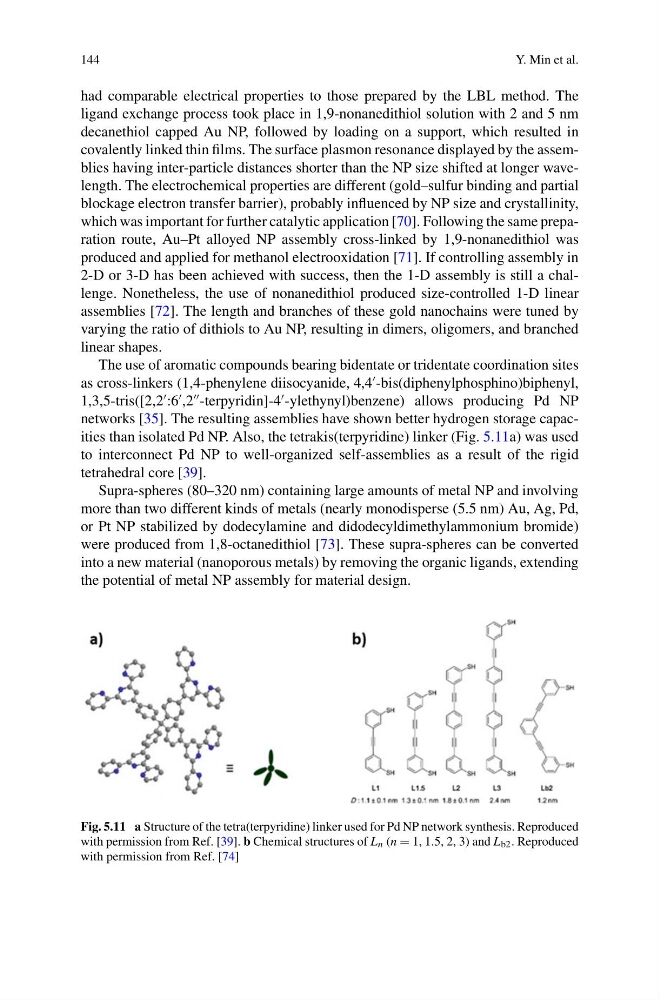
networks [35]. The resulting assemblies have shown better hydrogen storage capacities than isolated Pd NP. Also, the tetrakis(terpyridine) linker (Fig. 5.11a) was used
to interconnect Pd NP to well-organized self-assemblies as a result of the rigid
tetrahedral core [39].
Supra-spheres (80–320 nm) containing large amounts of metal NP and involving
more than two different kinds of metals (nearly monodisperse (5.5 nm) Au, Ag, Pd,
or Pt NP stabilized by dodecylamine and didodecyldimethylammonium bromide)
were produced from 1,8-octanedithiol [73]. These supra-spheres can be converted
into a new material (nanoporous metals) by removing the organic ligands, extending
the potential of metal NP assembly for material design.
Fig. 5.11 a Structure of the tetra(terpyridine) linker used for Pd NP network synthesis. Reproduced
with permission from Ref. [39]. b Chemical structures of L n (n = 1, 1.5, 2, 3) and L b2 . Reproduced
with permission from Ref. [74]
Y. Min et al.
had comparable electrical properties to those prepared by the LBL method. The
ligand exchange process took place in 1,9-nonanedithiol solution with 2 and 5 nm
decanethiol capped Au NP, followed by loading on a support, which resulted in
covalently linked thin films. The surface plasmon resonance displayed by the assemblies having inter-particle distances shorter than the NP size shifted at longer wavelength. The electrochemical properties are different (gold–sulfur binding and partial
blockage electron transfer barrier), probably influenced by NP size and crystallinity,
which was important for further catalytic application [70]. Following the same preparation route, Au–Pt alloyed NP assembly cross-linked by 1,9-nonanedithiol was
produced and applied for methanol electrooxidation [71]. If controlling assembly in
2-D or 3-D has been achieved with success, then the 1-D assembly is still a challenge. Nonetheless, the use of nonanedithiol produced size-controlled 1-D linear
assemblies [72]. The length and branches of these gold nanochains were tuned by
varying the ratio of dithiols to Au NP, resulting in dimers, oligomers, and branched
linear shapes.
The use of aromatic compounds bearing bidentate or tridentate coordination sites
as cross-linkers (1,4-phenylene diisocyanide, 4,4
-bis(diphenylphosphino)biphenyl,
1,3,5-tris([2,2
:6
,2
-terpyridin]-4
-ylethynyl)benzene) allows producing Pd NP
networks [35]. The resulting assemblies have shown better hydrogen storage capacities than isolated Pd NP. Also, the tetrakis(terpyridine) linker (Fig. 5.11a) was used
to interconnect Pd NP to well-organized self-assemblies as a result of the rigid
tetrahedral core [39].
Supra-spheres (80–320 nm) containing large amounts of metal NP and involving
more than two different kinds of metals (nearly monodisperse (5.5 nm) Au, Ag, Pd,
or Pt NP stabilized by dodecylamine and didodecyldimethylammonium bromide)
were produced from 1,8-octanedithiol [73]. These supra-spheres can be converted
into a new material (nanoporous metals) by removing the organic ligands, extending
the potential of metal NP assembly for material design.
Fig. 5.11 a Structure of the tetra(terpyridine) linker used for Pd NP network synthesis. Reproduced
with permission from Ref. [39]. b Chemical structures of L n (n = 1, 1.5, 2, 3) and L b2 . Reproduced
with permission from Ref. [74]