

5 Covalent Assemblies of Metal Nanoparticles—Strategies …
145
Neouze et al. presented a new approach to build networks of Pt NP using both
a carboxylic acid-functional thiol ligand (mercaptopropionic acid) and an alcoholfunctional thiol ligand (mercaptoethanol) before introducing them into a TiO 2 matrix
[75]. Pt NP stabilized by the two different ligands (Au–S coordination) were crosslinked. FTIR analyses have shown that the –COOH groups did not react with the
–OH groups, and that the pending –COOH groups interact, as –COO
− groups with
neighboring Pt NP. Furthermore, there were residual pending carboxylic acids of the
Pt–Pt network that can further coordinate to the titanium centers of the TiO 2 matrix,
ensuring stability to the coating film.
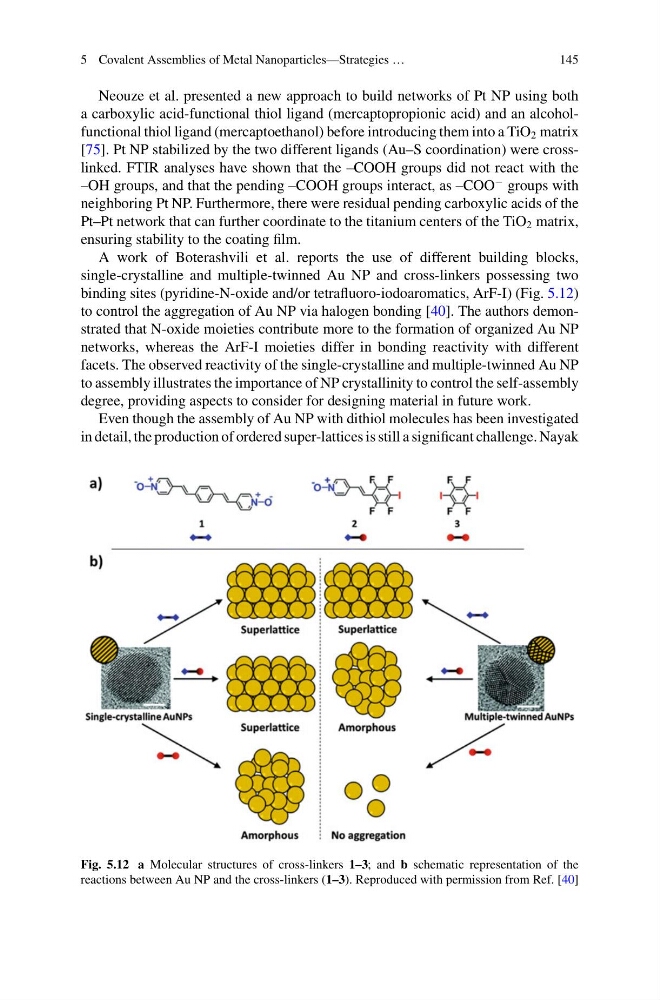
A work of Boterashvili et al. reports the use of different building blocks,
single-crystalline and multiple-twinned Au NP and cross-linkers possessing two
binding sites (pyridine-N-oxide and/or tetrafluoro-iodoaromatics, ArF-I) (Fig. 5.12)
to control the aggregation of Au NP via halogen bonding [40]. The authors demonstrated that N-oxide moieties contribute more to the formation of organized Au NP
networks, whereas the ArF-I moieties differ in bonding reactivity with different
facets. The observed reactivity of the single-crystalline and multiple-twinned Au NP
to assembly illustrates the importance of NP crystallinity to control the self-assembly
degree, providing aspects to consider for designing material in future work.
Even though the assembly of Au NP with dithiol molecules has been investigated
in detail, the production of ordered super-lattices is still a significant challenge. Nayak
Fig. 5.12 a Molecular structures of cross-linkers 1–3; and b schematic representation of the
reactions between Au NP and the cross-linkers (1–3). Reproduced with permission from Ref. [40]
145
Neouze et al. presented a new approach to build networks of Pt NP using both
a carboxylic acid-functional thiol ligand (mercaptopropionic acid) and an alcoholfunctional thiol ligand (mercaptoethanol) before introducing them into a TiO 2 matrix
[75]. Pt NP stabilized by the two different ligands (Au–S coordination) were crosslinked. FTIR analyses have shown that the –COOH groups did not react with the
–OH groups, and that the pending –COOH groups interact, as –COO
− groups with
neighboring Pt NP. Furthermore, there were residual pending carboxylic acids of the
Pt–Pt network that can further coordinate to the titanium centers of the TiO 2 matrix,
ensuring stability to the coating film.
A work of Boterashvili et al. reports the use of different building blocks,
single-crystalline and multiple-twinned Au NP and cross-linkers possessing two
binding sites (pyridine-N-oxide and/or tetrafluoro-iodoaromatics, ArF-I) (Fig. 5.12)
to control the aggregation of Au NP via halogen bonding [40]. The authors demonstrated that N-oxide moieties contribute more to the formation of organized Au NP
networks, whereas the ArF-I moieties differ in bonding reactivity with different
facets. The observed reactivity of the single-crystalline and multiple-twinned Au NP
to assembly illustrates the importance of NP crystallinity to control the self-assembly
degree, providing aspects to consider for designing material in future work.
Even though the assembly of Au NP with dithiol molecules has been investigated
in detail, the production of ordered super-lattices is still a significant challenge. Nayak
Fig. 5.12 a Molecular structures of cross-linkers 1–3; and b schematic representation of the
reactions between Au NP and the cross-linkers (1–3). Reproduced with permission from Ref. [40]