

5 Covalent Assemblies of Metal Nanoparticles—Strategies …
143
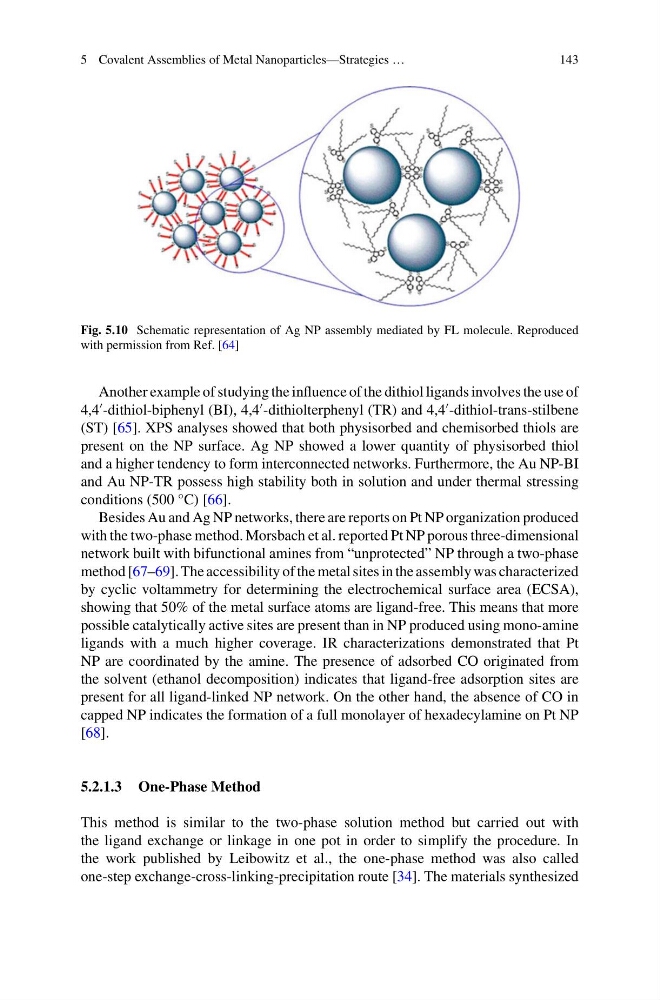
Fig. 5.10 Schematic representation of Ag NP assembly mediated by FL molecule. Reproduced
with permission from Ref. [64]
Another example of studying the influence of the dithiol ligands involves the use of
4,4
-dithiol-biphenyl (BI), 4,4
-dithiolterphenyl (TR) and 4,4
-dithiol-trans-stilbene
(ST) [65]. XPS analyses showed that both physisorbed and chemisorbed thiols are
present on the NP surface. Ag NP showed a lower quantity of physisorbed thiol
and a higher tendency to form interconnected networks. Furthermore, the Au NP-BI
and Au NP-TR possess high stability both in solution and under thermal stressing
conditions (500 °C) [66].
Besides Au and Ag NP networks, there are reports on Pt NP organization produced
with the two-phase method. Morsbach et al. reported Pt NP porous three-dimensional
network built with bifunctional amines from “unprotected” NP through a two-phase
method [67–69]. The accessibility of the metal sites in the assembly was characterized
by cyclic voltammetry for determining the electrochemical surface area (ECSA),
showing that 50% of the metal surface atoms are ligand-free. This means that more
possible catalytically active sites are present than in NP produced using mono-amine
ligands with a much higher coverage. IR characterizations demonstrated that Pt
NP are coordinated by the amine. The presence of adsorbed CO originated from
the solvent (ethanol decomposition) indicates that ligand-free adsorption sites are
present for all ligand-linked NP network. On the other hand, the absence of CO in
capped NP indicates the formation of a full monolayer of hexadecylamine on Pt NP
[68].
5.2.1.3 One-Phase Method
This method is similar to the two-phase solution method but carried out with
the ligand exchange or linkage in one pot in order to simplify the procedure. In
the work published by Leibowitz et al., the one-phase method was also called
one-step exchange-cross-linking-precipitation route [34]. The materials synthesized
143
Fig. 5.10 Schematic representation of Ag NP assembly mediated by FL molecule. Reproduced
with permission from Ref. [64]
Another example of studying the influence of the dithiol ligands involves the use of
4,4
-dithiol-biphenyl (BI), 4,4
-dithiolterphenyl (TR) and 4,4
-dithiol-trans-stilbene
(ST) [65]. XPS analyses showed that both physisorbed and chemisorbed thiols are
present on the NP surface. Ag NP showed a lower quantity of physisorbed thiol
and a higher tendency to form interconnected networks. Furthermore, the Au NP-BI
and Au NP-TR possess high stability both in solution and under thermal stressing
conditions (500 °C) [66].
Besides Au and Ag NP networks, there are reports on Pt NP organization produced
with the two-phase method. Morsbach et al. reported Pt NP porous three-dimensional
network built with bifunctional amines from “unprotected” NP through a two-phase
method [67–69]. The accessibility of the metal sites in the assembly was characterized
by cyclic voltammetry for determining the electrochemical surface area (ECSA),
showing that 50% of the metal surface atoms are ligand-free. This means that more
possible catalytically active sites are present than in NP produced using mono-amine
ligands with a much higher coverage. IR characterizations demonstrated that Pt
NP are coordinated by the amine. The presence of adsorbed CO originated from
the solvent (ethanol decomposition) indicates that ligand-free adsorption sites are
present for all ligand-linked NP network. On the other hand, the absence of CO in
capped NP indicates the formation of a full monolayer of hexadecylamine on Pt NP
[68].
5.2.1.3 One-Phase Method
This method is similar to the two-phase solution method but carried out with
the ligand exchange or linkage in one pot in order to simplify the procedure. In
the work published by Leibowitz et al., the one-phase method was also called
one-step exchange-cross-linking-precipitation route [34]. The materials synthesized