

345
The c-D 2 D
H
was prepared by the heterocondensation of tetramethyldisiloxane- 1,3diol (TMSD) with MDS with a low yield (51%) (Paulasaari and Weber 1999).
Earlier c-D 2 D
H
was synthesized with the 85% yield by the condensation of
bis(isopropenoxy)methylsilane HMeSi(OMeC=CH 2 ) 2 with TMSD, in the presence
of Et 3 N and ZnCl 2 (Masatoshi et al. 1986; Masatoshi 1988).
Chruściel et al. (1997), Chruściel (1999a, b) developed a sequential polycondensation method which leads to PDMS-b-PMHS block copolymers containing in their
structure single or multiple MeHSiO units, reactive dimethylsiloxanol HOMe 2 SiO 0.5
and dimethylsiloxane M
H
end groups, and non-reactive Me 3 SiO 0.5 groups at chain
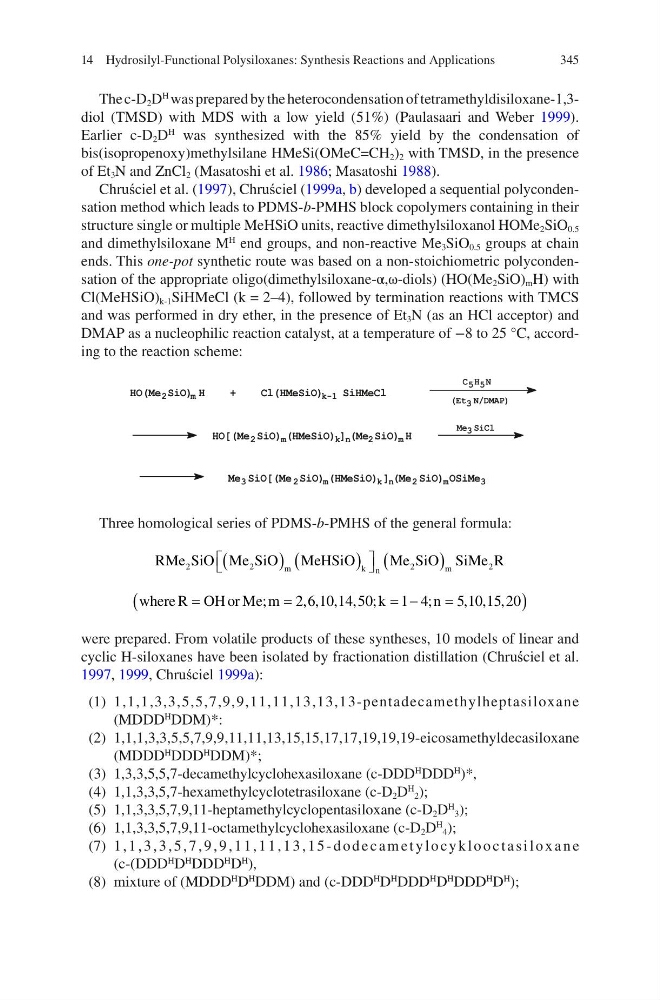
ends. This one-pot synthetic route was based on a non-stoichiometric polycondensation of the appropriate oligo(dimethylsiloxane-α,ω-diols) (HO(Me 2 SiO) m H) with
Cl(MeHSiO) k-1 SiHMeCl (k = 2–4), followed by termination reactions with TMCS
and was performed in dry ether, in the presence of Et 3 N (as an HCl acceptor) and
DMAP as a nucleophilic reaction catalyst, at a temperature of −8 to 25 °C, according to the reaction scheme:
HO(Me 2 SiO) m H
+
Cl(HMeSiO) k-1 SiHMeCl
C 5 H 5 N
(Et 3 N/DMAP)
HO[(Me 2 SiO) m (HMeSiO) k ] n (Me 2 SiO) m H
Me 3 SiCl
Me 3 SiO[(Me 2 SiO) m (HMeSiO) k ] n (Me 2 SiO) m OSiMe 3
Three homological series of PDMS-b-PMHS of the general formula:
RMe SiO Me SiO
MeHSiO
Me SiO SiMe R
m
k n
m
2
2
2
2
(
) (
)
(
)
where R OH or Me;m
k
n
=
=
= −
=
(
)
2 6 10 14 50
1 4
5 10 15 20
, , , , ;
;
, , ,
were prepared. From volatile products of these syntheses, 10 models of linear and
cyclic H-siloxanes have been isolated by fractionation distillation (Chruściel et al.
1997, 1999, Chruściel 1999a):
(1) 1,1,1,3,3,5,5,7,9,9,11,11,13,13,13-pentadecamethylheptasiloxane
(MDDD
H
DDM)*:
(2) 1,1,1,3,3,5,5,7,9,9,11,11,13,15,15,17,17,19,19,19-eicosamethyldecasiloxane
(MDDD
H
DDD
H
DDM)*;
(3) 1,3,3,5,5,7-decamethylcyclohexasiloxane (c-DDD
H
DDD
H
)*,
(4) 1,1,3,3,5,7-hexamethylcyclotetrasiloxane (c-D 2 D
H 2 );
(5) 1,1,3,3,5,7,9,11-heptamethylcyclopentasiloxane (c-D 2 D
H 3 );
(6) 1,1,3,3,5,7,9,11-octamethylcyclohexasiloxane (c-D 2 D
H 4 );
(7) 1 , 1 , 3 , 3 , 5 , 7 , 9 , 9 , 1 1 , 1 1 , 1 3 , 1 5 - d o d e c a m e t y l o cy k l o o c t a s i l o x a n e
(c-(DDD
H
D
H
DDD
H
D
H
),
(8) mixture of (MDDD
H
D
H
DDM) and (c-DDD
H
D
H
DDD
H
D
H
DDD
H
D
H
);
14 Hydrosilyl-Functional Polysiloxanes: Synthesis Reactions and Applications