

344
14.3 Most Important Achievements in a Field of Chemistry
and Technology of PMHS
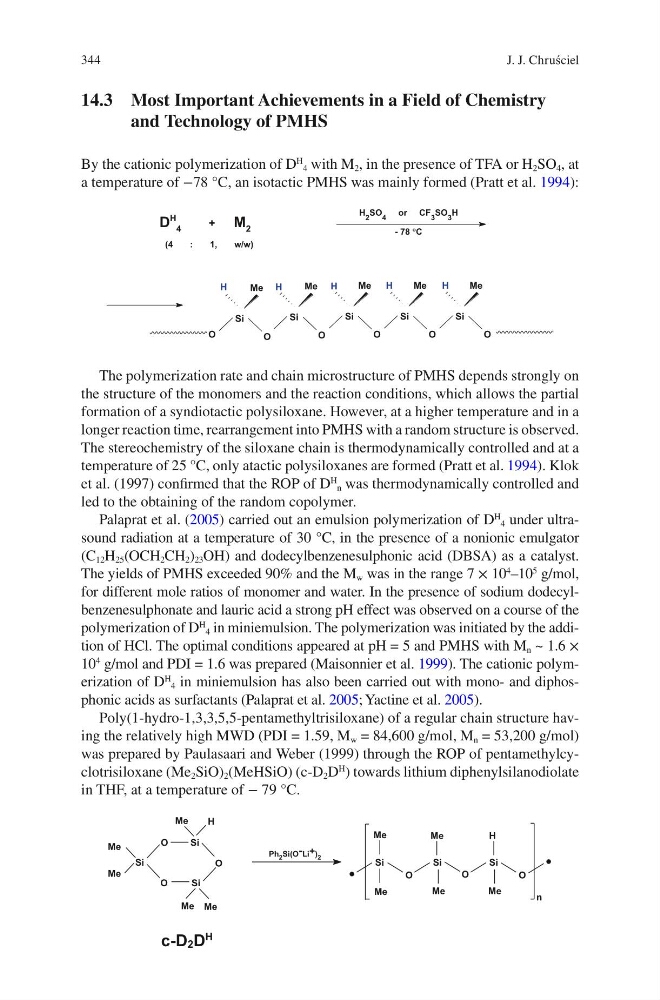
By the cationic polymerization of D
H 4 with M 2 , in the presence of TFA or H 2 SO 4 , at
a temperature of −78 °C, an isotactic PMHS was mainly formed (Pratt et al. 1994):
O
Si
O
Si
O
Si
O
Si
O
Si
O
H
Me
Me
Me
Me
Me
H
H
H
H
D
H
4
+
M 2
H
2
SO
4
or CF 3
SO
3
H
- 78 ∞C
(4
:
1,
w/w)
The polymerization rate and chain microstructure of PMHS depends strongly on
the structure of the monomers and the reaction conditions, which allows the partial
formation of a syndiotactic polysiloxane. However, at a higher temperature and in a
longer reaction time, rearrangement into PMHS with a random structure is observed.
The stereochemistry of the siloxane chain is thermodynamically controlled and at a
temperature of 25 °C, only atactic polysiloxanes are formed (Pratt et al. 1994). Klok
et al. (1997) confirmed that the ROP of D
H n was thermodynamically controlled and
led to the obtaining of the random copolymer.
Palaprat et al. (2005) carried out an emulsion polymerization of D
H
4 under ultrasound radiation at a temperature of 30 °C, in the presence of a nonionic emulgator
(C 12 H 25 (OCH 2 CH 2 ) 23 OH) and dodecylbenzenesulphonic acid (DBSA) as a catalyst.
The yields of PMHS exceeded 90% and the M w was in the range 7 × 10
4
–10
5
g/mol,
for different mole ratios of monomer and water. In the presence of sodium dodecylbenzenesulphonate and lauric acid a strong pH effect was observed on a course of the
polymerization of D
H
4 in miniemulsion. The polymerization was initiated by the addition of HCl. The optimal conditions appeared at pH = 5 and PMHS with M n ~ 1.6 ×
10
4
g/mol and PDI = 1.6 was prepared (Maisonnier et al. 1999). The cationic polymerization of D
H
4 in miniemulsion has also been carried out with mono- and diphosphonic acids as surfactants (Palaprat et al. 2005; Yactine et al. 2005).
Poly(1-hydro-1,3,3,5,5-pentamethyltrisiloxane) of a regular chain structure having the relatively high MWD (PDI = 1.59, M w = 84,600 g/mol, M n = 53,200 g/mol)
was prepared by Paulasaari and Weber (1999) through the ROP of pentamethylcyclotrisiloxane (Me 2 SiO) 2 (MeHSiO) (c-D 2 D
H
) towards lithium diphenylsilanodiolate
in THF, at a temperature of − 79 °C.
Si
O
S i
Si
O
O
Me
H
Me
Me
Me
Me
Ph 2 Si(O - Li + ) 2
Si
O
Si
O
Si
O
H
Me
Me
Me
Me
Me
n
.
.
c-D 2 D
H
J. J. Chruściel