

343
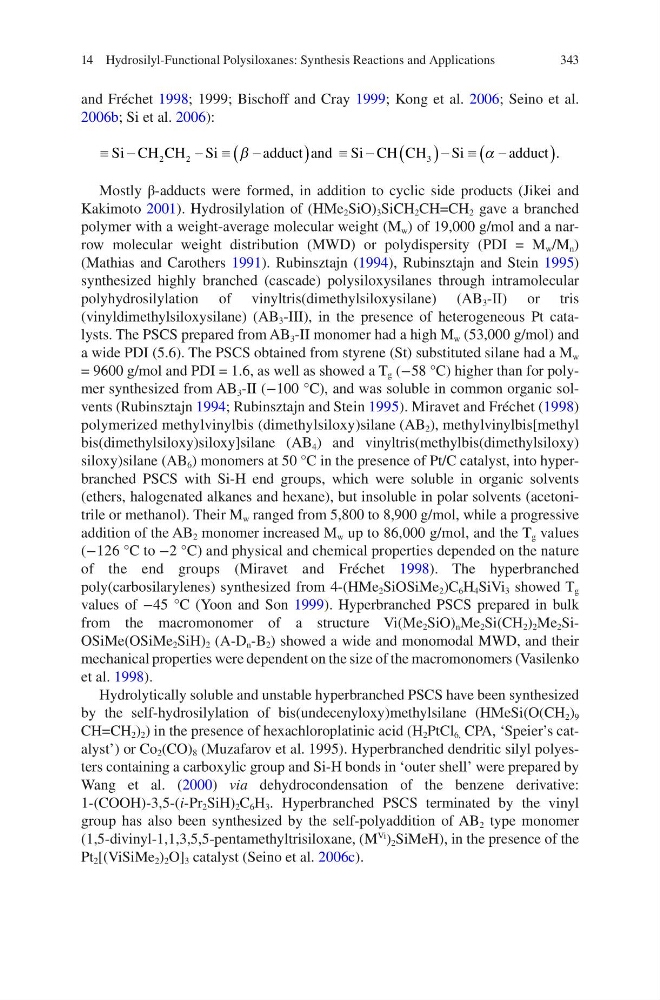
and Fréchet 1998; 1999; Bischoff and Cray 1999; Kong et al. 2006; Seino et al.
2006b; Si et al. 2006):
≡ −
− ≡ −
≡ −
− ≡ −
Si CH CH Si
adduct and Si CH CH
Si
adduct .
2
2
3
β
α
(
)
( )
(
)
Mostly β-adducts were formed, in addition to cyclic side products (Jikei and
Kakimoto 2001). Hydrosilylation of (HMe 2 SiO) 3 SiCH 2 CH=CH 2 gave a branched
polymer with a weight-average molecular weight (M w ) of 19,000 g/mol and a narrow molecular weight distribution (MWD) or polydispersity (PDI = M w /M n )
(Mathias and Carothers 1991). Rubinsztajn (1994), Rubinsztajn and Stein 1995)
synthesized highly branched (cascade) polysiloxysilanes through intramolecular
polyhydrosilylation of vinyltris(dimethylsiloxysilane) (AB 3 -II) or tris
(vinyldimethylsiloxysilane) (AB 3 - III), in the presence of heterogeneous Pt catalysts. The PSCS prepared from AB 3 -II monomer had a high M w (53,000 g/mol) and
a wide PDI (5.6). The PSCS obtained from styrene (St) substituted silane had a M w
= 9600 g/mol and PDI = 1.6, as well as showed a T g (−58 °C) higher than for polymer synthesized from AB 3 -II (−100 °C), and was soluble in common organic solvents (Rubinsztajn 1994; Rubinsztajn and Stein 1995). Miravet and Fréchet (1998)
polymerized methylvinylbis (dimethylsiloxy)silane (AB 2 ), methylvinylbis[methyl
bis(dimethylsiloxy)siloxy]silane (AB 4 ) and vinyltris(methylbis(dimethylsiloxy)
siloxy)silane (AB 6 ) monomers at 50 °C in the presence of Pt/C catalyst, into hyperbranched PSCS with Si-H end groups, which were soluble in organic solvents
(ethers, halogenated alkanes and hexane), but insoluble in polar solvents (acetonitrile or methanol). Their M w ranged from 5,800 to 8,900 g/mol, while a progressive
addition of the AB 2 monomer increased M w up to 86,000 g/mol, and the T g values
(−126 °C to −2 °C) and physical and chemical properties depended on the nature
of the end groups (Miravet and Fréchet 1998). The hyperbranched
poly(carbosilarylenes) synthesized from 4-(HMe 2 SiOSiMe 2 )C 6 H 4 SiVi 3 showed T g
values of −45 °C (Yoon and Son 1999). Hyperbranched PSCS prepared in bulk
from the macromonomer of a structure Vi(Me 2 SiO) n Me 2 Si(CH 2 ) 2 Me 2 SiOSiMe(OSiMe 2 SiH) 2 (A-D n -B 2 ) showed a wide and monomodal MWD, and their
mechanical properties were dependent on the size of the macromonomers (Vasilenko
et al. 1998).
Hydrolytically soluble and unstable hyperbranched PSCS have been synthesized
by the self-hydrosilylation of bis(undecenyloxy)methylsilane (HMeSi(O(CH 2 ) 9
CH=CH 2 ) 2 ) in the presence of hexachloroplatinic acid (H 2 PtCl 6, CPA, ‘Speier’s catalyst’) or Co 2 (CO) 8 (Muzafarov et al. 1995). Hyperbranched dendritic silyl polyesters containing a carboxylic group and Si-H bonds in ‘outer shell’ were prepared by
Wang et al. (2000) via dehydrocondensation of the benzene derivative:
1-(COOH)-3,5-(i-Pr 2 SiH) 2 C 6 H 3 . Hyperbranched PSCS terminated by the vinyl
group has also been synthesized by the self-polyaddition of AB 2 type monomer
(1,5-divinyl-1,1,3,5,5-pentamethyltrisiloxane, (M
Vi
) 2 SiMeH), in the presence of the
Pt 2 [(ViSiMe 2 ) 2 O] 3 catalyst (Seino et al. 2006c).
14 Hydrosilyl-Functional Polysiloxanes: Synthesis Reactions and Applications