

346
(9) 1,1,1,3,3,5,5,7,9,11,11,13,13,15,17,19,19,21,21,23,23,23- docosamethyldode
casiloxane (MD 2 D
H 2 D 2 D
H 2 D 2 M);
(10) 15-hydro(hentriacontamethylpentadecasiloxane)
(MD 6 D
H
D 6 M)
(new
compounds).
The cyclosiloxanes: c-D 2 D
H 2 , c-D 2 D
H 3 and c-D 2 D
H 4 have been the main products
from appropriate syntheses, and the chemical structures of the isolated H-siloxanes
were established by Fourier transform infrared (FTIR) spectroscopy,
1
H- and
29
Si-NMR and an elemental analysis (Chruściel et al. 1999).
14.3.1 The Tacticity (Microstructure) of PMHS Chains
The isolation and spectral characterization of new model H-siloxanes: MD 2 D
H
D 2 M,
M(D 2 D
H
) 2 D 2 M, c-(D 2 D
H
) 2 , c-D 2 D
H 4 , MD 2 D
H 2 D 2 M, c-(D 2 D
H 2 D 2 D
H 2 ), MD 6 D
H
D 6 M,
c-(D 2 D
H 2 D 2 D
H 2 D 2 D
H 2 ) and M(D 2 D
H 2 ) 2 D 2 allowed to establish the regular microstructure of these PDMS-b-PMHS, which was then confirmed by
1
H- and
29
Si-NMR. All copolymers were also characterized by the elemental analysis (%C,
%H, and %Si-H) and the results of the elemental analysis were very satisfactory.
The block structure of PDMS-b-PMHS and the microstructure of the polysiloxane
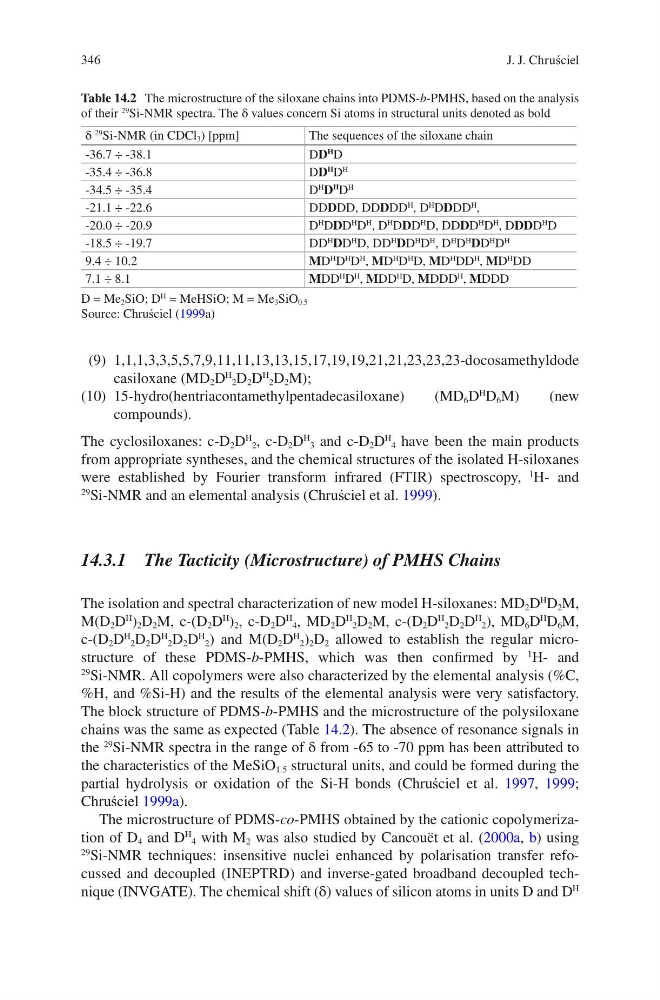
chains was the same as expected (Table 14.2). The absence of resonance signals in
the
29
Si-NMR spectra in the range of δ from -65 to -70 ppm has been attributed to
the characteristics of the MeSiO 1.5 structural units, and could be formed during the
partial hydrolysis or oxidation of the Si-H bonds (Chruściel et al. 1997, 1999;
Chruściel 1999a).
The microstructure of PDMS-co-PMHS obtained by the cationic copolymerization of D 4 and D
H 4 with M 2 was also studied by Cancouët et al. (2000a, b) using
29
Si-NMR techniques: insensitive nuclei enhanced by polarisation transfer refocussed and decoupled (INEPTRD) and inverse-gated broadband decoupled technique (INVGATE). The chemical shift (δ) values of silicon atoms in units D and D
H
Table 14.2 The microstructure of the siloxane chains into PDMS-b-PMHS, based on the analysis
of their
29 Si-NMR spectra. The δ values concern Si atoms in structural units denoted as bold
δ
29
Si-NMR (in CDCl 3 ) [ppm]
The sequences of the siloxane chain
-36.7 ÷ -38.1
DD
H
D
-35.4 ÷ -36.8
DD
H
D
H
-34.5 ÷ -35.4
D
H
D
H
D
H
-21.1 ÷ -22.6
DDDDD, DDDDD
H
, D
H
DDDD
H
,
-20.0 ÷ -20.9
D
H
DDD
H D
H
, D
H
DDD
H
D, DDDD
H
D
H
, DDDD
H
D
-18.5 ÷ -19.7
DD
H
DD
H
D, DD
H
DD
H
D
H
, D
H
D
H
DD
H
D
H
9.4 ÷ 10.2
MD
H
D
H
D
H
, MD
H
D
H
D, MD
H
DD
H
, MD
H
DD
7.1 ÷ 8.1
MDD
H
D
H
, MDD
H
D, MDDD
H
, MDDD
D = Me 2 SiO; D
H = MeHSiO; M = Me 3 SiO 0.5
Source: Chruściel (1999a)
J. J. Chruściel