

315
Initially reported in 1996 by Piers using small molecules (Parks and Piers 1996),
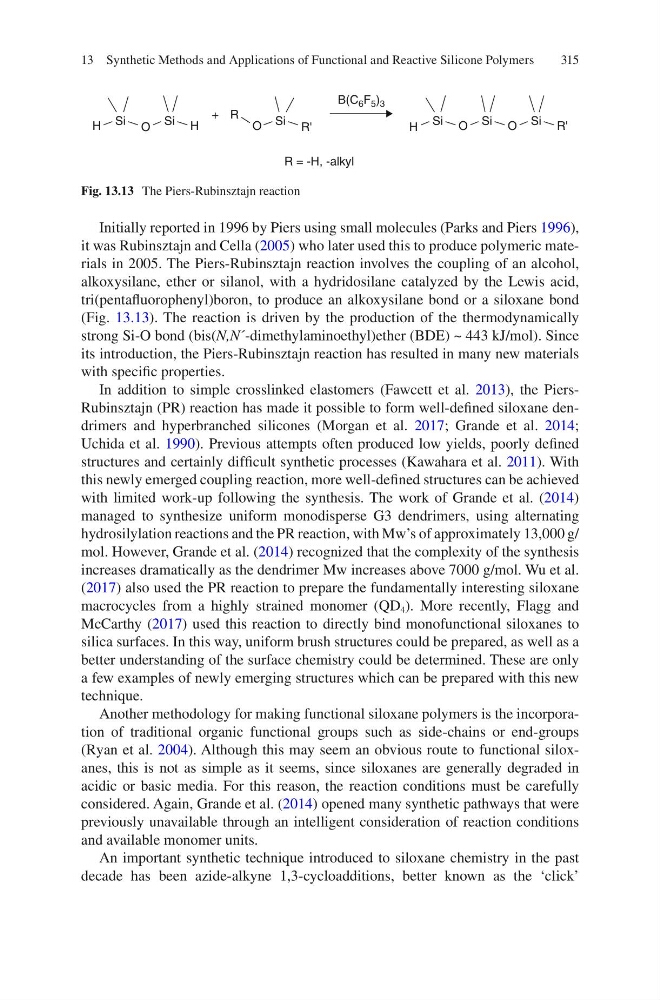
it was Rubinsztajn and Cella (2005) who later used this to produce polymeric materials in 2005. The Piers-Rubinsztajn reaction involves the coupling of an alcohol,
alkoxysilane, ether or silanol, with a hydridosilane catalyzed by the Lewis acid,
tri(pentafluorophenyl)boron, to produce an alkoxysilane bond or a siloxane bond
(Fig. 13.13). The reaction is driven by the production of the thermodynamically
strong Si-O bond (bis(N,N´-dimethylaminoethyl)ether (BDE) ~ 443 kJ/mol). Since
its introduction, the Piers-Rubinsztajn reaction has resulted in many new materials
with specific properties.
In addition to simple crosslinked elastomers (Fawcett et al. 2013), the PiersRubinsztajn (PR) reaction has made it possible to form well-defined siloxane dendrimers and hyperbranched silicones (Morgan et al. 2017; Grande et al. 2014;
Uchida et al. 1990). Previous attempts often produced low yields, poorly defined
structures and certainly difficult synthetic processes (Kawahara et al. 2011). With
this newly emerged coupling reaction, more well-defined structures can be achieved
with limited work-up following the synthesis. The work of Grande et al. (2014)
managed to synthesize uniform monodisperse G3 dendrimers, using alternating
hydrosilylation reactions and the PR reaction, with Mw’s of approximately 13,000 g/
mol. However, Grande et al. (2014) recognized that the complexity of the synthesis
increases dramatically as the dendrimer Mw increases above 7000 g/mol. Wu et al.
(2017) also used the PR reaction to prepare the fundamentally interesting siloxane
macrocycles from a highly strained monomer (QD 4 ). More recently, Flagg and
McCarthy (2017) used this reaction to directly bind monofunctional siloxanes to
silica surfaces. In this way, uniform brush structures could be prepared, as well as a
better understanding of the surface chemistry could be determined. These are only
a few examples of newly emerging structures which can be prepared with this new
technique.
Another methodology for making functional siloxane polymers is the incorporation of traditional organic functional groups such as side-chains or end-groups
(Ryan et al. 2004). Although this may seem an obvious route to functional siloxanes, this is not as simple as it seems, since siloxanes are generally degraded in
acidic or basic media. For this reason, the reaction conditions must be carefully
considered. Again, Grande et al. (2014) opened many synthetic pathways that were
previously unavailable through an intelligent consideration of reaction conditions
and available monomer units.
An important synthetic technique introduced to siloxane chemistry in the past
decade has been azide-alkyne 1,3-cycloadditions, better known as the ‘click’
H
H
+
O
Si
Si
O
R
R'
R = -H, -alkyl
B(C 6 F 5 ) 3
Si
O
H
Si
O
Si
R'
Si
Fig. 13.13 The Piers-Rubinsztajn reaction
13 Synthetic Methods and Applications of Functional and Reactive Silicone Polymers