

316
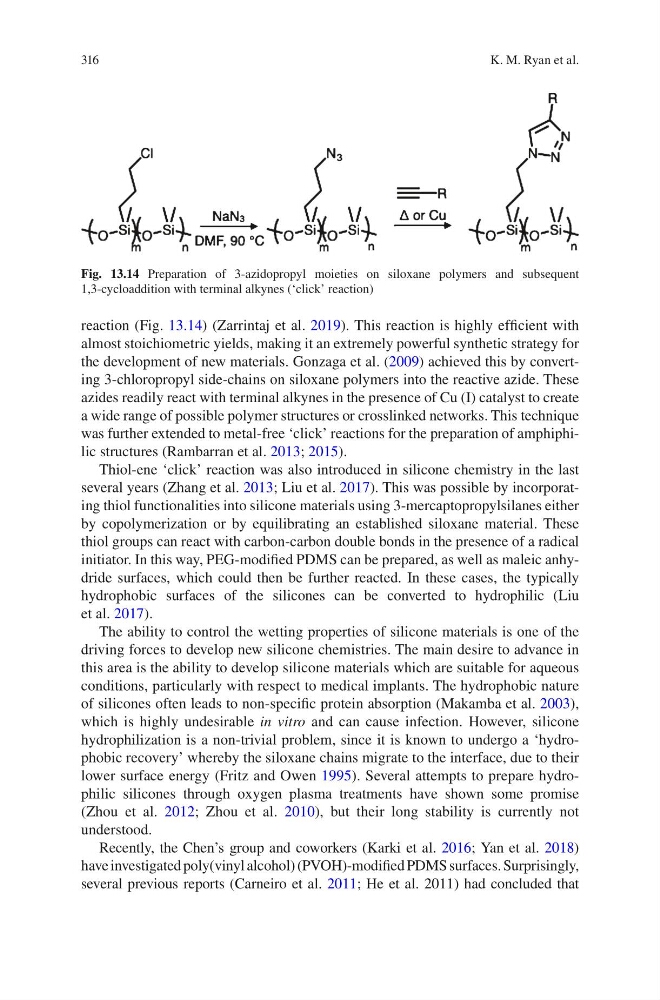
reaction (Fig. 13.14) (Zarrintaj et al. 2019). This reaction is highly efficient with
almost stoichiometric yields, making it an extremely powerful synthetic strategy for
the development of new materials. Gonzaga et al. (2009) achieved this by converting 3-chloropropyl side-chains on siloxane polymers into the reactive azide. These
azides readily react with terminal alkynes in the presence of Cu (I) catalyst to create
a wide range of possible polymer structures or crosslinked networks. This technique
was further extended to metal-free ‘click’ reactions for the preparation of amphiphilic structures (Rambarran et al. 2013; 2015).
Thiol-ene ‘click’ reaction was also introduced in silicone chemistry in the last
several years (Zhang et al. 2013; Liu et al. 2017). This was possible by incorporating thiol functionalities into silicone materials using 3-mercaptopropylsilanes either
by copolymerization or by equilibrating an established siloxane material. These
thiol groups can react with carbon-carbon double bonds in the presence of a radical
initiator. In this way, PEG-modified PDMS can be prepared, as well as maleic anhydride surfaces, which could then be further reacted. In these cases, the typically
hydrophobic surfaces of the silicones can be converted to hydrophilic (Liu
et al. 2017).
The ability to control the wetting properties of silicone materials is one of the
driving forces to develop new silicone chemistries. The main desire to advance in
this area is the ability to develop silicone materials which are suitable for aqueous
conditions, particularly with respect to medical implants. The hydrophobic nature
of silicones often leads to non-specific protein absorption (Makamba et al. 2003),
which is highly undesirable in vitro and can cause infection. However, silicone
hydrophilization is a non-trivial problem, since it is known to undergo a ‘hydrophobic recovery’ whereby the siloxane chains migrate to the interface, due to their
lower surface energy (Fritz and Owen 1995). Several attempts to prepare hydrophilic silicones through oxygen plasma treatments have shown some promise
(Zhou et al. 2012; Zhou et al. 2010), but their long stability is currently not
understood.
Recently, the Chen’s group and coworkers (Karki et al. 2016; Yan et al. 2018)
have investigated poly(vinyl alcohol) (PVOH)-modified PDMS surfaces. Surprisingly,
several previous reports (Carneiro et al. 2011; He et al. 2011) had concluded that
Fig. 13.14 Preparation of 3-azidopropyl moieties on siloxane polymers and subsequent
1,3- cycloaddition with terminal alkynes (‘click’ reaction)
K. M. Ryan et al.