

313
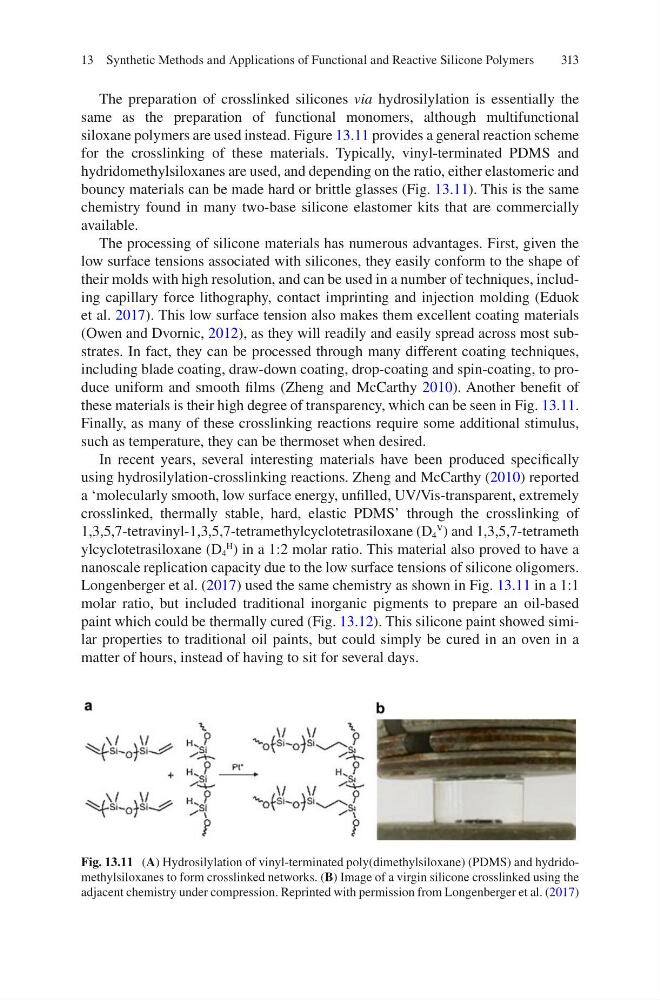
The preparation of crosslinked silicones via hydrosilylation is essentially the
same as the preparation of functional monomers, although multifunctional
siloxane polymers are used instead. Figure 13.11 provides a general reaction scheme
for the crosslinking of these materials. Typically, vinyl-terminated PDMS and
hydridomethylsiloxanes are used, and depending on the ratio, either elastomeric and
bouncy materials can be made hard or brittle glasses (Fig. 13.11). This is the same
chemistry found in many two-base silicone elastomer kits that are commercially
available.
The processing of silicone materials has numerous advantages. First, given the
low surface tensions associated with silicones, they easily conform to the shape of
their molds with high resolution, and can be used in a number of techniques, including capillary force lithography, contact imprinting and injection molding (Eduok
et al. 2017). This low surface tension also makes them excellent coating materials
(Owen and Dvornic, 2012), as they will readily and easily spread across most substrates. In fact, they can be processed through many different coating techniques,
including blade coating, draw-down coating, drop-coating and spin-coating, to produce uniform and smooth films (Zheng and McCarthy 2010). Another benefit of
these materials is their high degree of transparency, which can be seen in Fig. 13.11.
Finally, as many of these crosslinking reactions require some additional stimulus,
such as temperature, they can be thermoset when desired.
In recent years, several interesting materials have been produced specifically
using hydrosilylation-crosslinking reactions. Zheng and McCarthy (2010) reported
a ‘molecularly smooth, low surface energy, unfilled, UV/Vis-transparent, extremely
crosslinked, thermally stable, hard, elastic PDMS’ through the crosslinking of
1,3,5,7-tetravinyl-1,3,5,7-tetramethylcyclotetrasiloxane (D 4
V
) and 1,3,5,7- tetrameth
ylcyclotetrasiloxane (D 4
H
) in a 1:2 molar ratio. This material also proved to have a
nanoscale replication capacity due to the low surface tensions of silicone oligomers.
Longenberger et al. (2017) used the same chemistry as shown in Fig. 13.11 in a 1:1
molar ratio, but included traditional inorganic pigments to prepare an oil-based
paint which could be thermally cured (Fig. 13.12). This silicone paint showed similar properties to traditional oil paints, but could simply be cured in an oven in a
matter of hours, instead of having to sit for several days.
Fig. 13.11 (A) Hydrosilylation of vinyl-terminated poly(dimethylsiloxane) (PDMS) and hydridomethylsiloxanes to form crosslinked networks. (B) Image of a virgin silicone crosslinked using the
adjacent chemistry under compression. Reprinted with permission from Longenberger et al. (2017)
13 Synthetic Methods and Applications of Functional and Reactive Silicone Polymers