

311
DT-resins are derived from difunctional and trifunctional reactive silanes, and
MQ-resins are derived from monofunctional and tetrafunctional reactive silanes.
These resins are, therefore, theoretically structural isomers of each other. Recently,
Flagg and McCarthy (2016) reported a new reproducible method for preparing
MQ-resins and observed the interesting properties of these ‘phantom nanoparticles’
made by the addition of monomers containing vinyl or hydride, they were able to
prepare resins of this type which can undergo further reaction. These materials
showed extremely high thermal stability with only ~20% weight loss up to
900 °C. Another report by Gao and McCarthy (2006a) noted that the reaction of
azeotropes of tetrachlorosilane (Q) and trimethylchlorosilane (M) on the surfaces
resulted in the formation of superhydrophobic ‘nanofilaments’. These can be viewed
as surface-bound MQ structures in their own right.
Room-temperature vulcanization (RTV) of functional silicones is perhaps the
most widely known of all crosslinking processes for silicones (Yoshimura et al.
1999; Kumar and Lee 2017), as it is used extensively in bathroom caulking and
nautical sealants. However, instead of starting directly from monomers, a difunctional siloxane is often mixed with a multifunctional crosslinking unit after polymerization. This provides more control over the properties of the resulting crosslinked
materials and also reduces the amount of byproduct that is produced during curing.
As RTV-silicone kits are widely available to the public, the use of chlorosilanes is
prohibitive, due to the dangerous byproduct of hydrochloric acid. In contrast, alkyoxysilanes are often used as resulting byproducts, e.g. acetic acid, ethanol or methanol, are largely considered benign. One of the most commonly used RTV silicones
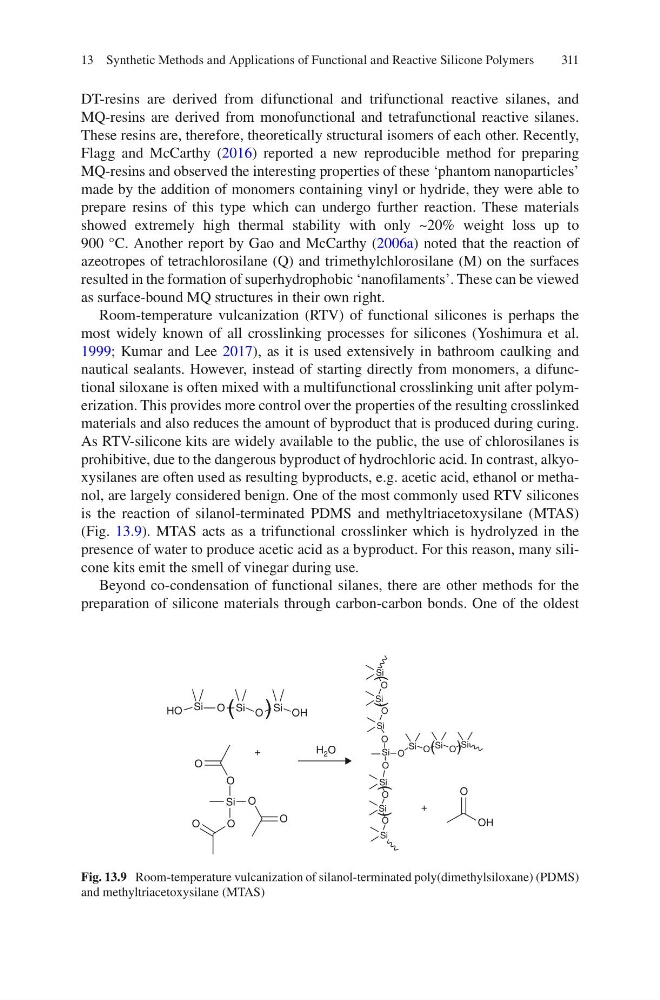
is the reaction of silanol-terminated PDMS and methyltriacetoxysilane (MTAS)
(Fig. 13.9). MTAS acts as a trifunctional crosslinker which is hydrolyzed in the
presence of water to produce acetic acid as a byproduct. For this reason, many silicone kits emit the smell of vinegar during use.
Beyond co-condensation of functional silanes, there are other methods for the
preparation of silicone materials through carbon-carbon bonds. One of the oldest
HO Si O
O
O
O
O
O
O
Si
( )
O
O H
Si
Si
O
OH
+
+
H 2 O
O
O(
)
O
Si
Si
Si
O
O
O
( )
O
Si
Si
Si
Si
O
( )
O
Si
Si
Si
Fig. 13.9 Room-temperature vulcanization of silanol-terminated poly(dimethylsiloxane) (PDMS)
and methyltriacetoxysilane (MTAS)
13 Synthetic Methods and Applications of Functional and Reactive Silicone Polymers
DT-resins are derived from difunctional and trifunctional reactive silanes, and
MQ-resins are derived from monofunctional and tetrafunctional reactive silanes.
These resins are, therefore, theoretically structural isomers of each other. Recently,
Flagg and McCarthy (2016) reported a new reproducible method for preparing
MQ-resins and observed the interesting properties of these ‘phantom nanoparticles’
made by the addition of monomers containing vinyl or hydride, they were able to
prepare resins of this type which can undergo further reaction. These materials
showed extremely high thermal stability with only ~20% weight loss up to
900 °C. Another report by Gao and McCarthy (2006a) noted that the reaction of
azeotropes of tetrachlorosilane (Q) and trimethylchlorosilane (M) on the surfaces
resulted in the formation of superhydrophobic ‘nanofilaments’. These can be viewed
as surface-bound MQ structures in their own right.
Room-temperature vulcanization (RTV) of functional silicones is perhaps the
most widely known of all crosslinking processes for silicones (Yoshimura et al.
1999; Kumar and Lee 2017), as it is used extensively in bathroom caulking and
nautical sealants. However, instead of starting directly from monomers, a difunctional siloxane is often mixed with a multifunctional crosslinking unit after polymerization. This provides more control over the properties of the resulting crosslinked
materials and also reduces the amount of byproduct that is produced during curing.
As RTV-silicone kits are widely available to the public, the use of chlorosilanes is
prohibitive, due to the dangerous byproduct of hydrochloric acid. In contrast, alkyoxysilanes are often used as resulting byproducts, e.g. acetic acid, ethanol or methanol, are largely considered benign. One of the most commonly used RTV silicones
is the reaction of silanol-terminated PDMS and methyltriacetoxysilane (MTAS)
(Fig. 13.9). MTAS acts as a trifunctional crosslinker which is hydrolyzed in the
presence of water to produce acetic acid as a byproduct. For this reason, many silicone kits emit the smell of vinegar during use.
Beyond co-condensation of functional silanes, there are other methods for the
preparation of silicone materials through carbon-carbon bonds. One of the oldest
HO Si O
O
O
O
O
O
O
Si
( )
O
O H
Si
Si
O
OH
+
+
H 2 O
O
O(
)
O
Si
Si
Si
O
O
O
( )
O
Si
Si
Si
Si
O
( )
O
Si
Si
Si
Fig. 13.9 Room-temperature vulcanization of silanol-terminated poly(dimethylsiloxane) (PDMS)
and methyltriacetoxysilane (MTAS)
13 Synthetic Methods and Applications of Functional and Reactive Silicone Polymers