

310
crosslinking to become significant materials. This can be achieved through several
methods. Perhaps the simplest method for preparing crosslinked siloxane materials
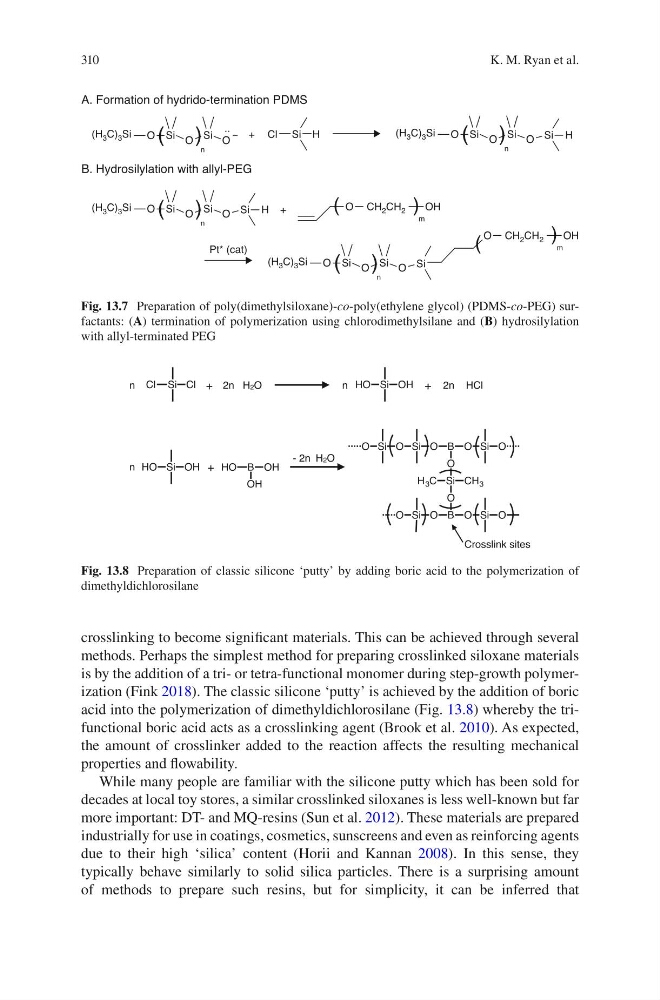
is by the addition of a tri- or tetra-functional monomer during step-growth polymerization (Fink 2018). The classic silicone ‘putty’ is achieved by the addition of boric
acid into the polymerization of dimethyldichlorosilane (Fig. 13.8) whereby the trifunctional boric acid acts as a crosslinking agent (Brook et al. 2010). As expected,
the amount of crosslinker added to the reaction affects the resulting mechanical
properties and flowability.
While many people are familiar with the silicone putty which has been sold for
decades at local toy stores, a similar crosslinked siloxanes is less well-known but far
more important: DT- and MQ-resins (Sun et al. 2012). These materials are prepared
industrially for use in coatings, cosmetics, sunscreens and even as reinforcing agents
due to their high ‘silica’ content (Horii and Kannan 2008). In this sense, they
typically behave similarly to solid silica particles. There is a surprising amount
of methods to prepare such resins, but for simplicity, it can be inferred that
(H 3 C) 3 Si O ( )
O n
O
H
Si
Si
Si
(H 3 C) 3 Si O
A. Formation of hydrido-termination PDMS
B. Hydrosilylation with allyl-PEG
( )
O n
O
+
+
O
(
)OH
m
CH 2 CH 2
Cl Si H
−
..
Si
Si
(H 3 C) 3 Si O ( )
O n
O Si
Si
Si
(H 3 C) 3 Si O ( )
O n
O
Pt* (cat)
H
Si
Si
Si
O
(
) OH
m
CH 2 CH 2
Fig. 13.7 Preparation of poly(dimethylsiloxane)-co-poly(ethylene glycol) (PDMS-co-PEG) surfactants: (A) termination of polymerization using chlorodimethylsilane and (B) hydrosilylation
with allyl-terminated PEG
Fig. 13.8 Preparation of classic silicone ‘putty’ by adding boric acid to the polymerization of
dimethyldichlorosilane
K. M. Ryan et al.
crosslinking to become significant materials. This can be achieved through several
methods. Perhaps the simplest method for preparing crosslinked siloxane materials
is by the addition of a tri- or tetra-functional monomer during step-growth polymerization (Fink 2018). The classic silicone ‘putty’ is achieved by the addition of boric
acid into the polymerization of dimethyldichlorosilane (Fig. 13.8) whereby the trifunctional boric acid acts as a crosslinking agent (Brook et al. 2010). As expected,
the amount of crosslinker added to the reaction affects the resulting mechanical
properties and flowability.
While many people are familiar with the silicone putty which has been sold for
decades at local toy stores, a similar crosslinked siloxanes is less well-known but far
more important: DT- and MQ-resins (Sun et al. 2012). These materials are prepared
industrially for use in coatings, cosmetics, sunscreens and even as reinforcing agents
due to their high ‘silica’ content (Horii and Kannan 2008). In this sense, they
typically behave similarly to solid silica particles. There is a surprising amount
of methods to prepare such resins, but for simplicity, it can be inferred that
(H 3 C) 3 Si O ( )
O n
O
H
Si
Si
Si
(H 3 C) 3 Si O
A. Formation of hydrido-termination PDMS
B. Hydrosilylation with allyl-PEG
( )
O n
O
+
+
O
(
)OH
m
CH 2 CH 2
Cl Si H
−
..
Si
Si
(H 3 C) 3 Si O ( )
O n
O Si
Si
Si
(H 3 C) 3 Si O ( )
O n
O
Pt* (cat)
H
Si
Si
Si
O
(
) OH
m
CH 2 CH 2
Fig. 13.7 Preparation of poly(dimethylsiloxane)-co-poly(ethylene glycol) (PDMS-co-PEG) surfactants: (A) termination of polymerization using chlorodimethylsilane and (B) hydrosilylation
with allyl-terminated PEG
Fig. 13.8 Preparation of classic silicone ‘putty’ by adding boric acid to the polymerization of
dimethyldichlorosilane
K. M. Ryan et al.