

309
important functional polymer is poly(hydridomethylsiloxane) (PHMS), which is
widely used in crosslinking reactions. This polymer can be prepared by polycondensation of dichloromethylsilane or by the ROP of 1,3,5,7- tetramethylcyclotetrasi
loxane (D 4
H
) to produce different Mw of the same polymer. Other functional siloxanes can be imagined by polymerization of difunctional monomers containing
reactive handles, such as (ethylene oxide)methylsilanes, 3-aminopropylmethyl(diethoxy)silane or 3-propylthiolmethyl(diethoxy)silane, which impart
groups capable of further reaction, as well as the manufacture of water-soluble
siloxanes (Dewasthale et al. 2017).
End-group functionalized PDMS’s are also an important and widely used class
of reactive siloxane polymers. These are prepared by including monofunctional
silanes into the polymerization or being equilibrated with a functionalized disiloxane (Jones et al. 2000). These act as end-cappers to the polymer chains in the same
manner as described above. The ROP of cyclic monomers provides a greater degree
of tailorability with respect to the nature of the end-groups. The choice of initiator
can lead to a polymer with a single functional end-group or one that has two different functionalities on each end (Peters et al. 1995). This is particularly important for
the preparation of PDMS-co-poly(ethylene glycol) (PDMS-co-PEG) surfactants
(Fig. 13.7), which have a wide variety of applications, including cosmetics and
polyurethane (PU) foaming agents (Zhang et al. 1999).
13.5 Crosslinking of Siloxane Polymers
Several reactive and functional siloxanes can be prepared by means of different
well-known polymerization techniques. However, linear siloxanes are oils in a wide
spectrum of temperatures. For this reason, siloxane polymers often require
O
O
(H 3 C) 3 Si O ( )
O
2
−
O
Si
Si
K
+
O
Si
Si
Si
O
O
O
Si
Si
Cl Si
Si
(H 3 C) 3 Si O ( )
O
2
−
−
O
Si
Si
K
+
K
+
(H 3 C) 3 Si O
(H 3 C) 3 Si O ( )
O
3n+2
−
O
Si
Si
K
+
(H 3 C) 3 Si O ( )
O
3n+2
−
O
Si
Si
K
+
(H 3 C) 3 Si O ( )
O
3n+2
O
Si
Si
Si
..
.. +
A. Initiation
B. Propogation
C. Termination
+n
+
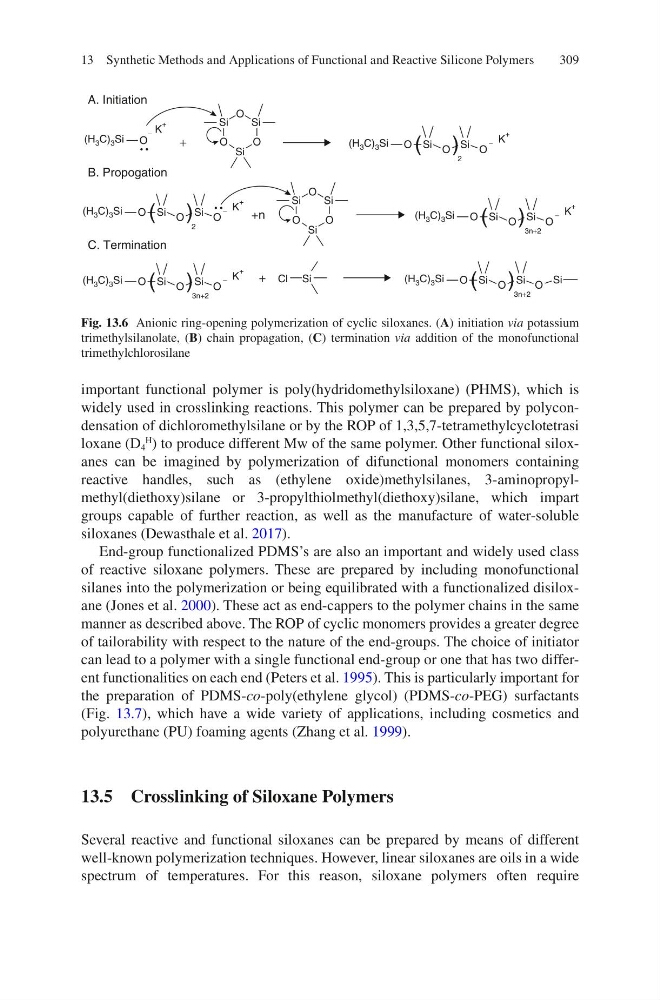
Fig. 13.6 Anionic ring-opening polymerization of cyclic siloxanes. (A) initiation via potassium
trimethylsilanolate, (B) chain propagation, (C) termination via addition of the monofunctional
trimethylchlorosilane
13 Synthetic Methods and Applications of Functional and Reactive Silicone Polymers
important functional polymer is poly(hydridomethylsiloxane) (PHMS), which is
widely used in crosslinking reactions. This polymer can be prepared by polycondensation of dichloromethylsilane or by the ROP of 1,3,5,7- tetramethylcyclotetrasi
loxane (D 4
H
) to produce different Mw of the same polymer. Other functional siloxanes can be imagined by polymerization of difunctional monomers containing
reactive handles, such as (ethylene oxide)methylsilanes, 3-aminopropylmethyl(diethoxy)silane or 3-propylthiolmethyl(diethoxy)silane, which impart
groups capable of further reaction, as well as the manufacture of water-soluble
siloxanes (Dewasthale et al. 2017).
End-group functionalized PDMS’s are also an important and widely used class
of reactive siloxane polymers. These are prepared by including monofunctional
silanes into the polymerization or being equilibrated with a functionalized disiloxane (Jones et al. 2000). These act as end-cappers to the polymer chains in the same
manner as described above. The ROP of cyclic monomers provides a greater degree
of tailorability with respect to the nature of the end-groups. The choice of initiator
can lead to a polymer with a single functional end-group or one that has two different functionalities on each end (Peters et al. 1995). This is particularly important for
the preparation of PDMS-co-poly(ethylene glycol) (PDMS-co-PEG) surfactants
(Fig. 13.7), which have a wide variety of applications, including cosmetics and
polyurethane (PU) foaming agents (Zhang et al. 1999).
13.5 Crosslinking of Siloxane Polymers
Several reactive and functional siloxanes can be prepared by means of different
well-known polymerization techniques. However, linear siloxanes are oils in a wide
spectrum of temperatures. For this reason, siloxane polymers often require
O
O
(H 3 C) 3 Si O ( )
O
2
−
O
Si
Si
K
+
O
Si
Si
Si
O
O
O
Si
Si
Cl Si
Si
(H 3 C) 3 Si O ( )
O
2
−
−
O
Si
Si
K
+
K
+
(H 3 C) 3 Si O
(H 3 C) 3 Si O ( )
O
3n+2
−
O
Si
Si
K
+
(H 3 C) 3 Si O ( )
O
3n+2
−
O
Si
Si
K
+
(H 3 C) 3 Si O ( )
O
3n+2
O
Si
Si
Si
..
.. +
A. Initiation
B. Propogation
C. Termination
+n
+
Fig. 13.6 Anionic ring-opening polymerization of cyclic siloxanes. (A) initiation via potassium
trimethylsilanolate, (B) chain propagation, (C) termination via addition of the monofunctional
trimethylchlorosilane
13 Synthetic Methods and Applications of Functional and Reactive Silicone Polymers