

308
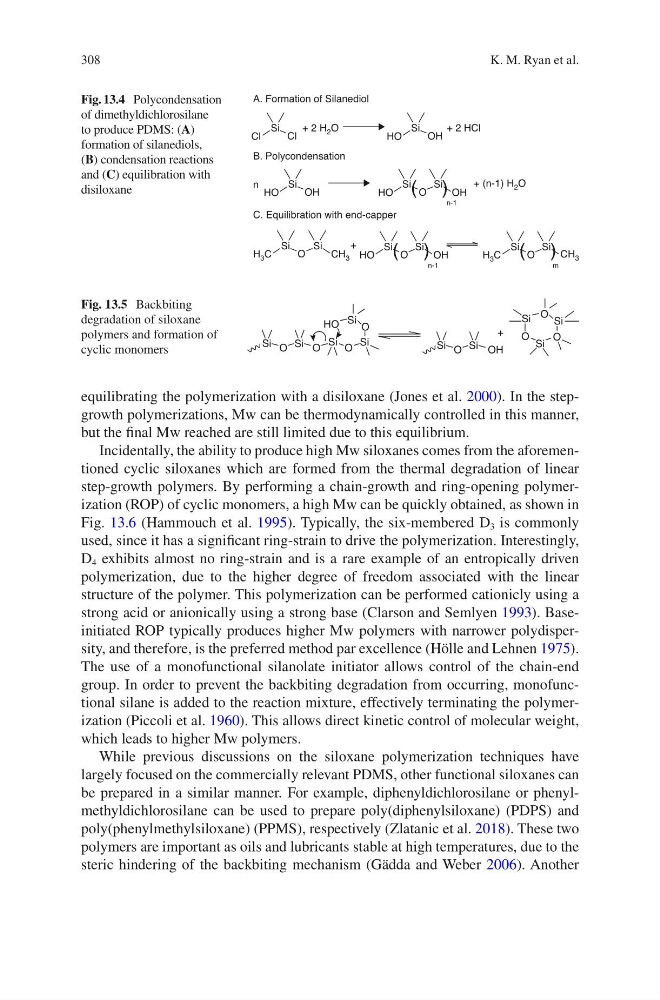
equilibrating the polymerization with a disiloxane (Jones et al. 2000). In the stepgrowth polymerizations, Mw can be thermodynamically controlled in this manner,
but the final Mw reached are still limited due to this equilibrium.
Incidentally, the ability to produce high Mw siloxanes comes from the aforementioned cyclic siloxanes which are formed from the thermal degradation of linear
step-growth polymers. By performing a chain-growth and ring-opening polymerization (ROP) of cyclic monomers, a high Mw can be quickly obtained, as shown in
Fig. 13.6 (Hammouch et al. 1995). Typically, the six- membered D 3 is commonly
used, since it has a significant ring-strain to drive the polymerization. Interestingly,
D 4 exhibits almost no ring-strain and is a rare example of an entropically driven
polymerization, due to the higher degree of freedom associated with the linear
structure of the polymer. This polymerization can be performed cationicly using a
strong acid or anionically using a strong base (Clarson and Semlyen 1993). Baseinitiated ROP typically produces higher Mw polymers with narrower polydispersity, and therefore, is the preferred method par excellence (Hölle and Lehnen 1975).
The use of a monofunctional silanolate initiator allows control of the chain-end
group. In order to prevent the backbiting degradation from occurring, monofunctional silane is added to the reaction mixture, effectively terminating the polymerization (Piccoli et al. 1960). This allows direct kinetic control of molecular weight,
which leads to higher Mw polymers.
While previous discussions on the siloxane polymerization techniques have
largely focused on the commercially relevant PDMS, other functional siloxanes can
be prepared in a similar manner. For example, diphenyldichlorosilane or phenylmethyldichlorosilane can be used to prepare poly(diphenylsiloxane) (PDPS) and
poly(phenylmethylsiloxane) (PPMS), respectively (Zlatanic et al. 2018). These two
polymers are important as oils and lubricants stable at high temperatures, due to the
steric hindering of the backbiting mechanism (Gädda and Weber 2006). Another
Si
2 H 2 O
+
+
Cl
A. Formation of Silanediol
B. Polycondensation
C. Equilibration with end-capper
n
Cl
Si
2 HCl
+
(n-1) H 2 O
+
HO
OH
Si
HO
OH
Si
H 3 C
Si CH 3
CH 3
O
( )
Si
HO
Si
H
O
O
n-1
( )
Si
HO
Si
H
O
O
n-1
( )
Si
H 3 C
Si
O
m
Fig. 13.4 Polycondensation
of dimethyldichlorosilane
to produce PDMS: (A)
formation of silanediols,
(B) condensation reactions
and (C) equilibration with
disiloxane
Si
Si
Si
Si O
O
O
O
Si
Si
O
HO
OH
+
Si
O
O Si
Si
Si
O
Fig. 13.5 Backbiting
degradation of siloxane
polymers and formation of
cyclic monomers
K. M. Ryan et al.
equilibrating the polymerization with a disiloxane (Jones et al. 2000). In the stepgrowth polymerizations, Mw can be thermodynamically controlled in this manner,
but the final Mw reached are still limited due to this equilibrium.
Incidentally, the ability to produce high Mw siloxanes comes from the aforementioned cyclic siloxanes which are formed from the thermal degradation of linear
step-growth polymers. By performing a chain-growth and ring-opening polymerization (ROP) of cyclic monomers, a high Mw can be quickly obtained, as shown in
Fig. 13.6 (Hammouch et al. 1995). Typically, the six- membered D 3 is commonly
used, since it has a significant ring-strain to drive the polymerization. Interestingly,
D 4 exhibits almost no ring-strain and is a rare example of an entropically driven
polymerization, due to the higher degree of freedom associated with the linear
structure of the polymer. This polymerization can be performed cationicly using a
strong acid or anionically using a strong base (Clarson and Semlyen 1993). Baseinitiated ROP typically produces higher Mw polymers with narrower polydispersity, and therefore, is the preferred method par excellence (Hölle and Lehnen 1975).
The use of a monofunctional silanolate initiator allows control of the chain-end
group. In order to prevent the backbiting degradation from occurring, monofunctional silane is added to the reaction mixture, effectively terminating the polymerization (Piccoli et al. 1960). This allows direct kinetic control of molecular weight,
which leads to higher Mw polymers.
While previous discussions on the siloxane polymerization techniques have
largely focused on the commercially relevant PDMS, other functional siloxanes can
be prepared in a similar manner. For example, diphenyldichlorosilane or phenylmethyldichlorosilane can be used to prepare poly(diphenylsiloxane) (PDPS) and
poly(phenylmethylsiloxane) (PPMS), respectively (Zlatanic et al. 2018). These two
polymers are important as oils and lubricants stable at high temperatures, due to the
steric hindering of the backbiting mechanism (Gädda and Weber 2006). Another
Si
2 H 2 O
+
+
Cl
A. Formation of Silanediol
B. Polycondensation
C. Equilibration with end-capper
n
Cl
Si
2 HCl
+
(n-1) H 2 O
+
HO
OH
Si
HO
OH
Si
H 3 C
Si CH 3
CH 3
O
( )
Si
HO
Si
H
O
O
n-1
( )
Si
HO
Si
H
O
O
n-1
( )
Si
H 3 C
Si
O
m
Fig. 13.4 Polycondensation
of dimethyldichlorosilane
to produce PDMS: (A)
formation of silanediols,
(B) condensation reactions
and (C) equilibration with
disiloxane
Si
Si
Si
Si O
O
O
O
Si
Si
O
HO
OH
+
Si
O
O Si
Si
Si
O
Fig. 13.5 Backbiting
degradation of siloxane
polymers and formation of
cyclic monomers
K. M. Ryan et al.