

307
coupling (Calas and Dunoguès 1976), but the two methodologies presented here are
the most significant means in use today.
Commercially available siloxane polymers became a viable option through the
step-growth polycondensation of reactive dichlorodialkylsilanes (Fig. 13.4) (Odian
2004). This reaction easily occurs in the presence of water which forms the silanediol intermediate via hydrolysis. It should be noted that the byproduct of this first
step is hydrochloric acid, a corrosive material, but it can be easily distilled off from
reaction . Other reactive silanes, such as diethoxysilanes, dimethylaminosilanes and
methoxysilanes, undergo a similar hydrolysis in the first step, but different byproducts are produced (Plueddemann 1991). In this way, careful control of the byproduct
can be achieved. The second step follows a polycondensation of silanediol to produce a linear polymer. While this process occurs quite easily, it is limited in the
achievable Mws, which can be produced, and therefore, is only practical for producing lower Mw polymers.
The limitations in Mw arise from the formation of an equilibrium with cyclic
monomer species, mainly the six- (D 3 ) and eight-membered (D 4 ) rings (Fig. 13.5).
This equilibrium is caused by a backbiting mechanism from the silanol chain ends,
which begin after several chlorosilane monomers have been reacted (Camino
et al. 2002). A common method to prevent this backbiting mechanism is
by adding monofunctional chain-stoppers, such as trimethylchlorosilane, or by
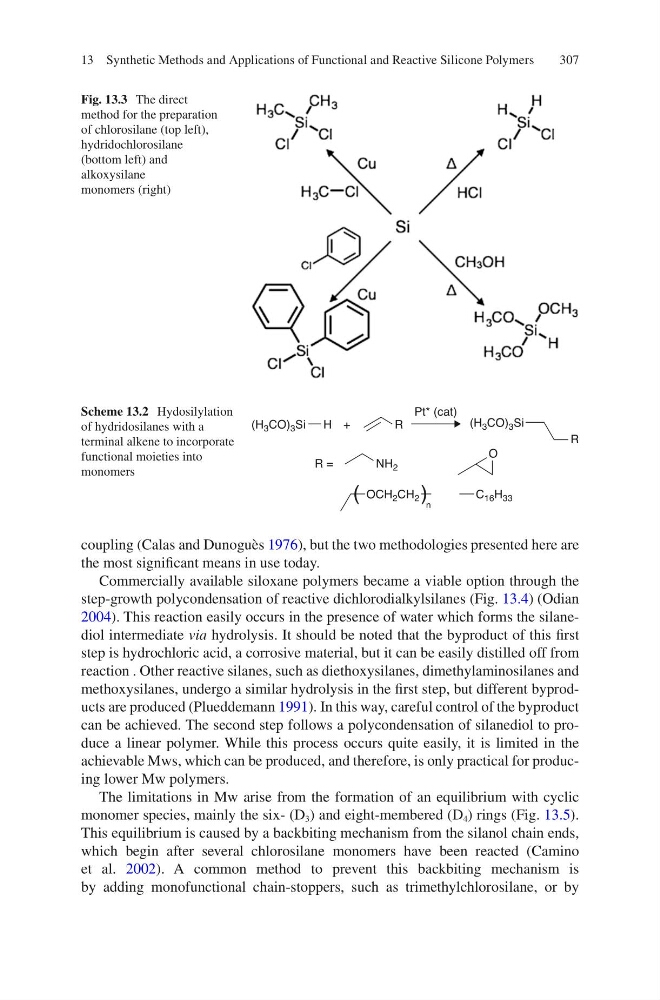
Fig. 13.3 The direct
method for the preparation
of chlorosilane (top left),
hydridochlorosilane
(bottom left) and
alkoxysilane
monomers (right)
(H 3 CO) 3 Si
(H 3 CO) 3 Si
H +
R
R =
N H 2
OCH 2 CH 2
C 16 H 33
O
(
) n
R
Pt* (cat)
Scheme 13.2 Hydosilylation
of hydridosilanes with a
terminal alkene to incorporate
functional moieties into
monomers
13 Synthetic Methods and Applications of Functional and Reactive Silicone Polymers
coupling (Calas and Dunoguès 1976), but the two methodologies presented here are
the most significant means in use today.
Commercially available siloxane polymers became a viable option through the
step-growth polycondensation of reactive dichlorodialkylsilanes (Fig. 13.4) (Odian
2004). This reaction easily occurs in the presence of water which forms the silanediol intermediate via hydrolysis. It should be noted that the byproduct of this first
step is hydrochloric acid, a corrosive material, but it can be easily distilled off from
reaction . Other reactive silanes, such as diethoxysilanes, dimethylaminosilanes and
methoxysilanes, undergo a similar hydrolysis in the first step, but different byproducts are produced (Plueddemann 1991). In this way, careful control of the byproduct
can be achieved. The second step follows a polycondensation of silanediol to produce a linear polymer. While this process occurs quite easily, it is limited in the
achievable Mws, which can be produced, and therefore, is only practical for producing lower Mw polymers.
The limitations in Mw arise from the formation of an equilibrium with cyclic
monomer species, mainly the six- (D 3 ) and eight-membered (D 4 ) rings (Fig. 13.5).
This equilibrium is caused by a backbiting mechanism from the silanol chain ends,
which begin after several chlorosilane monomers have been reacted (Camino
et al. 2002). A common method to prevent this backbiting mechanism is
by adding monofunctional chain-stoppers, such as trimethylchlorosilane, or by
Fig. 13.3 The direct
method for the preparation
of chlorosilane (top left),
hydridochlorosilane
(bottom left) and
alkoxysilane
monomers (right)
(H 3 CO) 3 Si
(H 3 CO) 3 Si
H +
R
R =
N H 2
OCH 2 CH 2
C 16 H 33
O
(
) n
R
Pt* (cat)
Scheme 13.2 Hydosilylation
of hydridosilanes with a
terminal alkene to incorporate
functional moieties into
monomers
13 Synthetic Methods and Applications of Functional and Reactive Silicone Polymers