

306
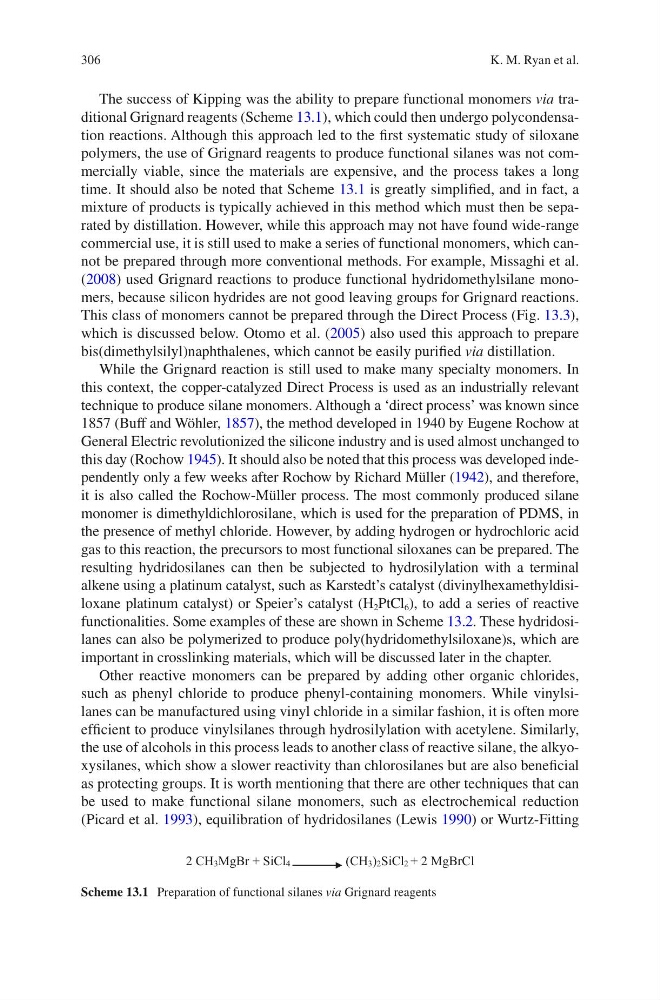
The success of Kipping was the ability to prepare functional monomers via traditional Grignard reagents (Scheme 13.1), which could then undergo polycondensation reactions. Although this approach led to the first systematic study of siloxane
polymers, the use of Grignard reagents to produce functional silanes was not commercially viable, since the materials are expensive, and the process takes a long
time. It should also be noted that Scheme 13.1 is greatly simplified, and in fact, a
mixture of products is typically achieved in this method which must then be separated by distillation. However, while this approach may not have found wide-range
commercial use, it is still used to make a series of functional monomers, which cannot be prepared through more conventional methods. For example, Missaghi et al.
(2008) used Grignard reactions to produce functional hydridomethylsilane monomers, because silicon hydrides are not good leaving groups for Grignard reactions.
This class of monomers cannot be prepared through the Direct Process (Fig. 13.3),
which is discussed below. Otomo et al. (2005) also used this approach to prepare
bis(dimethylsilyl)naphthalenes, which cannot be easily purified via distillation.
While the Grignard reaction is still used to make many specialty monomers. In
this context, the copper-catalyzed Direct Process is used as an industrially relevant
technique to produce silane monomers. Although a ‘direct process’ was known since
1857 (Buff and Wöhler, 1857), the method developed in 1940 by Eugene Rochow at
General Electric revolutionized the silicone industry and is used almost unchanged to
this day (Rochow 1945). It should also be noted that this process was developed independently only a few weeks after Rochow by Richard Müller (1942), and therefore,
it is also called the Rochow-Müller process. The most commonly produced silane
monomer is dimethyldichlorosilane, which is used for the preparation of PDMS, in
the presence of methyl chloride. However, by adding hydrogen or hydrochloric acid
gas to this reaction, the precursors to most functional siloxanes can be prepared. The
resulting hydridosilanes can then be subjected to hydrosilylation with a terminal
alkene using a platinum catalyst, such as Karstedt’s catalyst (divinylhexamethyldisiloxane platinum catalyst) or Speier’s catalyst (H 2 PtCl 6 ), to add a series of reactive
functionalities. Some examples of these are shown in Scheme 13.2. These hydridosilanes can also be polymerized to produce poly(hydridomethylsiloxane)s, which are
important in crosslinking materials, which will be discussed later in the chapter.
Other reactive monomers can be prepared by adding other organic chlorides,
such as phenyl chloride to produce phenyl-containing monomers. While vinylsilanes can be manufactured using vinyl chloride in a similar fashion, it is often more
efficient to produce vinylsilanes through hydrosilylation with acetylene. Similarly,
the use of alcohols in this process leads to another class of reactive silane, the alkyoxysilanes, which show a slower reactivity than chlorosilanes but are also beneficial
as protecting groups. It is worth mentioning that there are other techniques that can
be used to make functional silane monomers, such as electrochemical reduction
(Picard et al. 1993), equilibration of hydridosilanes (Lewis 1990) or Wurtz-Fitting
2 CH3MgBr + SiCl4
(CH3)2SiCl2 + 2 MgBrCl
Scheme 13.1 Preparation of functional silanes via Grignard reagents
K. M. Ryan et al.
The success of Kipping was the ability to prepare functional monomers via traditional Grignard reagents (Scheme 13.1), which could then undergo polycondensation reactions. Although this approach led to the first systematic study of siloxane
polymers, the use of Grignard reagents to produce functional silanes was not commercially viable, since the materials are expensive, and the process takes a long
time. It should also be noted that Scheme 13.1 is greatly simplified, and in fact, a
mixture of products is typically achieved in this method which must then be separated by distillation. However, while this approach may not have found wide-range
commercial use, it is still used to make a series of functional monomers, which cannot be prepared through more conventional methods. For example, Missaghi et al.
(2008) used Grignard reactions to produce functional hydridomethylsilane monomers, because silicon hydrides are not good leaving groups for Grignard reactions.
This class of monomers cannot be prepared through the Direct Process (Fig. 13.3),
which is discussed below. Otomo et al. (2005) also used this approach to prepare
bis(dimethylsilyl)naphthalenes, which cannot be easily purified via distillation.
While the Grignard reaction is still used to make many specialty monomers. In
this context, the copper-catalyzed Direct Process is used as an industrially relevant
technique to produce silane monomers. Although a ‘direct process’ was known since
1857 (Buff and Wöhler, 1857), the method developed in 1940 by Eugene Rochow at
General Electric revolutionized the silicone industry and is used almost unchanged to
this day (Rochow 1945). It should also be noted that this process was developed independently only a few weeks after Rochow by Richard Müller (1942), and therefore,
it is also called the Rochow-Müller process. The most commonly produced silane
monomer is dimethyldichlorosilane, which is used for the preparation of PDMS, in
the presence of methyl chloride. However, by adding hydrogen or hydrochloric acid
gas to this reaction, the precursors to most functional siloxanes can be prepared. The
resulting hydridosilanes can then be subjected to hydrosilylation with a terminal
alkene using a platinum catalyst, such as Karstedt’s catalyst (divinylhexamethyldisiloxane platinum catalyst) or Speier’s catalyst (H 2 PtCl 6 ), to add a series of reactive
functionalities. Some examples of these are shown in Scheme 13.2. These hydridosilanes can also be polymerized to produce poly(hydridomethylsiloxane)s, which are
important in crosslinking materials, which will be discussed later in the chapter.
Other reactive monomers can be prepared by adding other organic chlorides,
such as phenyl chloride to produce phenyl-containing monomers. While vinylsilanes can be manufactured using vinyl chloride in a similar fashion, it is often more
efficient to produce vinylsilanes through hydrosilylation with acetylene. Similarly,
the use of alcohols in this process leads to another class of reactive silane, the alkyoxysilanes, which show a slower reactivity than chlorosilanes but are also beneficial
as protecting groups. It is worth mentioning that there are other techniques that can
be used to make functional silane monomers, such as electrochemical reduction
(Picard et al. 1993), equilibration of hydridosilanes (Lewis 1990) or Wurtz-Fitting
2 CH3MgBr + SiCl4
(CH3)2SiCl2 + 2 MgBrCl
Scheme 13.1 Preparation of functional silanes via Grignard reagents
K. M. Ryan et al.