

305
‘surfactant- like’ properties where the siloxane skeleton is arranged on polar surfaces, although they are not particularly effective surfactants unless they are present
as copolymers. The viscosities of the siloxane polymers depend significantly on the
molecular weight (Mw) of the polymer and can range from easily pourable liquids
to more viscous than honey, while the densities typically range between 0.90–0.98 g/
mL. Bulky substituents on the polymer chain, such as fluoroalkyl groups, can
increase density up to 1.30 g/mL. Other important physical properties of PDMS are
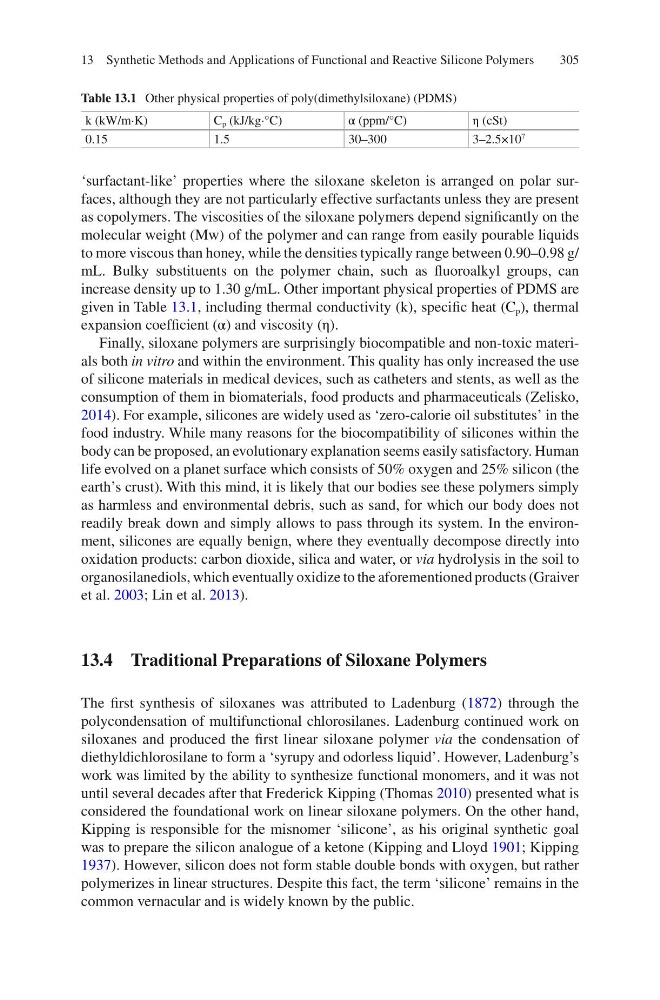
given in Table 13.1, including thermal conductivity (k), specific heat (C p ), thermal
expansion coefficient (α) and viscosity (η).
Finally, siloxane polymers are surprisingly biocompatible and non-toxic materials both in vitro and within the environment. This quality has only increased the use
of silicone materials in medical devices, such as catheters and stents, as well as the
consumption of them in biomaterials, food products and pharmaceuticals (Zelisko,
2014). For example, silicones are widely used as ‘zero-calorie oil substitutes’ in the
food industry. While many reasons for the biocompatibility of silicones within the
body can be proposed, an evolutionary explanation seems easily satisfactory. Human
life evolved on a planet surface which consists of 50% oxygen and 25% silicon (the
earth’s crust). With this mind, it is likely that our bodies see these polymers simply
as harmless and environmental debris, such as sand, for which our body does not
readily break down and simply allows to pass through its system. In the environment, silicones are equally benign, where they eventually decompose directly into
oxidation products: carbon dioxide, silica and water, or via hydrolysis in the soil to
organosilanediols, which eventually oxidize to the aforementioned products (Graiver
et al. 2003; Lin et al. 2013).
13.4 Traditional Preparations of Siloxane Polymers
The first synthesis of siloxanes was attributed to Ladenburg (1872) through the
polycondensation of multifunctional chlorosilanes. Ladenburg continued work on
siloxanes and produced the first linear siloxane polymer via the condensation of
diethyldichlorosilane to form a ‘syrupy and odorless liquid’. However, Ladenburg’s
work was limited by the ability to synthesize functional monomers, and it was not
until several decades after that Frederick Kipping (Thomas 2010) presented what is
considered the foundational work on linear siloxane polymers. On the other hand,
Kipping is responsible for the misnomer ‘silicone’, as his original synthetic goal
was to prepare the silicon analogue of a ketone (Kipping and Lloyd 1901; Kipping
1937). However, silicon does not form stable double bonds with oxygen, but rather
polymerizes in linear structures. Despite this fact, the term ‘silicone’ remains in the
common vernacular and is widely known by the public.
Table 13.1 Other physical properties of poly(dimethylsiloxane) (PDMS)
k (kW/m·K)
C p (kJ/kg·°C)
α (ppm/°C)
η (cSt)
0.15
1.5
30–300
3–2.5×10
7
13 Synthetic Methods and Applications of Functional and Reactive Silicone Polymers
‘surfactant- like’ properties where the siloxane skeleton is arranged on polar surfaces, although they are not particularly effective surfactants unless they are present
as copolymers. The viscosities of the siloxane polymers depend significantly on the
molecular weight (Mw) of the polymer and can range from easily pourable liquids
to more viscous than honey, while the densities typically range between 0.90–0.98 g/
mL. Bulky substituents on the polymer chain, such as fluoroalkyl groups, can
increase density up to 1.30 g/mL. Other important physical properties of PDMS are
given in Table 13.1, including thermal conductivity (k), specific heat (C p ), thermal
expansion coefficient (α) and viscosity (η).
Finally, siloxane polymers are surprisingly biocompatible and non-toxic materials both in vitro and within the environment. This quality has only increased the use
of silicone materials in medical devices, such as catheters and stents, as well as the
consumption of them in biomaterials, food products and pharmaceuticals (Zelisko,
2014). For example, silicones are widely used as ‘zero-calorie oil substitutes’ in the
food industry. While many reasons for the biocompatibility of silicones within the
body can be proposed, an evolutionary explanation seems easily satisfactory. Human
life evolved on a planet surface which consists of 50% oxygen and 25% silicon (the
earth’s crust). With this mind, it is likely that our bodies see these polymers simply
as harmless and environmental debris, such as sand, for which our body does not
readily break down and simply allows to pass through its system. In the environment, silicones are equally benign, where they eventually decompose directly into
oxidation products: carbon dioxide, silica and water, or via hydrolysis in the soil to
organosilanediols, which eventually oxidize to the aforementioned products (Graiver
et al. 2003; Lin et al. 2013).
13.4 Traditional Preparations of Siloxane Polymers
The first synthesis of siloxanes was attributed to Ladenburg (1872) through the
polycondensation of multifunctional chlorosilanes. Ladenburg continued work on
siloxanes and produced the first linear siloxane polymer via the condensation of
diethyldichlorosilane to form a ‘syrupy and odorless liquid’. However, Ladenburg’s
work was limited by the ability to synthesize functional monomers, and it was not
until several decades after that Frederick Kipping (Thomas 2010) presented what is
considered the foundational work on linear siloxane polymers. On the other hand,
Kipping is responsible for the misnomer ‘silicone’, as his original synthetic goal
was to prepare the silicon analogue of a ketone (Kipping and Lloyd 1901; Kipping
1937). However, silicon does not form stable double bonds with oxygen, but rather
polymerizes in linear structures. Despite this fact, the term ‘silicone’ remains in the
common vernacular and is widely known by the public.
Table 13.1 Other physical properties of poly(dimethylsiloxane) (PDMS)
k (kW/m·K)
C p (kJ/kg·°C)
α (ppm/°C)
η (cSt)
0.15
1.5
30–300
3–2.5×10
7
13 Synthetic Methods and Applications of Functional and Reactive Silicone Polymers